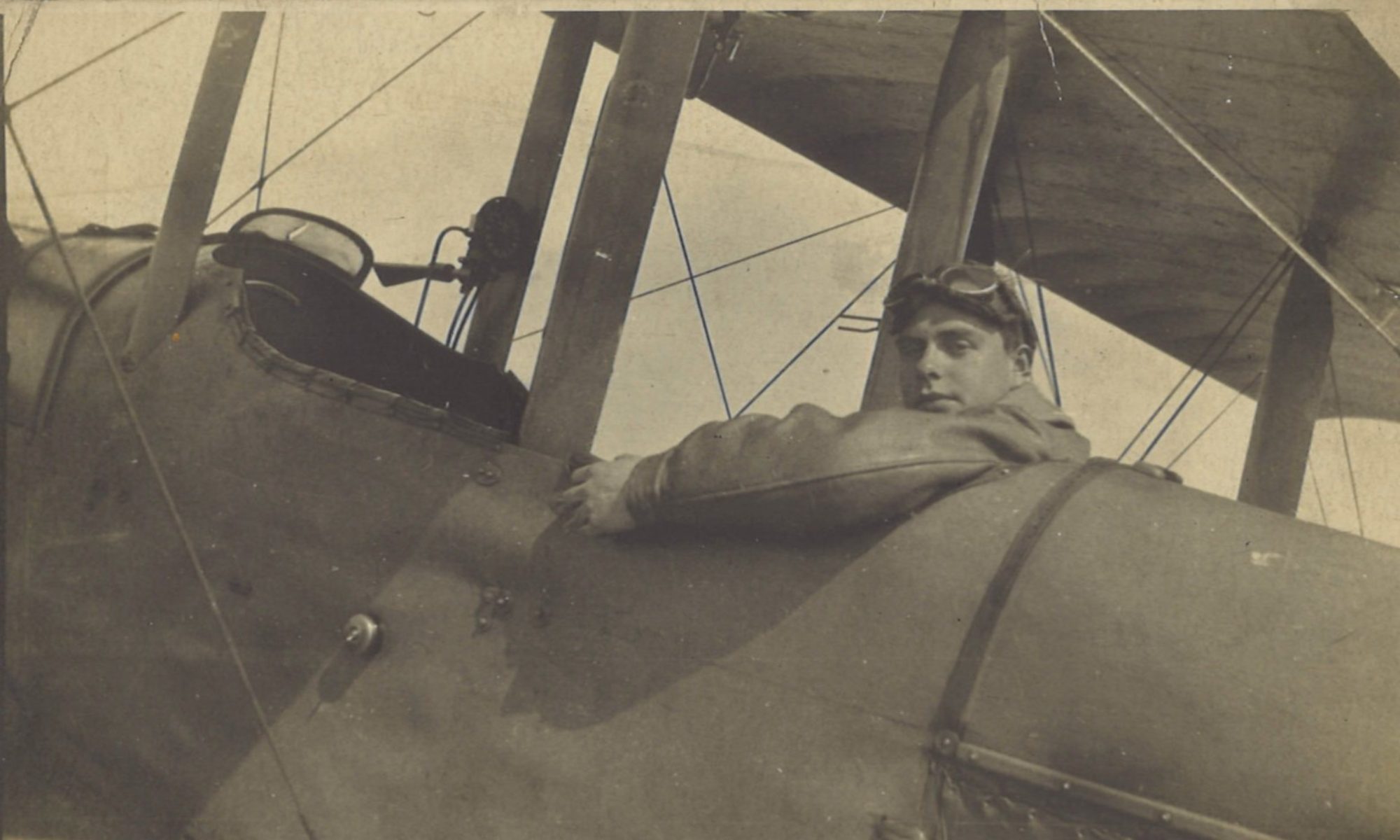
In another photo taken at Abscon, RE8 4889 (actually D4889) stands on the airfield with the cité ouvrière and the spire of Abscon church in the background. Pilot and observer are in position, as is the Lewis gun on the Scarff ring – but so are the wheel-chocks. And there are no ground crew in evidence, so this looks like a posed photo.
RE8 4889 (D4889) – squadron number B1 – at Abscon. Click for larger image. Credit: Air Force Museum of New Zealand
RE8 4889
In January 1919, RE8 4889 was in a scruffy state. Scratches, patches and scuff marks are all over it. It used to be pristine. In fact, this is the shiny state in which we saw the same aircraft previously. In the post for 27 August 1918 it was pictured with Capt. Bill Ledlie standing proprietorially in front of the gleaming aircraft:
Capt. Bill Ledlie, CO B Flight, 42 Sqn RAF, standing in front of RE8 4889 (D4889), squadron number B1. Click for larger image. Credit: Greg’s War Collection
In this older photograph (probably taken at Rely, to where 42 Squadron had moved on 25 April 1918) the aircraft was clearly pretty new. It had been built by Napier and delivered to the squadron on 8 July 1918. It stayed with them until 28 January 1919. On that day Lt Judd ferried 4889 to St Omer, where 13 Squadron took charge of it. It had survived its time of active war service without major incident.
Possibly 4889 was the aircraft that Capt. Ledlie often flew. The squadron designation was ‘B1’, and Capt. Ledlie was the flight commander of ‘B’ flight. So he might have been the pilot in the photo at Abscon. But Capt. Ledlie didn’t have exclusive use of it. For instance, Greg flew 4889 on 6 October 1918 and 7 October 1918. More likely, since the photograph came from Lt McDermont, who later emigrated to New Zealand, it was he who was the pilot in the January 1919 photo.
The Abscon RE8 Photographs
This photograph is one of a series of aeroplanes and crew taken – probably at least semi-officially – at Abscon. Two others have been posted in previous weeks, one (of 2872) from Greg’s collection and one (of 2924) from the Air Force Museum of New Zealand, as this one was.
No doubt there are others in museums and dusty attics around the world. And more still that have been lost or destroyed.
Abscon Church
In the January 1919 photograph of 4889, the stubby spire of Abscon church rises above the house behind the tail of the aircraft. That church is now gone. According to French Wikipedia:
The old church, built in 1892 and closed to worship in July 1969 because of mining subsidence, was replaced by a new building inaugurated in 1981.
It was the stubbiness of this spire that made me think that the spire in the photograph in the post for 28 December 1918 was probably not Abscon’s, but more likely to be that of Saultain:
On New Year’s Day 1919, Greg had ferried RE8 2924 (strictly speaking RE8 C2924) from Saultain to Abscon in his last recorded flight. The aircraft would remain at Abscon until 6 February 1918, when it was handed over to 13 Squadron RAF at St Omer. So on 8 January 1919 it would have been at Abscon, where this photograph was taken.
Houses of Abscon’s cité ouvrière are clearly visible in the background. Lt John G. McDermont is believed to be standing on the left.
RE8 C2924 at Abscon. Lt John Gilchrist Johnston McDermont is believed to be standing on the left. Click for larger image. Photo credit: Air Force Museum of New Zealand, MUS05056.
This photograph looks as though it is one of a series that includes the photograph in the 1 January post:
Lt John Gilchrist Johnston McDermont was born on 10 May 1896. This would make him 22 when the photograph was taken, and a little over two years older than Greg.
Lt McDermont was a pilot with B Flight, 42 Squadron RAF. When the squadron moved from Aulnoy to Saultain on 11 December 1918, he and his observer Lt Elliott crashed on landing RE8 D6740 at Saultain, but were both recorded as ‘OK’ in the casualty report, as previously noted here. (On the same occasion Greg and Lt Scarterfield had ferried RE8 2924 to the new aerodrome.)
After the war, Lt McDermont emigrated to New Zealand.
Thanks to…
Matthew O’Sullivan, Keeper of Photographs at the Air Force Museum of New Zealand for sending me the photograph and information about Lt McDermont, as well as for granting permission to use the photo here.
Andrew Pentland of www.airhistory.org.uk, whose Royal Flying Corps pages contain information about RE8 C2924 and Lt McDermont.
No doubt they would all have preferred to be at home for Christmas, but the chaps of 42 Squadron made the best of things at Saultain. “B” Flight Officers’ Mess was the setting for an evidently lavish, probably lengthy and undoubtedly boozy Christmas dinner. It inevitably became something of a farewell feast.
The Compliments of the Season
In one of Greg’s photo albums is a Christmas card. He probably sent the card home to Holyhead, and the family kept it.
42 Squadron’s Christmas Card, 1918, with artwork by Laurence East. Click for larger image.Inside of card signed by Greg, probably sent to home in Holyhead. Click for larger image.
The ‘card’ measures 3″ x 4¼” (8 cm x 10.5 cm), folded. It’s actually printed on photographic paper. Maybe someone in the squadron photographed the original artwork and printed off copies – rather as we might use a smartphone today as the front end of an impromptu printing press.
Inside, the card is signed “from Cecil”. He didn’t care for his given name, but on a Christmas card to his parents he really didn’t have much choice but to use it.
Laurence East, Illustrator and Cartoonist
The artwork on the front bears the signature Laurence East, France ’18. (Bottom right, small lettering – hard to read.) It was an early work of an illustrator who became better known after the war for his sketches, cartoons and book drawings. Laurence East was particularly a sketcher of sporting figures – especially from football and cricket. Examples of this work include Autographed Sketches of the 1930 Australian Cricketers, and The “Bees” (Brentford FC) Sketchbook 1936-37:
The “Bees” Sketchbook 1936-37 by Laurence East. Click to see a complete copy at The National Football Collection’s website.
Outside sport, his other specialisation was in illustrating books and magazines for children. For example, he illustrated the Chums Annual 1939, various periodicals for boys and girls, and Paddy the Pride of the School, written by Dorothy Dennison and published by Every Girl’s Paper Office in or around 1931.
East’s artwork for 42 Squadron’s Christmas card in 1918 is clearlya stylish composition. An aircraft heading home to Blighty would have been a popular image at the time. But members of the squadron would surely have questioned the rather elongated rendering of an RE8 – if that is indeed what it is meant to be! Note, incidentally, the winged laurel motif in the bottom right, which lists the three countries in which 42 Squadron served in 1918: France, Belgium (for all of two weeks, from Armistice Day) and Italy, from where they arrived on 14 March 1918:
On Christmas Day, there was again an abundance of food, with a few in-jokes on the menu. The after-dinner toasts, as listed, become rather poignant. And the back page gives us the names of the 42 Squadron B Flight officers present.
42 Squadron B Flight Christmas Dinner Menu, 1918, Page 1. Click for larger image.42 Squadron B Flight Christmas Dinner Menu, 1918, Page 2. Click for larger image.42 Squadron B Flight Christmas Dinner Menu, 1918, Page 3. Click for larger image.42 Squadron B Flight Christmas Dinner Menu, 1918, Page 4. Click for larger image.
  42 Squadron;  Royal Air Force
    "B" Flight Officers Mess
      (Somewhere in France)

              ---

       Christmas Day, 1918.
              ---

             MENU

DINNER:-
      Zero Hour   -    18.30
      "T" Out ---------?????

        Mr. C. E. Gregory
             MENU
           --------
Oysters (St.Omer Native)
          --
Tomato Soup
          --
Plaice (avec Findabs)
          --
Roast Turkey a l'Ulster
Roast Pork
Mashed Potatoes
          --
Roast Beef
Fried Potatoes
Brussels Sprouts
          --
Saultain Apricots
Custard or Cream
          --
Sardines on Toast
(or the Hun Air Force)
          --
Fromage
          --
Fruit, Nuts Etc.
          --
Coffee, Cigars, Liqueurs.
      T O A S T S.
  --------------------
1. Our Colonel in Chief -
   His Majesty The King

2. The Ladies (God bless 'em)

3. The Squadron Commander

4. To when we meet again -
   sometime, somewhere, somehow

5. To the memory of those who
   made the supreme sacrifice.
  "B" Flight Officers:-

Captain W. Ledlie
   "    C.F. Gordon, M.C.
Lieut C.E. Gregory
  "   K. Bon
  "   J.B. Judd
  "   D.C. Sewell
  "   H.G. Wallington
  "   J.G.J. McDermont
  "   R. Scarterfield
  "   J.E. Elliott
  "   T. Whittles
  "   A.N. Paton D.C.M.*
  "   A. Mulholland
  "   G.A. Lynch
*Should be A.Y. Paton D.C.M., not A.N. Thanks to Stuart Paton, Arthur Y. Paton’s great nephew, for the correction. See below for more information.
In-Jokes
As with the Farewell to Rely dinner menu in October, some of the in-jokes are more decipherable than others.
Oysters (St. Omer Native)
The very same conundrum as on the Rely menu! Only at Rely it was Huîtres de St. Omer. I still don’t understand it: St. Omer was better known for cauliflowers than for oysters. I continue to wonder, though, whether this was an obscure reference to St. Omer being thought of as the ‘home’ of the RAF and RFC.
Plaice (avec Findabs)
Plaice is clear enough. But why with Findabs? And what are Findabs anyway?
Maybe Findabs was/were something to do with dabs. A dab is a type of flatfish that, like plaice, is reasonably common in waters round the UK, presumably including the English Channel off northern France. Dabs, plaice and flounder look similar and are sometimes confused. Only the plaice has orange spots, according to Angling Addicts. But they all have fins…
Roast Turkey a l’Ulster
My guess is that this was a reference to B Flight’s commanding officer, Captain Bill Ledlie, who was an Ulsterman.
Back in October at Rely, occupying a key place in the menu was “Poulet Rôti d’Unter”. This was probably referring to Major Hunter, who at the time had overall command of 42 Squadron. Now, at a B Flight dinner, the flight commander may have been similarly – if obliquely – honoured, with a certain resonance to the original joke.
Saultain Apricots
This could mean exactly what it says. If apricots can grow in the Chiltern Hills in England, at least on a sheltered wall – which I can testify they do – then they should be able to grow in Saultain, which is 1.5° latitude nearer the equator. In December, they wouldn’t be fresh. But they could be tinned, or reconstituted from dried.
Sardines on Toast
With the savoury course comes the inevitable dig at the (former) enemy: the Hun Air Force. “Sardines on Toast” may have a been a more widespread derogatory term for German forces than just an in-joke of 42 Squadron. In “Fred’s War” by Andrew Davidson, Short Books, 2013, (republished as “A Doctor in The Great War” by Marble Arch Press in 2014) sardines on toast are referred to as “Remnants of the Huns” by the Cameronians (Scottish Rifles).
Toasts (sans Sardines)
The toasts follow what would have been a familiar sequence.
First the loyal toast.
Then the affectionate even if – to modern eyes – somewhat patronising toast to the ladies. Autres temps, autres mœurs.
The Squadron Commander was next. According to the squadron’s daily orders, by this stage the commanding officer was Major Geoffrey Harold Brinkman McCall, formerly of 6 Squadron.
Next came the toast “to when we meet again”. By this stage one can imagine a somewhat maudlin atmosphere setting in. They must have guessed that in fact most of them probably wouldn’t meet again after they dispersed and demobbed. The “sometime, somewhere, somehow” seems to acknowledge this. Yet they must have all have wondered what the future would hold.
And finally, the heartfelt toast to the fallen. 42 Squadron had its share. Two early deaths during Greg’s time were recorded in his diary on 24 June 1918:
On this subject, it seems odd that young 2/Lt Gregory was at the top of the list of lieutenants on the last page. Even allowing for the fact that the pilots (from Greg down to McDermont) are listed before the observers (Scarterfield to Lynch), it’s still less than seven months since Greg was the new boy of the flight in June. Let’s hope there were other reasons for the more senior lieutenant pilots to be no longerwith B flight.
Signatures
The signatures below the toasts are (I think):
Billy Ledlie
George A. Lynch
A.Y. Paton
R. Scarterfield
Jack E. Elliott
Wally (presumably Lt Wallington)
J. McDermont
C.F. Gordon
Not everyone signed (too much the worse for wear, maybe?), but enough did to enhance a memorable souvenir of the occasion.
2/Lt Arthur Young Paton D.C.M.
Arthur Young Paton was born on 9 May 1894, in Glencourse, Midlothian, Scotland, He died on 5 March 1965 in Irvine, Ayrshire, at the age of 70.
Prior to joining the Royal Air Force on 12 July 1918 and being trained as an observer with 42 Sqn, he was a Colour Sergeant Major in the Highland Light Infantry. During his army service he was awarded the Distinguished Conduct Medal the citation of which follows.
5th Sept 1915 1380 Sergeant A.Y. Paton, 1/6th (City of Glasgow) Bn., High. L.I. (T.F.) (LG 15 Sept. 1915).
For conspicuous gallantry and devotion to duty on July 12th, 1915, on the Gallipoli Peninsula. Although wounded in the shoulder he brought back a message for ammunition from his Commander, and after assisting to carry it back, he remained at his duty all day. On 13th July he led out a party under fire and brought in a wounded Officer and another who had been killed.
Many thanks to Stuart Paton for this information about his great uncle.
Two aircraft from B Flight, 42 Squadron, were in the air today. But the main activity was a couple of parades.
B Flight Orders
             B Flight 2/12/18

0900 Parade
For Officers only, outside B & C Flts.
CHATEAU
Dress. Drill Order. Gumboots, shoes & stockings drill not be worn.

Flying Orders
(2517) 0930 Lt McDERMONT & Sandbags.   Practice message dropping.
(2707) 0930 Lt SEWELL    Lt MULHOLLAND Zone calls

MEN’S CHURCH PARADE
10.30 Lt SCARTERFIELD is detailed to take charge of B Flight.

          C.E. Gregory, Lt
          O.C. B Flight
Parade for Officers
The weather was evidently still bad. Gumboots compulsory, and shoes and stockings forbidden. But the reason for the parade wasn’t specified.
Flying Orders
Practice message dropping and zone calls: some of the skills of war still being practised. It is a while since zone calls were mentioned on these pages:
It is a bit of a mystery why the men should have been on a church parade on a Monday. It is not as if it was a major saint’s day. The Catholic church recognises 2 December as the feast day of a little known 4th century Roman martyr, Saint Bibiana (or, variously, Viviana, Vivian, or Vibiana). But that seems an unlikely reason for a Monday church service for the air force of a country whose established church was protestant.
Perhaps it was just a question of helping to fill the men’s day. And maybe that explains what the officers were doing too.