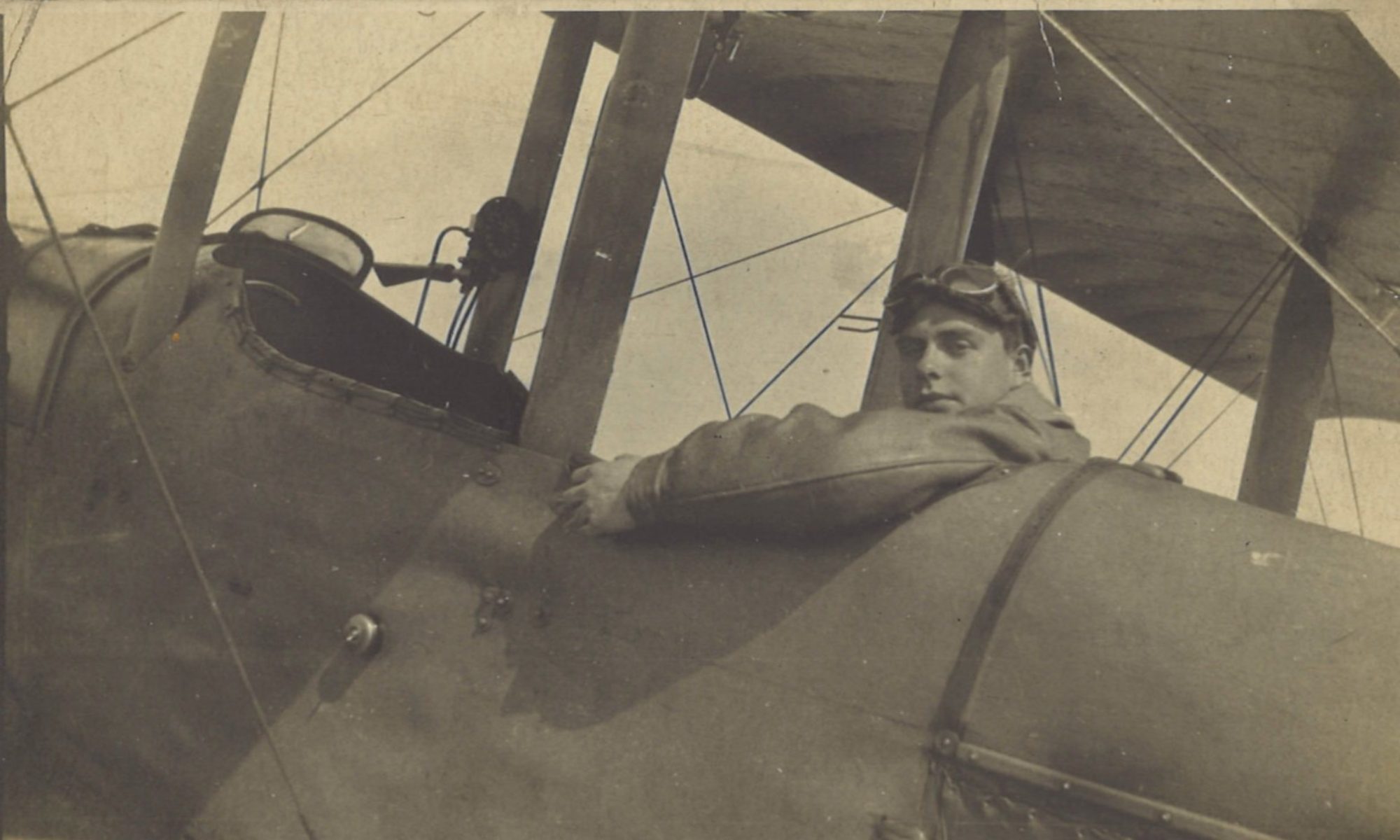
Lts Puckle (Pilot) and Nicolson (Observer) of 42 Sqn RAF again saw aerial combat, only three days after their last encounter. This time they were on photographic duty, and were incidentally attacking enemy kite balloons near Estaires when they became entangled with a couple of Albatros scouts. Presumably the job of the scouts was to defend the kite balloons.
Time: 11.35am
Locality: ESTAIRES
Pilot: Lt H. Puckle Observer: Lt J. F. W. Nicolson

Two Albatros Scouts.

While attacking 4 E.K.B. at R.4, R.11, R.17, G.20, two Albatross Scouts were seen by Observer to be climbing up to machine about 1500 feet below. Observer fired a drum of Lewis into nearest E.A. which spun down, flattened out and flew away East. The other Scout also flew away.
Estaires
The map squares R.4, R.11, R.17 and G.20 (1:40,000 sheets 36A and 36) are either side of Estaires, which is in the Département du Nord on the River Lys, about 15 miles (24 km) west of Lille:
Estaires and its environs. Scale: 1:40,000 on original print; each numbered square is 1,000 yds (914 m). Map credit: IWM/TNA/RGS/GreatWarDigital
But this time the flight was longer, with the sortie lasting more like the 2-3 hours that would be typical for a shoot in Greg’s squadron on the Western Front. Greg would have been flying in figure-of-eight patterns, as suggested in the SS 131 booklet “Co-operation of Aircraft with Artillery”, Revised Edition, as issued by the General Staff in December 1917:
Figure-of-eight circuits flown when observing a shoot. The points ‘G’ are when the aircraft signals ‘Fire’. The battery’s ground aerial is laid parallel to the ‘corrections’ leg.
And as a coda, there was some reconnaissance to end the day.
While Greg was at Hursley Park, an RE8 of 42 Sqn RAF saw aerial combat this day while Lts Puckle (Pilot) and Nicolson (Observer) were on artillery registration duty at 6:30am. “Artillery registration” was more informally known as a “shoot” – the process of directing fire from a battery onto a target, typically a hostile battery, as practised by Greg at Yatesbury on 4 May 1918:
Time: 6.30am Locality: Between NIEPPE FOREST and
                       MERVILLE

Pilot: Lt H. Puckle Observer: Lt J. F. W. Nicolson
Two seater, either an Albatros or resembling one

The E.A. was first fired on when flying north from
MERVILLE and 500 feet above us.  Two drums were fired
at him when he turned and flew towards MERVILLE,
and in flying somewhat across his track 1½ drums were
fired, and the E.A. disappeared into the haze over
ESTAIRES apparently undamaged.
Merville and the Nieppe Forest. Scale: 1:40,000 in original print; each numbered square is 1,000 yds (914 m). Map credit: IWM/TNA/RGS/GreatWarDigital
The area between the Nieppe Forest and Merville, on the River Lys. Merville is 17 miles (30 km) west of Lille. Map credit: Imperial War Museum/Great War DigitalSo no harm done (or inflicted). But a nervous moment for the crew of an RE8, which was not built for elective aerial combat. The risks were never far away.
The combat report was signed by Major H. J. F. Hunter MC, who on 17 April 1918 had taken over as the new CO of 42 Sqn from Major R. G. Gould MC. Major Hunter would be in charge when Greg was posted to the squadron in June.
With ground transport being arranged from Hursley Park to the aerodrome at Worthy Down, Greg took to the air again in an RE8 to practice aerial firing and photography with the Artillery & Infantry Co-operation School.
Date: 16.5.18
Hour: 11.0
Machine type and No.: RE 6616
Passenger: –
Time: 30 m
Height: 1500
Course: Aerodrome
Remarks: Aerial firing (150 rounds)
Date: 16.5.18
Hour: 1.45
Machine type and No.: RE 2472
Passenger: –
Time: 1 hr 5 m
Height: 2500
Course: Photography
Remarks: Camera jambed after 8th plate
Date: 16.5.18
Hour: 3.40
Machine type and No.: RE 2472
Passenger: –
Time: 1 hr 0 m
Height: 3500
Course: Photography
Remarks: Eighteen plates exposed. Successful.
Second time lucky with the camera.
And at the end of the day it was back in the transport to Hursley Park:
From Hursley Park to Worthy Down and back at the end of the day. Click or tap for a larger, zoomable image. Reproduced with the permission of the National Library of Scotland.
Greg’s next recorded flight would be on Tuesday 21 May 1918.
Although Greg had not yet got to France, this photograph dated 15 May 1918 of a kite balloon in operation at Bray-sur-Somme somehow found its way into his collection.
But where is the balloon, you might ask? About half way down the full image, and about one third in from the left hand edge. Here is a magnified detail:
Kite balloon detail
Kite balloons are shaped to be more aerodynamically stable than near-spherical balloons, and so can withstand more windy conditions. Both sides made good use of balloons as observation platforms, for artillery support and general reconnaissance. The balloon shown here is probably a German copy of a French Caquot design, designated Typ Ae, standing for Achthundert english. The Achthundert is a reference to the ~800 m³ capacity of the balloon, which was based on a captured British model.
Here it is at closer quarters:
German Ae 800 kite balloon, copied from the French Caquot design. Image Credit: wwi.hut2.ru
The position of the balloon was, when the photograph was taken, some 4½ miles/7 km ESE of the closest point of the forward positions of the British front line between Morlancourt and Sailly-le-Sec, and so was presumably intended to gather information from that direction.
As a comparison of the following two images shows, the landscape hasn’t changed a great deal in the intervening 100 years. The settlement at the bottom right of the old photo is La Neuville-lès-Bray, which hasn’t expanded much. Neither has Etinehem in the top right. And the courses of the Somme and the Canal de la Somme that joins it from the bottom centre of the photo are much the same.
The Somme between Bray and Etinehem 100 years ago: Kite Balloon in Operation. Image credit: Greg’s War Collection. Tap or click for a larger image.The Somme between Bray and Etinehem today: the kite balloon and field tracks have gone, and the trees have grown, but not much else has changed. Image credit: Google. Tap or click for a larger, zoomable view.
Popham panels were first mentioned in a post for 5 April 1918. They were the possible subject of a hard-to-read log book entry while Greg was at Yatesbury:
To recap, Popham panels, or T-signalling panels, were a means of ground-to-air communication. They were introduced towards the end of the war. Their use was principally by the infantry, as an alternative to the 12′ x 1′ “ground strips” used by the artillery to make up letters and symbols. I would guess that the ground strips were more favoured by airmen as they were larger and easier to see. But the smaller size of Popham panels would have made them much more practical for infantry use.
Instruction in Popham panel reading was certainly undertaken at Hursley Park. Dave Key’s post for 11 May 2018 on The History of Hursley Park website shows a course paper (the third image of the post) that refers to the following.
2. Lecture Popham panel & its use. Procedure of mess-
           ages Battn. & Bde. H.Q. & message dropping.
           Message pads & tracings-Flares - Final
           Report & Interview
Greg may have attended a lecture like this, perhaps on a non-flying day like today.
And when it came to the…
6. Practical. Popham Panel Reading
…then this is how it would have looked from the ground:
Greg’s pilot’s log book doesn’t contain any indication of Popham panel practical work at Hursley Park/Worthy Down. Maybe he just didn’t record it, or perhaps he was already specialised in the ‘ground-strips-and-artillery’ stream.
The Artillery & Infantry Co-operation School at Hursley Park delivered tuition for airmen generally – observers and pilots – on Sundays as well as weekdays. By 1918, some of the roles originally conceived as for observers – including, fairly naturally one would think, artillery observation – had in fact transferred to the pilots. This left the observers free to concentrate on what became their principal role, which was defence of the aircraft, and in particular keeping a careful look out for hostile aircraft. Because of this fluidity in responsibilities, some of the instruction would have overlapped, with both pilots and observers benefiting from it.
Observers School
I’m indebted to Dave Key of the History of Hursley Park website for the following outline of instruction entitled “Observers School – Analysis of Programme” as delivered at Hursley Park.
“Observers School – Analysis of Programme”. Image credit: Dave Key
Although the text is somewhat hard to read, the following components of the course can be deciphered to varying degrees of certainty:
Commandants Lecture
Church
General Lecture (CFS [Central Flying School] Reconn.)
Reconnaissance
Contact Patrol
Art. Obs. [Artillery Observation]
[??]
Hostile Aircraft
Map[?] Reading
Elementary Gunnery
Photography[?]
See alsothe post dated yesterday (11 May 2018) on the History of Hursley Park website entitled “The best I think predominate“, which explains more about the operation of the Arty. & Inf. Co-op. School.
An alternative programme was scheduled in the event of bad weather, indicating that at least some of these components must have been practical rather than just classroom-based.
Church Parade
The reference to ‘Church’ shows that lectures continued on a Sunday, and indeed it was only in the previous month that Church Parade on Sundays had been reinstated, not least because of the enthusiasm of the recently arrived Chaplain, the Reverend G. W. R. Tobias RAF. We know this from a letter from Mr Tobias to his parents dated 14 April 1918 (transcript courtesy of Dave Key again). The following extract also shows the scale of operations at Hursley (“600 Flying Officers on a short final course”):
Royal Flying Corps,
Hursley Park Camp,
Nr Winchester
14/april/18
My dear dear Mother & Dad,
You will see above that I have been attached to the Royal Air Force. It’s Sunday evening I am scribbling this in the Mess Ante Room where a jolly American Officer is doing impromptu conjuring tricks with great skill & effect. He is a fine fellow & his patter & jests are extremely clever, topical & impromptu. I find it very hard to cease thinking of dear old Meyer for a moment. I can’t take up a paper or hear any discussion of the war without hoping & praying for the dear old fellow’s safety.
…
I arrived in the camp on Friday afternoon & have had a hurry time ever since. There are here some 600 Flying Officers on a short final course. Some 300 Air Mechanics 110 American ditto & 300 w.a.a.c.s (clerks, chauffeurs, cooks waitresses, mechanics etc.). There is a largish Hospital (Hutments) nearby which is just being taken over by the Americans. My predecessor devoted himself almost entirely to the Hospital & the w.a.a.c.s. The Flying Corps he abandoned in despair as the Officers are here for only about a month’s course & flying & Lectures go on on Sundays as on Weekdays. He had closed down the Camp Church completely. I got a batman & Church orderly in and appointed to me & got the Church cleaned out. I had an interview with the Colonel who quite agreed that lectures should cease from 10 to 11 on Sunday morning in order to allow of Church Parade. Everybody has been most kind & ready to help. I celebrated this morning at 6:30 in the Camp Church. At 8 at the Hospital & breakfasted with Matron afterwards. At 10 we had a fine Church Parade service, mostly Officers about 40 Waacs & 20 air mechanics. About 200 in all but had to turn away 100 officers as the Church is too small. I must find a larger place or have an open air parade next Sunday if fine. At six I had Evensong in the Hospital Chapel. A dozen nurses 6 American & 6 English. All the up patients have left & most of the English Staff & only a few Americans have come in their place. Also present were the Camp Supt. Major & the Lady in Charge of the Waacs & one of the corridor Officers. At 7 I held a service in their new C.E. Hut. Poor attendance, a couple of Waacs & about 30 mechanics.
…
Contact Patrol
The programme also refers to a ‘Contact Patrol’. What was that about? The Aerodrome Forum’s contributor ‘bristol scout’ offers the following explanation:
The other main function of the squadron was contact patrol. It was an aerial liaison between the front line and the battalion and brigade headquarters, designed to keep them in close touch with each other during the inevitable disorganisation of other means of communication during an offensive. At such times, it was realised, the advance would often find itself cut off from its supports and would have difficulty, or sometimes be actually unable, to send back word where they were. But an aeroplane patrolling at low altitude could easily see the red flares which the Tommies carried and were instructed to light at given times.
The observer could mark the positions of these flares on the map, write down their co-ordinations on a slip of paper, put it in a weighted message bag and, swooping down over battalion headquarters (whose position was known by a semi-circular sheet of white cloth pegged out on the ground), drop the message bag. (http://www.theaerodrome.com/forum/showthread.php?t=42474)
That’s the theory, but as the same contributor goes on to comment:
They actually just flew low enough to see the men in the trenches with accuracy…….brave, brave men.
Although Greg’s pilot’s log book shows that his first flight from Hursley Park/Worthy Down wasn’t until Thursday 16 May 1918, he must have arrived a little before then, and possibly had some initial classroom instruction before he took to the air over Hampshire.
So perhaps it was around 10 May that Greg arrived at Winchester station and was driven the five miles or so past what was then known as Oliver Cromwell’s Battery (an iron age hill fort, reused as a camp by the Roundheads in the English Civil War) to Hursley.
Winchester to Hursley Park. Route superimposed on a 1902 Bartholomew map, reproduced by permission of the National Library of Scotland. Click or tap for a larger, zoomable image.
There he would have first set eyes on the magnificent Queen Anne-style mansion that is Hursley House, set in its surrounding parkland.
A 1906 photograph of Hursley House. Reproduced by permission of Historic England Archive.
For a highly informative source of Hursley Park’s history from medieval times, through the building of the present mansion house and its role in two world wars to the arrival of IBM in 1958 and their continued occupation since then, look no further than Dave Key’s excellent History of Hursley Park site.
As Dave explains, towards the end of the First World War:
By 1917…[Hursley Park] Camp had given way to the Royal Flying Corps, first as Cadets and then as Observers, coming to receive advanced training in the Artillery [and] Infantry Cooperation School. Their departure in May 1918 (now as the newly formed Royal Air Force) made way for the camp to be taken over by the Americans who, like the British Army before them used the Winchester area as a staging post before embarking for France. In Hursley the US AEF [American Expeditionary Force] established a new Base Hospital by bringing together the British Military Hospital and Army Camp to create a massive new hospital to handle an expected 2,000 casualties. (https://hursleypark.wixsite.com/history/history-ww1-1914-1918)
So in mid-May 1918 Greg was probably one of the last cohort of airmen to pass through the portals of the “Arty. & Inf. Co-op. School” at Hursley.
Header image: Detail from a 1906 photograph of Hursley House. Reproduced by permission of Historic England Archive.
With three last flights today, Greg’s basic training is over. A successful time with the camera, at last: 18 plates exposed and no reported jamming. Greg’s final flight at Yatesbury was in a BE2e, the type of aircraft in which he had his first flight on 14 March 1918.
Log book entry
Date: 6.5.18
Hour: 2.0
Machine type and No.: RE 5146
Passenger: –
Time: 1 hr 0 m
Height: 2500
Course: –
Remarks: Photos. 18 plates exposed
Date: 6.5.18
Hour: 5.50
Machine type and No.: RE 5148
Passenger: –
Time: 40 m
Height: 1500
Course: –
Remarks: Practice turns etc. 1 landing
Date: 6.5.18
Hour: 7.25
Machine type and No.: BE 8660
Passenger: –
Time: 40 m
Height: 1500
Course: –
Remarks: Camera
It was just over seven weeks since Greg’s first flight:
So the instructors would see another batch of students off, and the young airmen would wonder what their fate would be. Goodbyes all round:
Yatesbury. Image Credit: Greg’s War Collection
Yatesbury
And no doubt there would be some convivial celebration. At the Officers’ Mess, maybe? Or perhaps at a nearby hostelry, such as the Waggon & Horses in Beckhampton, which doesn’t look as if it has changed much in the last 100 years…apart from the addition of a TV aerial:
Waggon & Horses, Beckhampton. Image Credit: Laurie Barber. Tap or click to see source
As the song goes:
Bonsoir old thing, cheerio! chin chin!
Nah-poo! Toodle-oo!
Good-bye-ee!
To Hursley Park…
Greg’s training would continue at Hursley Park in Hampshire, with the next entry in his log book being dated 16 May 1918. And before the month was out he would be posted to France.
Greg’s last-but-one day at Yatesbury, and the last on which he would fly DH.6s saw a couple of outings around the aerodrome, for aerial fighting and general practice:
Log book entry
Date: 5.5.18
Hour: 8.0
Machine type and No.: DH 5155
Passenger: –
Time: 55 m
Height: 2000
Course: Aerodrome
Remarks: Aerial fighting
Date: 5.5.18
Hour: 3.5
Machine type and No.: DH 5463
Passenger: –
Time: 50 m
Height: 2000
Course: [Aerodrome]
Remarks: Practice
Perhaps Greg would miss friends he’d made at Yatesbury. A later entry in his diary suggests that he was in touch for a while with Albert Gertrey, at least. And maybe Holmes and Jones were particular friends, too: