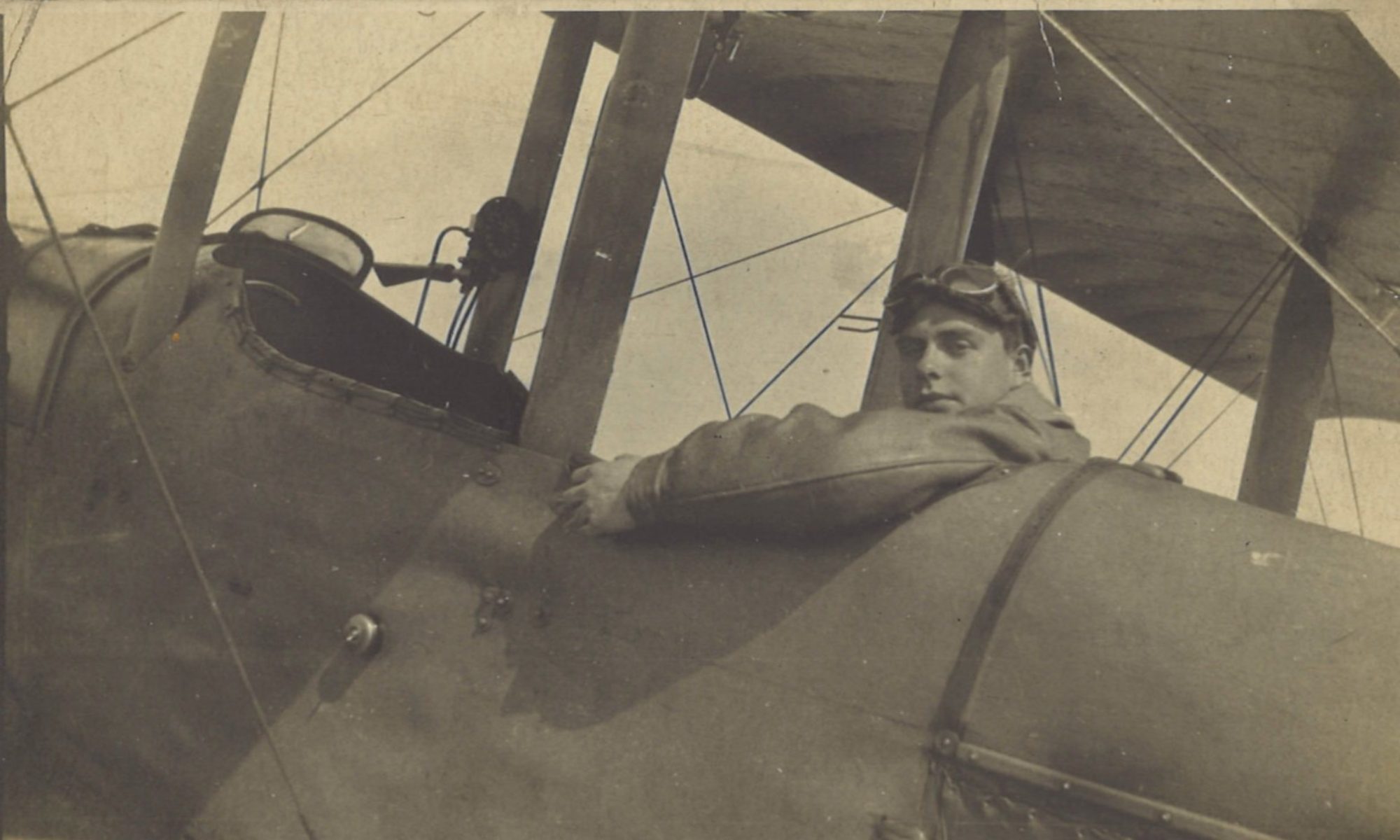
Today was spent getting more familiar with the RE8, under dual control with Lt Thomas, and doing some consolidation solo work in the DH.6 – despite being forced down by storm:
Log book entry
Date: 2.4.18
Hour: 8.45
Instructor: Lt Thomas
Machine type and No.: RE3551
Passenger: Self
Time: 35 min
Height: 2500
Course: Aerodrome
Remarks: Dual.  Turns & landings
Date: 2.4.18
Hour: 10.10
Instructor: –
Machine type and No.: DH7670
Passenger: –
Time: 10 min
Height: 1000
Course: [Aerodrome]
Remarks: Left hand flying.  Forced down by storm
Date: 2.4.18
Hour: 11.15
Instructor: –
Machine type and No.: DH7670
Passenger: –
Time: 25 min
Height: 1000
Course: [Aerodrome]
Remarks: Landings (3)
Easter Monday 1918 was a significant day in several respects:
The RAF’s Birthday
First, it was the day on which the Royal Air Force was formed, by an amalgamation of the Army’s Royal Flying Corps and the Royal Naval Air Service.
Greg’s RAF Commission
Secondly, and not unconnected with the first point, it was the date from which Greg’s commission in the RAF was effective.
Greg’s RAF Commission, dated 1 November 1918 but effective from 1 April 1918. Click or tap for larger image.
First Flight in RE8
Thirdly, it was the date of his first flight in an RE8, the aircraft of his future squadron in France. Back to dual control for this. See the ‘Setting the Scene’ article on the Royal Aircraft Factory RE8 here.
Log book
Date: 1.4.18
Hour: 3.15
Machine type and No.: DH7226
Passenger: –
Time: 30 mins
Height: 1500
Course: [Aerodrome]
Remarks: Practice forced landings on aerodrome
Date: 1.4.18
Hour: 4.5
Machine type and No.: RE3551
Passenger: Self
Time: 10 mins
Height: 1000
Course: [Aerodrome]
Remarks: Dual.  Forced down by rain
Date: 1.4.18
Hour: 5.35
Machine type and No.: DH7672
Passenger: –
Time: 40 mins
Height: 1600
Course: [Aerodrome]
Remarks: Practice turns
Date: 1.4.18
Hour: 6.40
Machine type and No.: RE3551
Passenger: Self
Time: 25 mins
Height: 3000
Course: [Aerodrome]
Remarks: Dual.  Flying straight & turns
Date: 1.4.18
Hour: 7.30
Machine type and No.: DH7672
Passenger: –
Time: 35 mins
Height: 2600
Course: [Aerodrome]
Remarks: Practice S turns. Crashed.
Crash!
And fourthly, as the final log book entry of the day shows, it was the first time that Greg crashed an aeroplane: DH.6 7672, on the last flight of the day. Obviously not badly, as he was flying again the next day and the aircraft was soon back in service, but probably his ego was bruised if nothing else.
As the US aviator Chuck Yeager said, long after the First World War:
If you can walk away from a landing, it’s a good landing. If you use the airplane the next day, it’s an outstanding landing.
RAF Type A Roundel (WW1) credit: Wikimedia user NiD.29. Licensed under CC BY-SA 3.0, adapted with white surround.
42 Squadron RFC, Greg’s future squadron, saw multiple enemy aircraft engagements on this day. Aerial combat was by no means the primary role of RE8s, but they defended themselves as well as they could when they had to – successfully on each of the occasions described below.
The squadron had moved to Chocques only the previous Friday, 22 March 1918, but today was back in action in the Somme sector as part of the defence against Operation Michael of the Kaiserschlacht.
Three separate combat reports were filed by the crew of 42 Squadron aircraft that were on reconnaissance or bombing missions. The pilot of the third aircraft was the Squadron Commander, Major R. G. Gould, M.C.
RE8 3866
42 Sqn Combat Report; Click or tap for larger image
Time: 12 Noon; Locality: between VILLERS & BRAY SUR SOMME
Pilot: Lt A. D. McDonald; Observer: Lt J. Chatterton
Five E.A. Albatros scouts.
Crossed front S. of Albert and West of VILLERS. Just E. of Villers saw body of men and horses apparently in Coy formation. Bombs dropped at these and while observer concentrating on these with Lewis gun, pilot sighted one Albatros some distance below, apparently manoeuvring for tail position. Turned and steered westward, and immediately encountered four more E.A.. Two above and on left, and two about level and nearly behind. Enemy secured about 20 hits on our machine. Observer fired on one attacking machine behind us, and after 10 rounds gun jambed. Owing to mist and very thick haze, we were able to get away .
RE8 3598
42 Sqn Combat Report; Click or tap for larger image
Time: 5 p.m.; Locality: between BAPAUME & ALBERT
Pilot: 2/Lt A. R. Holthouse; Observer: Capt. M. F. Bridge
Albatros Scouts (7) seven.
After bombing and shooting on ground targets from 3000 ft to 7800 feet, in vicinity of BAPAUME, 7 Albatros scouts attacked us.
Fought down to 3000 feet, when relief arrived by our own scouts, believed to be S.E.5’s.
About 10 shots only obtained out of Vickers gun, when it jambed. Four shots went through propeller. Old Vickers gear on gun – unsatisfactory.
Lewis gun also jambed, and both guns were out of action.
Controls and machine shot about. Large holes in tail, sight, & tank from A.A.
Observer wounded in leg.
Machine landed at No.2 A.F.C. Aerodrome.
RE8 5886
42 Sqn Combat Report; Click or tap for larger image
Time: 6.30 p.m.; Locality: MORLANCOURT
Pilot: Major R. G. Gould, M.C. ; Observer: 2/Lt. D. G. Smith
Albatross Scout
One drum fired at E.A. after which he turned away, and did not worry us again.
The remainder of the enemy formation was engaged by other British Machines.
Date: 26.3.18
Hour: 5.15
Machine type and No.: DH5452
Passenger: –
Time: 20 mins
Height: 1000
Course: Aerodrome
Remarks: Practice
Date: 26.3.18
Hour: 7.25
Machine type and No.: DH7670
Passenger: –
Time: 20 mins
Height: 1500
Course: Aerodrome
Remarks: Practice
It’s hard to tell from the log book whether these were
two morning flights, one of them very early;
two evening flights, one very late; or
one early morning flight and one late evening flight.
Sunrise for today in Yatesbury was at 6.58 am and sunset at 7.29 pm (British Summer Time, which had started on 24 March 1918), so it is more likely that they were evening flights. As the afternoon turned to evening and night, the weather, as reported by the Met Office for Salisbury Plain, turned from blue sky (not more than a quarter of the sky covered) to partly cloudy (one half covered), with gentle winds (Force 2) from the northwest. A lovely evening for a 20 minute flight as the sun was setting.