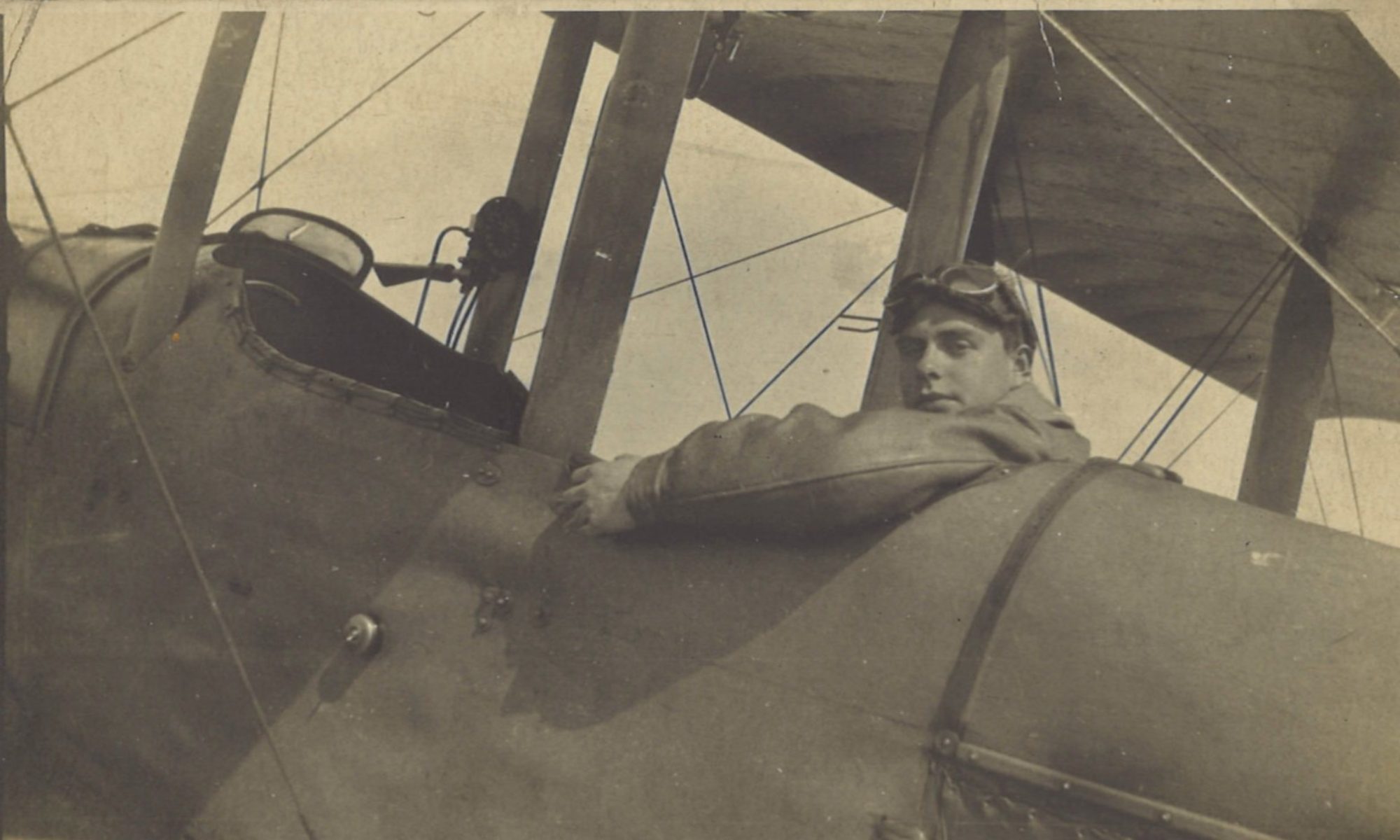
On a day of intense flying in two aeroplanes, BE2e 8646 and RE8 3551, Greg spends almost 5 hours in the air over the course of five flights and 25 take offs and landings, three of which were in his first cross country flight:
Log book entry
Date: 7.4.18
Hour: 7.50
Instructor: Lt Thomas
Machine type and No.: BE2E 8646
Passenger: Self
Time: 35 min
Height: 1000
Course: [Aerodrome]
Remarks: Dual. Six landings.
Date: 7.4.18
Hour: 8.35
Instructor: –
Machine type and No.: BE2E 8646
Passenger: –
Time: 25 min
Height: 1500
Course: [Aerodrome]
Remarks: Solo. Two landings.
Date: 7.4.18
Hour: 11.15
Instructor: Lt Thomas
Machine type and No.: RE3551
Passenger: Self
Time: 1 hr
Height: 1000
Course: [Aerodrome]
Remarks: 12 take off and landings.
Date: 7.4.18
Hour: 2.35
Instructor: –
Machine type and No.: BE2E 8646
Passenger: –
Time: 1 hr 50 min
Height: 3000
Course: Cross Country
Remarks: Landed at Andover & Netheravon
Date: 7.4.18
Hour: 6.45
Instructor: –
Machine type and No.: BE2E 8646
Passenger: – Time: 1 hr 5 min
Height: 2500
Course: Aerodrome
Remarks: Practice turns & landings (2)
The single flight in the RE8 at 11:15 am was real ‘circuits and bumps’ practice: 12 times around in one hour.
The cross country solo flight from 2:35 to 3:35 pm reached 3,000 ft and covered a course of almost 50 miles: 24 miles to Andover, another 10 miles to Netheravon, and then back home to Yatesbury:
Yatesbury-Andover-Netheravon-Yatesbury cross country flight shown on a modern map (courtesy Google). Click for a larger, zoomable map (opens in new tab)
First take-off at 7:50 am and last landing at 7:50 pm: a long day.
Another day of work in both an RE8 (dual control, with Lt Thomas) and a DH.6 (solo). Plenty of landings in the RE8, and a somewhat hard to decipher log book entry for the DH.6:
Log book entry
Date: 5.4.18
Hour: 6.45
Instructor: Lt Thomas
Machine type and No.: RE3551
Passenger: Self
Time: 45 min
Height: 1500
Course: Aerodrome
Remarks: Landings (9). Dual.
Date: 5.4.18
Hour: 3.25
Instructor: –
Machine type and No.: DH2130
Passenger: –
Time: 1 hr 20 min
Height: 2000
Course: [Aerodrome]
Remarks: Ground stps & Pann: Successful
So, what is “Ground stps & Pann” all about – if that is indeed what it says?
Log book entry (enlarged)
My best guess is that it is referring to artillery cooperation work and, specifically, to the use of ground strips and panels.
Although by 1918 the reconnaissance aircraft of the RFC and RAF were equipped with radios, and although those radios were by then small enough so that they did not take the place of the observer – who by this stage was principally responsible for the defence of the aircraft in flight – there was still a problem. That was that radio communication was one way only: from air to ground. Signals from the aircraft were received by RFC/RAF wireless operators attached to artillery units, which in Greg’s case were typically Royal Garrison Artillery Siege Batteries.
Ground Strips
So how did the ground wireless operator communicate back to the aircraft? Various methods were tried during the course of the war. Signalling lamps were not an enduring success, not least because of the need for the pilot to be actually looking in the direction of the lamp at the moment of signalling, which was not always feasible. A better solution proved to be the more primitive sounding strips of cloth laid our on the ground: ground strips. These were typically 12 ft x 1 ft (3.7 m x 0.3 m) strips of white cloth, which could be arranged into pre-designated code symbols or letters. Here are some examples, taken from The Illustrated London News of 23 January 1915 p107, which were stated to be “merely typical signals, and do not represent any actually in use” – just in case it should fall into the wrong hands:
“CODE OF LETTERS used for signalling from ground to the airman above”. Image credit: British Newspaper Archive (www.britishnewspaperarchive.co.uk), The British Library Board and Illustrated London News Group.
¦     Direction of Target
L     Observe for line
X     Observe for range
Z     Observe for fuze
V     Observe for effect of fire
N     Repeat last signal
T     Land
F     Fresh target (additional letters are used with this signal)
And if there was snow on the ground, then dark coloured strips were used instead.
So much for “Ground stps”. What about “& Pann”?
Panels
I have hazarded above that “Pann” refers to panels. An apparent difficulty with this theory is the rather imperfect abbreviation: too many ‘n’s. But although current dictionaries spell the word with one ‘n’, the Oxford English Dictionary (completed in 1933) lists “pannel” as a variant of “panel”, as does the 1913 edition of Webster’s Dictionary. So that objection does not seem to be fatal. Furthermore, the meaning is a good contextual fit.
The Popham or T-signalling panel was an alternative means of ground-to-air communication introduced towards the end of the war, in use by the infantry in particular. In the official pamphlet SS135 “The Division in Attack” (available for download here) issued by the General Staff in November 1918 it is described as consisting of:
…a black or dark blue cloth to which are sewn strips of white Americal cloth in the shape of the letter “T”.
From this “T” project nine arms of white American cloth. These arms are provided with flaps of black or dark blue cloth, so that any or all of them can be covered or exposed to view from the air at will.
These arms are numbered consecutively from 1 to 9, as shown in the following diagram, and are always known by these numbers:
Popham T Panel
Then by covering and exposing appropriate arms, a large number of combinations of numerals may be set out, of which the following are three examples:-
Popham T Panel examples
… A simple figure code is used with the panel, each group of numerals representing a phase or sentence which the infantry are likely to wish to send to the aeroplane.
It niggles me that this was principally an infantry means of communication, rather than artillery, and Greg’s future role was in artillery cooperation. But maybe his speciality hadn’t yet been decided upon. And the question remains: if “Pann” doesn’t refer to Popham T panels, what does it mean?
Today was spent getting more familiar with the RE8, under dual control with Lt Thomas, and doing some consolidation solo work in the DH.6 – despite being forced down by storm:
Log book entry
Date: 2.4.18
Hour: 8.45
Instructor: Lt Thomas
Machine type and No.: RE3551
Passenger: Self
Time: 35 min
Height: 2500
Course: Aerodrome
Remarks: Dual.  Turns & landings
Date: 2.4.18
Hour: 10.10
Instructor: –
Machine type and No.: DH7670
Passenger: –
Time: 10 min
Height: 1000
Course: [Aerodrome]
Remarks: Left hand flying.  Forced down by storm
Date: 2.4.18
Hour: 11.15
Instructor: –
Machine type and No.: DH7670
Passenger: –
Time: 25 min
Height: 1000
Course: [Aerodrome]
Remarks: Landings (3)
Easter Monday 1918 was a significant day in several respects:
The RAF’s Birthday
First, it was the day on which the Royal Air Force was formed, by an amalgamation of the Army’s Royal Flying Corps and the Royal Naval Air Service.
Greg’s RAF Commission
Secondly, and not unconnected with the first point, it was the date from which Greg’s commission in the RAF was effective.
Greg’s RAF Commission, dated 1 November 1918 but effective from 1 April 1918. Click or tap for larger image.
First Flight in RE8
Thirdly, it was the date of his first flight in an RE8, the aircraft of his future squadron in France. Back to dual control for this. See the ‘Setting the Scene’ article on the Royal Aircraft Factory RE8 here.
Log book
Date: 1.4.18
Hour: 3.15
Machine type and No.: DH7226
Passenger: –
Time: 30 mins
Height: 1500
Course: [Aerodrome]
Remarks: Practice forced landings on aerodrome
Date: 1.4.18
Hour: 4.5
Machine type and No.: RE3551
Passenger: Self
Time: 10 mins
Height: 1000
Course: [Aerodrome]
Remarks: Dual.  Forced down by rain
Date: 1.4.18
Hour: 5.35
Machine type and No.: DH7672
Passenger: –
Time: 40 mins
Height: 1600
Course: [Aerodrome]
Remarks: Practice turns
Date: 1.4.18
Hour: 6.40
Machine type and No.: RE3551
Passenger: Self
Time: 25 mins
Height: 3000
Course: [Aerodrome]
Remarks: Dual.  Flying straight & turns
Date: 1.4.18
Hour: 7.30
Machine type and No.: DH7672
Passenger: –
Time: 35 mins
Height: 2600
Course: [Aerodrome]
Remarks: Practice S turns. Crashed.
Crash!
And fourthly, as the final log book entry of the day shows, it was the first time that Greg crashed an aeroplane: DH.6 7672, on the last flight of the day. Obviously not badly, as he was flying again the next day and the aircraft was soon back in service, but probably his ego was bruised if nothing else.
As the US aviator Chuck Yeager said, long after the First World War:
If you can walk away from a landing, it’s a good landing. If you use the airplane the next day, it’s an outstanding landing.
RAF Type A Roundel (WW1) credit: Wikimedia user NiD.29. Licensed under CC BY-SA 3.0, adapted with white surround.