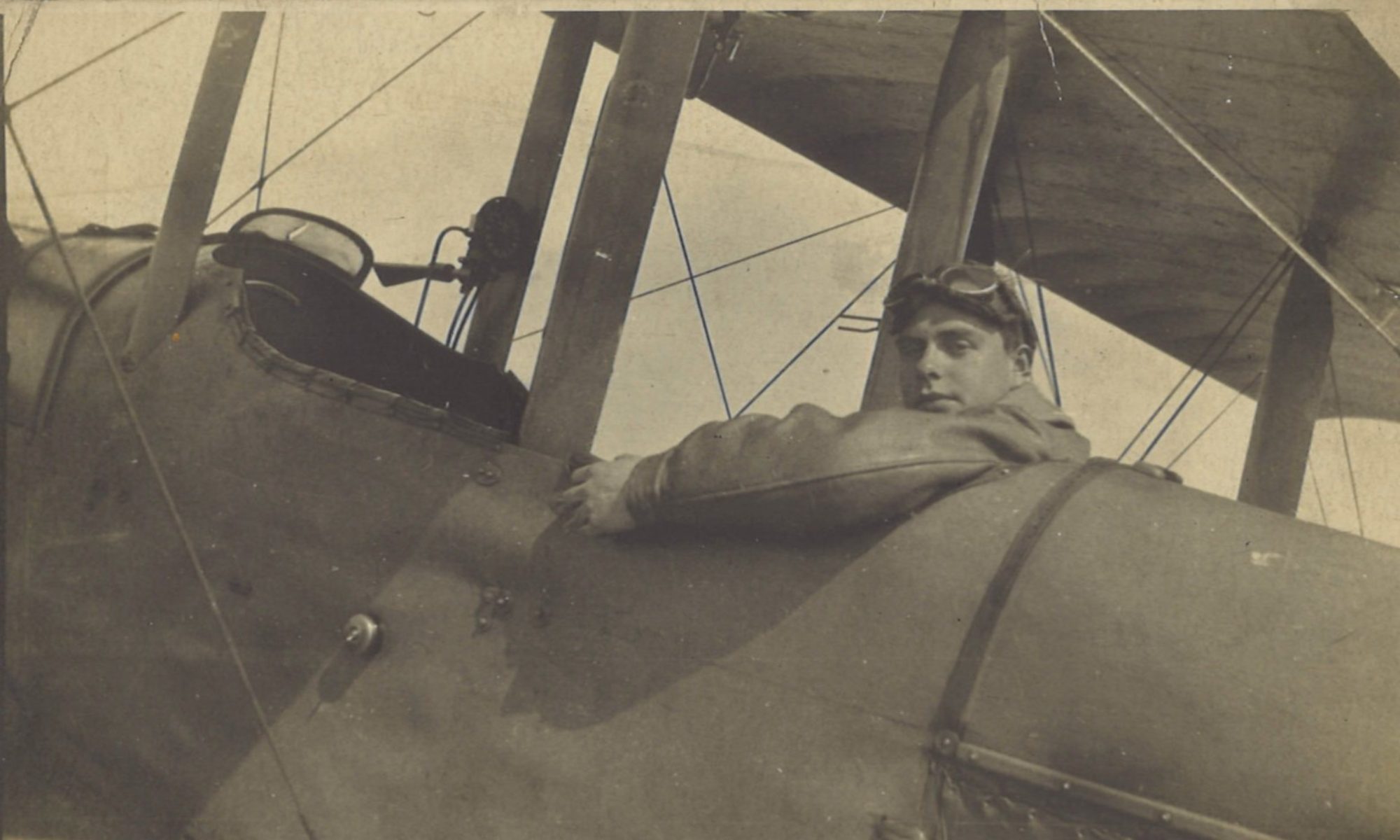
Another miserable day, cloudy and raining, in which Greg achieved 40 minutes of Counter-Battery Patrol work in the afternoon – while firing off 400 rounds from the two guns.
Log Book
Date: 5.8.18
Time: 3.50
Rounds Lewis: 200
Rounds Vickers: 200
Bombs: -
Time on RE8s: 106 hrs 55 mins
RE8: E27
Observer: Lt Hodgson
Time: 40 mins
Height: 1500
Course/Remarks: C.B.P.  Cloudy.  Dud.
Diary
Monday August 5th. CBP 3.50pm. Dud, raining and cloudy.
Back to the core activities of a counter-battery patrol and a shoot. The patrol was over and around Merville, as today’s Squadron Record Book entry shows, but the shoot was aborted because of low clouds.
Log Book
Date: 4.8.18
Time: 1.20pm
Rounds Lewis: 400
Rounds Vickers: -
Bombs: 2
Time on RE8s: 106 hrs 15 mins
RE8: E27
Observer: Lt Hodgson
Time: 2 hrs 35 mins
Height: 2000
Course/Remarks: C.B.P.  Cloudy.  Machine guns active.
Diary
Sunday Aug 4th.  CBP & Shoot (1 pm).

Unable to do shoot because of (very) low clouds.  Called up battery & afterwards sent UL [Weather unfit for Counter Battery work]. Hun ground machine guns active.
Despite not being able to do the shoot, Greg’s patrol was fairly active over and around Merville:
Squadron Record Book
Click for larger image
Type and Number: R.E.8.2500 [sic, should be 27]
Pilot and Observer: P. Lt Gregory. O. Lt Hodgson
Duty: Artillery Patrol
Start: 13.20
Return: 15.55
Results and Remarks:
13.25. 2-25lb bombs dropped at K.34.a.6.5.  Bursts observed.
13.25. fire in building at K.29.c.2.2.
13.30. sent U.L. U.R. U.D. C.20. [Weather unfit for counter-battery work, registration or photography.]
13.35. C.W.S. sent X.
13.45. called up 323 S.B. and got triangle out. [wait] Clouds came at 1500’ so sent U.L. Clouds, before starting shoot.
14.30.  C.W.S. sent Q.6.  No flashes seen in Q.6.
14.34. 1. E.K.B. [enemy kite balloon] N. of ESTAIRES.
14.35. 200 rounds L.G. into Q.8.d. from 1800’.
15.10. C.W.S. sent L.14.  No flashes seen there.
15.15. to 15.30. 100 rounds L.G. into Q.8.d. from 1700’
Concentrations. [Concentrations of artilley fore, as opposed to barrages]
14.00. Square K.35.b.  M.P.I. [mean point of impact] good.
14.50. Houses in area Q.4.b.15.37.  M.P.I. good.
         "    "   "    K.34.c.65.15.  "     "
         "    "   "    K.34.c.99.20.  "     "
15.35. Southern half of MERVILLE, K.29.c & d.
A.A. normal.  M.G.s active
Vis. good.  Obs. By P. & O.
The following map contains the points and squares mentioned above .
Merville and surroundings from a 1:40,000 map. Click for larger image. Credit: IWM/TNA/GreatWarDigital.
Back in the air again after two days of miserable weather. But a dusk reconnaissance ended in rain. The evening brightened with entertainment by a concert party – Leslie Henson’s ‘The Gaieties’.
Log Book
Date: 3.8.18
Time: 7.35pm
Rounds Lewis: 400
Rounds Vickers: -
Bombs: 4
Time on RE8s: 103 hrs 40 mins
RE8: E27
Observer: Hodgson
Time: 1 hr 25 mins
Height: 3000
Course/Remarks: Dusk reconnaissance. Rain.
Greg had by now adapted his log book entries. He now not only recorded the ammunition fired from each gun and the number of bombs dropped but also noted the cumulative time he had flown on RE8s.
Diary
Saturday 3rd August.  Wrote home.  Dusk reconnaissance.  Returned in rain, engine nothing great.  Four bombs & 400 rounds Lewis.

Concert party – ‘Gaieties’ in Hangar.  Leslie Henson, Errol & Teddie Horton [sic., probably should be Holton]
‘Gaieties’
‘The Gaieties’ was a troupe of army entertainers under the direction of Leslie Henson. Henson had begun his professional stage career before the war, appearing in Edwardian musical comedies, among other productions, in the West End and elsewhere. He joined the RFC, but in 1918 was asked by General Gough to form a touring concert party to entertain the troops of the 5th Army in France. Evidently this survived Gough’s removal and the re-formation of the 5th Army under General Birdwood. So here were ‘The Gaieties’ at 42 Squadron in Rely, just over three weeks after General Birdwood’s visit on 12 July 1918.
Among the members of the troupe was Bert Errol, ‘a noted female impersonator’. Quite possibly it is Errol, and maybe others members of The Gaieties cast, in this photograph from Greg’s collection:
A concert party by Leslie Henson’s ‘The Gaieties’ was held at Rely on 3 August 1918. Greg is third from the right in the middle row, next to one of the ‘ladies’. Click for larger image. Credit: Greg’s War Collection.
Greg’s diary entry also mentions ‘Teddie Horton’. Possibly this was meant to be Teddie Holton, who (spoiler alert) was certainly performing with Henson, Errol and others in The Gaieties in early November 1918. More on them then…
An intended early counter battery patrolwas cancelled in view of the weather. So Greg had the day off and went to St Omer. A “good time”; but a close encounter with some bombs at night.
Diary
August 1st 1918.  Thursday.  CBP at 5.30am.  Too dud to take off, heavy fog and ground mist.

Went to St Omer at 11.am & came back at 7.  Good time, quite a change from camp.

Bomb raid at night.  10 bombs dropped near us.
St Omer
St Omer was something of an aviation hub during the First World War. It was the largest British airfield on the Western Front, and the centre of operations for the RFC and then the RAF. There was also an associated hinterland of supply facilities. Socially, it was quite a buzz too. Nonetheless, as Cross & Cockade International reports, there was a variety of views on the merits of the place:
The town itself seems to have brought out mixed reactions. Major Edward (Mick) Mannock, described St Omer as a ‘nasty town, mainly composed of estaminets, old women, and dirty – very dirty children’, while Lieutenant Harry van Goethem, who arrived with 10 Squadron at St Omer in July 1915, appears to have relished his brief time billeted there describing his visit as ‘historic’. He particularly enjoyed the Café Vincent and ‘the wonderful waitress (Jeanne) whose fair coiffe was the admiration of countless thousands of British officers. “Given the number of squadrons for whom a night out in St Omer was a regular social event – being recognised as a meeting place for members of any squadron within a reasonable distance – it may be concluded that for the majority of RFC personnel it was an agreeable destination. (https://www.crossandcockade.com/StOmer/)
From Greg’s brief report, he evidently shared the majority view.
A successful shoot with 237 Siege Battery (at last), was almost compromised by a German aircraft. And later there was a German bombing raid, possibly by Gotha bombers.
Wednesday July 31st.  CBP at 10.30.

Took up a shoot with 237 SB.  Called them up at 11, but there was a Hun overhead & did not put out groundstrips.  Shoot successful, battery firing wide during battery fire, so re-ranged them & then came home.

Dozens of Huns knocking about.  Hun bombing raid at night.  Three or four big Huns overhead.  No bombs dropped anywhere near.
Shoot with 237 Siege Battery
During his counter battery patrol, Greg took up a shoot with 237 Siege Battery. He must have been relieved to have a successful shoot with this battery, as previous attempts with them on 21 July and 28 July 1918 had failed.
A German aircraft overhead nearly compromised the shoot, since the battery could not communicate with the aircraft by putting out the usual ground strips (see the article on Shoots for an explanation).
Hun Bombing Raid at Night
It was an active day for enemy aircraft. Rely Aerodrome seems not to have been the target, but the ‘big Huns’ – possibly Gotha G.IV or G.V bombers such as illustrated below – were plainly heard. This was the kind of aircraft that used to bomb London.
Gotha G.IV or G.V bomber, with twin pusher engines, seen above trenches. Click for larger image. Credit: Greg’s War Collection.