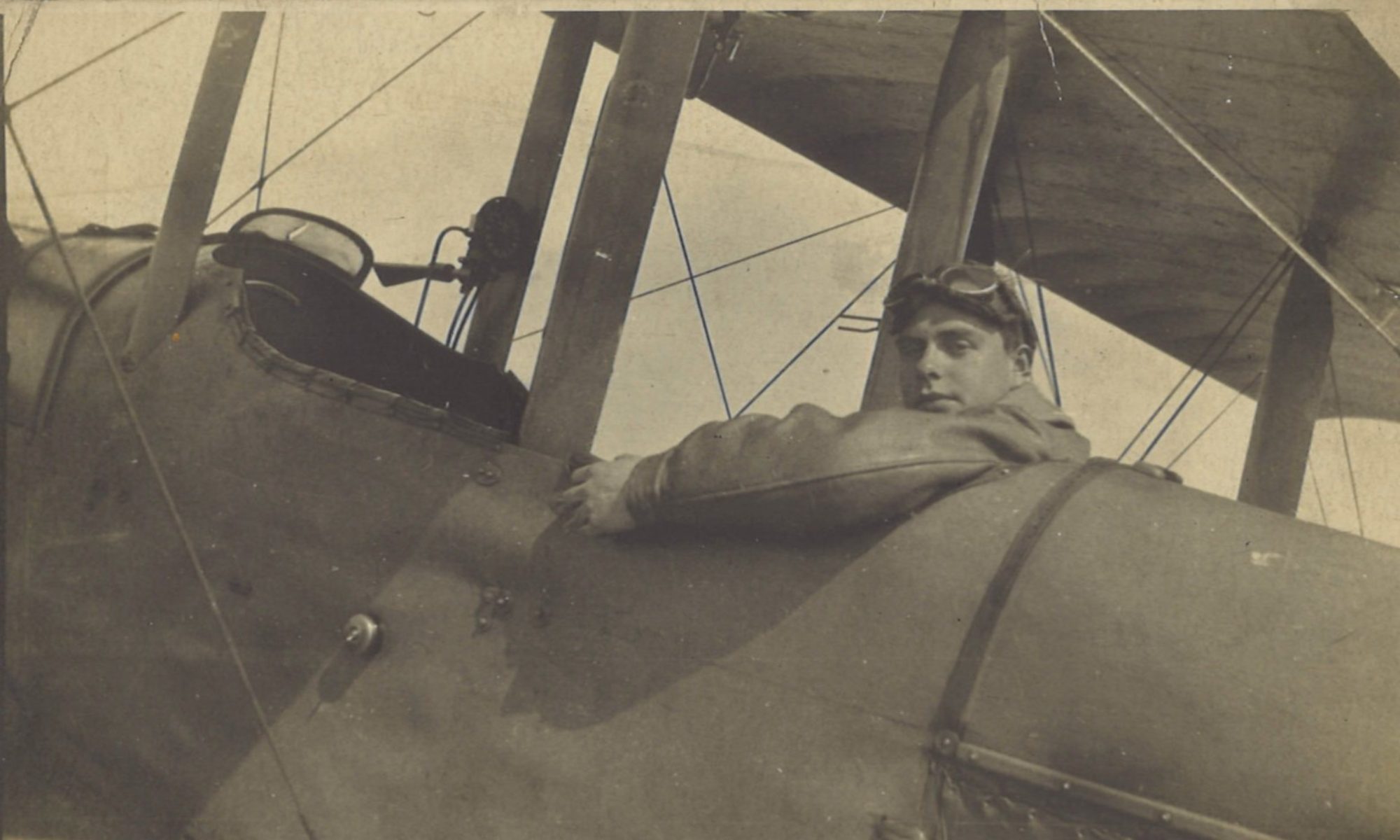
Greg’s last-but-one day at Yatesbury, and the last on which he would fly DH.6s saw a couple of outings around the aerodrome, for aerial fighting and general practice:
Log book entry
Date: 5.5.18
Hour: 8.0
Machine type and No.: DH 5155
Passenger: –
Time: 55 m
Height: 2000
Course: Aerodrome
Remarks: Aerial fighting
Date: 5.5.18
Hour: 3.5
Machine type and No.: DH 5463
Passenger: –
Time: 50 m
Height: 2000
Course: [Aerodrome]
Remarks: Practice
Perhaps Greg would miss friends he’d made at Yatesbury. A later entry in his diary suggests that he was in touch for a while with Albert Gertrey, at least. And maybe Holmes and Jones were particular friends, too:
In an important training exercise, Greg begins today to practice ‘zone calls’.
Log book entry
Date: 29.4.18
Hour: 2.35
Machine type and No.: DH 5155
Passenger: –
Time: 55 m
Height: 3000
Course: Aerodrome
Remarks: Practice.
Date: 29.4.18
Hour: 5.55
Machine type and No.: DH 5155
Passenger: –
Time: 1 h 20 m
Height: 3000
Course: –
Remarks: Zone calls
Date: 29.4.18
Hour: 8.0
Machine type and No.: RE 5146
Passenger: –
Time: 30 m
Height: 2500
Course: Aerodrome
Remarks: Practice 1 landing.
Zone Calls
Zone calls are one way wireless messages by Morse code from aircraft to artillery batteries giving information about targets, such as enemy batteries firing, enemy transport and troop movements.
A zone call might be something like:
NF L 26 c 2 0
Example of a zone call, with map reference – somewhere in France. All will be revealed on 8 August (although there is enough information in this post to identify where…). Adapted from 1:10,000 scale trench map (credit: Great War Digital).
This would mean: Guns Now Firing from a position at map reference L 26 c 2 0. Maps of the Western Front (and presumably maps used by Greg’s Training Squadron at Yatesbury) used a reference system that was a combination of squares and a grid.
Each 1:40,000 map sheet was divided into twenty-four 6,000 yd squares, arranged in a 6 x 4 array and lettered A to X – in our case, L.
Each 6,000 yd square was in turn subdivided into thirty-six 1,000 yd squares, numbered 1 to 36 – in our case, 26.
Each 1,000 yd square was then subdivided into four quadrants (a, b, c, d) – in our case, c.
Finally, a decimal grid reference (eastings and then northings) was used to specify the intended position with the required degree of precision. This could be to one significant figure as in our example (2 0), which identified a 50 yd square. Or it could be to two significant figures if greater precision was desired and achievable (22 01, for example), which would identify a 5 yd square within the 50 yd square denoted by 2 0.
Fine levels of detail are not visualisable on a 1:40,000 map. The artillery and infantry tended to use 1:20,000 and 1:10,000 scale maps, depending on the purpose in hand, which were revised periodically as trenches and other ground features changed. These revisions, incidentally, would rely heavily on the aerial photography of work of the corps squadrons. The complete map reference would include the number of the 1:40,000 sheet (eg Sheet 36A, to give 36A L 26 c 2 0), but the sheet number was typically understood in context and therefore omitted in zone calls.
If this combination of squares and grid references sounds complicated, it is not actually different in principle from an Ordnance Survey grid reference, which in one of its incarnations uses a combination of an identified square and a decimal grid reference within the square. For example, the OS reference SU 053711 is based on a 100 km square designated SU and then, within that square, a three significant figure decimal grid reference 053 711. This in turn identifies a 100 m square – which, as it happens, is on the former Yatesbury airfield (1:50,000 Landranger sheet 173 in today’s OS maps).
A zone call was a one way wireless message from the aircraft to an artillery battery on the ground. Ground to air communication was done by ‘ground strips’, as explained in this earlier post:
After more practice on landings, Greg spent the final flight of the day on artillery co-operation work, specifically a practice shoot – recorded as successful.