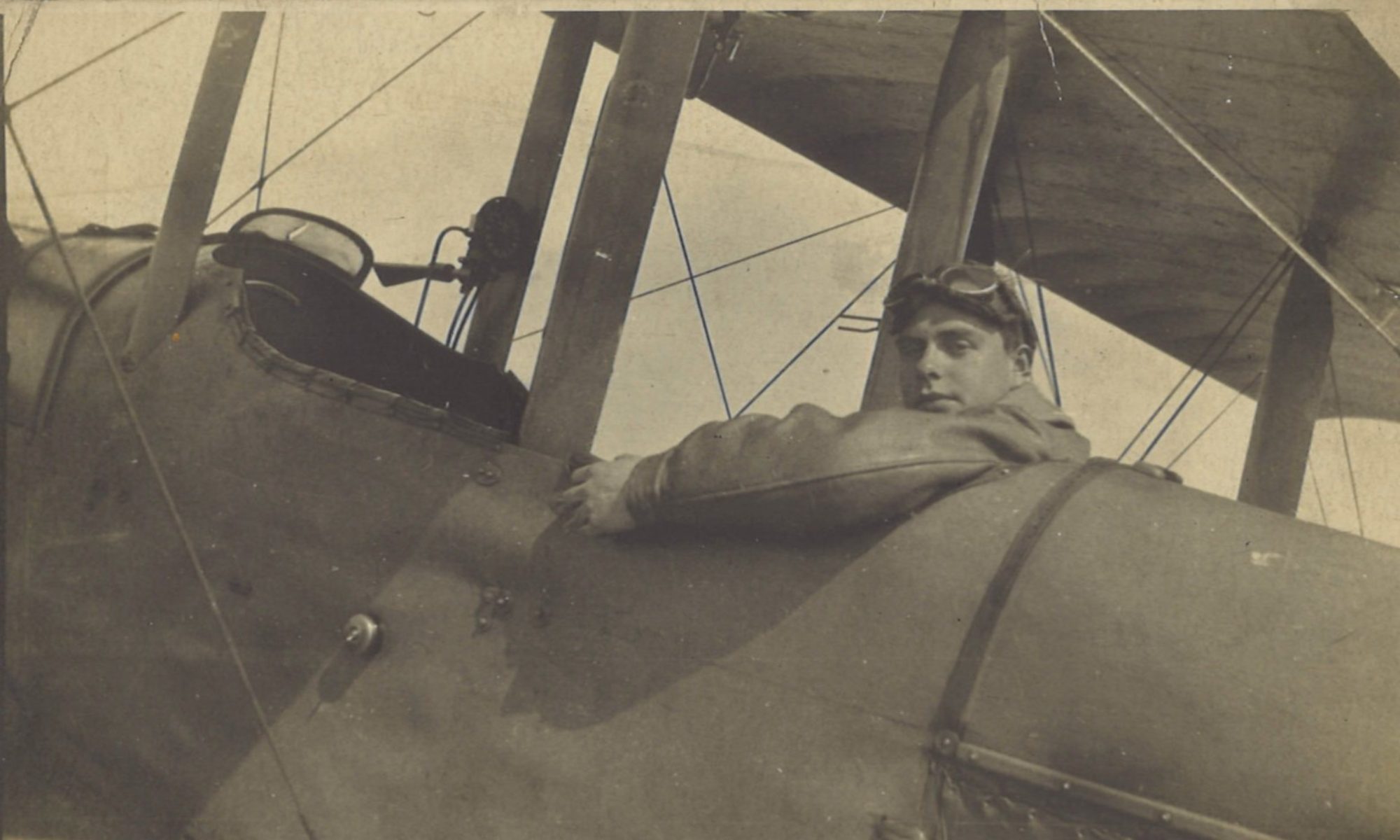


After the false starts earlier in the week, Greg starts to ease into what will become one of his routine activities: the Counter Battery Patrol. This one, which at three hours duration was one of the longer ones, was enlivened by some ‘Archie’ – anti-aircraft fire.
Log Book


Date: 13.6.18
Hour: 4.00
Machine type: RE8
No.: E27
Observer: Lt Roche
Time: 3 hrs
Height: 2,800
Course/Remarks: C.B.P. Bad landing.  Engine rough.
Diary


Thursday June 13th.  E27. Counter battery patrol from 4 to 7. Rather dud, engine rough.

One ‘Archie’ burst under tail.  Two explosions in Hunland.  Bad landing.  Observer fired off 100 rounds into Calonne.
All the As: Archie, Ack-Ack and Anti-Aircraft Fire

‘Archie’ and ‘ack-ack’ were both slang terms used by British airmen for anti-aircraft fire in the First World War. One is easier to explain than the other.
Ack-ack
Ack-ack’ is the easier term to explain, as ‘Ack’ was the letter A in an early military alphabet, as set out by The Royal Signals Museum here. AA or ack-ack was the standard abbreviation for anti-aircraft (fire).
Archie
But what of ‘Archie’? The most prevalent explanation seems to be that it derived from a popular music hall number called Archibald! Certainly not, first sung by George Robey in 1911. The story is that a pilot used to shout the song title, which was also the refrain, to his observer when an anti-aircraft shell exploded nearby (but missed), and ‘Archibald’ of course became abbreviated to ‘Archie’. Some accounts credit the first usage to Lieutenant Amyas ‘Biffy’ Borton of 5 Sqn RFC.
In a competing explanation, this source has a rather more elaborate account of the origin of the expression, quoting Ernest Weekley’s An Etymological Dictionary of Modern English (1921) :
“It was at once noticed at Brooklands [where much aviation development and testing was carried out prior to 1914, and portrayed in the film Those Magnificent Men in their Flying Machines] that in the vicinity of, or over, water or damp ground, there were disturbances in the air causing bumps or drops to these early pioneers. Some of these ‘remous’ were found to be permanent, one over the Wey river, and another at the corner of the aerodrome next to the sewage-farm. Youth being fond of giving proper names to inanimate objects, the bump near the sewage-farm was called by them Archibald. As subsequently, when war broke out, the effect of having shell bursting near an aeroplane was to produce a ‘remous’ reminding the Brookland trained pilots of their old friend Archibald, they called being shelled ‘being Archied’ for short. Any flying-man who trained at Brooklands before the war will confirm the above statement” (Col. C H Joubert de la Ferté, I M S ret.)
Well, which is right? Either way, you can hear Harry Bluff singing Archibald! Certainly not here:
Calonne
“Observer fired off 100 rounds into Calonne.” Calonne (today, Calonne-sur-la-Lys) is a small settlement 2 miles (3 km) south west of Merville, itself 17 miles (30 km) west of Lille. The German line ran through Calonne and Le Sart, to its north, at the time. Anywhere to the east of this line qualified as ‘Hunland’.

Counter Battery Patrols
For an explanation of what counter battery patrols involved, see this new page in the ‘Setting the Scene – Background Articles’ series:


