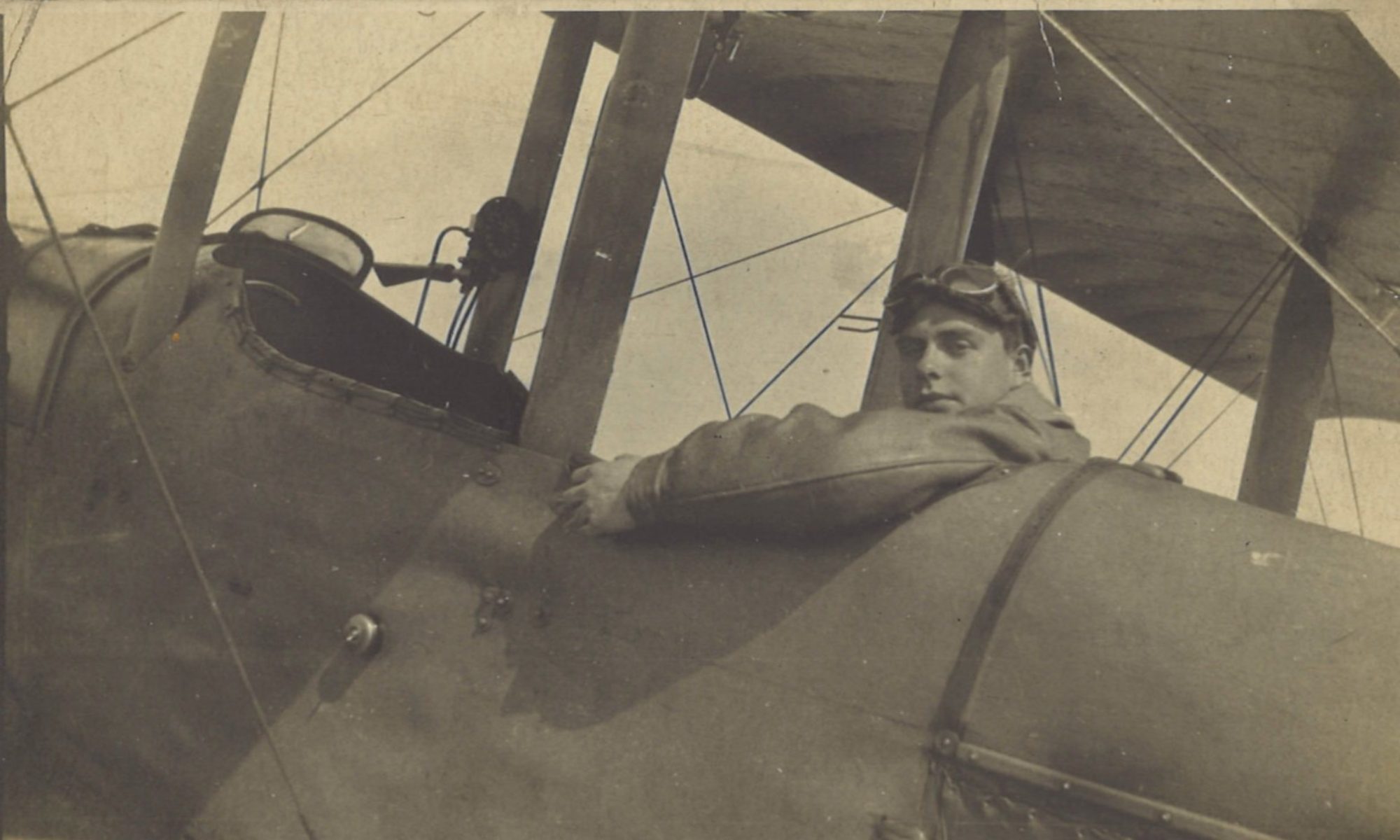
Tuesday 3 September 1918 – Contact Patrol

Just after Greg landed at the end of his counter-battery patrol as covered in this morning’s post, the next aircraft of 42 Squadron to take to the air from Rely aerodrome was on contact patrol.  Greg wasn’t the pilot, but there’s a nice reason to take a look at what the crew reported. The information in the Squadron Record Book (SRB) for this patrol gives the precise positions of troops on the ground in the Lys Sector as they approach Laventie.  We get a good sense of their rate of progress, as we know where the British line was yesterday morning.  

So here, 100 years to the hour after their patrol, is the report that Lts Newson (Pilot) and Griffiths (Observer) filed.

Squadron Record Book

Squadron Record Book
Squadron Record Book – click for larger image
Type and Number: RE8 2300
Pilot and Observer: P. Lt Newson. O. Lt Griffiths
Duty: Contact Pat’l
Hour of Start: 12.45
Hour of Return: 2.15
Remarks: 13.03 Called for flares.  White panels observed at M 3b 5.5, M 9a 7.5, G 32a 7.5, M 15d 6.4, M 15b 6.3
Troops observed along main ESTAIRES ROAD from G 26.c 2.0 – M 21a 5.0
Troops observed walking along from M 14b 7.7 to M 9c 20.35
14.45 Fi[r]es in WOODS at M 10c 5.2 and M 16d 6.8
      Fire in HOUSE at M 4c 70.35
2 EKB’s in direction of AUBERS.
Vis good. Height 500’.  Obs by P & O.

Troops advance on Laventie

The troop locations and fires mentioned in the report are shown on this map:

Map of Estaires and Laventie
Map of Estaires and Laventie. Adapted from a composite of 1:40,000 scale maps. Each numbered square is 1,000 yards. Click for larger image. Map credit IWM/TNA/GreatWarDigital.

It looks like Estaires is now in British hands, and that units are positioning to take Laventie. The eastward advance continues.

Contact Patrol

Two earlier posts have dealt (briefly) with contact patrols.  They were essentially low altitude (e.g. 500 ft, as here) patrols gathering troop location information to feed back to HQ:

Sunday 12 May 1918 – Observers School

Thursday 27 June 1918 – CBP, Archie…and Sheet Tin

Thursday 27 June 1918 – CBP, Archie…and Sheet Tin

Another Counter Battery Patrol, in which Greg was twice switched to new targets, another four bombs dropped, some “pretty hot Archie”, and an intriguing order about sheet tin.

Log Book

Log BookLog Book

Date: 27.6.18 
Hour: - 
Machine type: RE8 
No.: E27 
Observer: Lt Kennedy 
Time: 2 hrs 5 m 
Height: 6000 
Course/Remarks: CBP. 4 bombs. Archie pretty hot.

Diary

DiaryDiary

Thursday June 27th. CBP 8 – 11 (8.40 – 10.45). Four bombs dropped, caused small fire.  Archie very persistent & pretty hot.

Sent FL FR FD & got to 6,000 ft.  Engine rough but picked up & ran very well.

Got X twice from CWS.


“Archie”…

…was anti-aircraft fire, as explained here:

Thursday 13 June 1918 – CBP and ‘Archie’

“Sent FL FR FD”…

…means that a series of favourable weather signals was sent, explained here,:

Saturday 15 June 1918 – CBP and Bombing

“Got X twice from CWS”…

…means that Greg twice was given the signal X from the squadron’s Central Wireless Station. ‘X’ meant ‘change to new target’. The X (formed of ground strips of cloth) would be followed by a description of the target. Sounds a bit like he felt was being messed around.

Sheet Tin

The day’s routine orders from the CO, Major Hunter MC, had an interesting entry about sheet tin, which was obviously of some value:

Recovery of sheet tin from Biscuit, Tea and other large tins

Arrangements having been made to sell all sheet tin which is in good condition and which is not required by the British Armies in France, it is necessary that as uniform a method of recovery as possible should be adopted.

Tins are to have their tops and bottoms removed entire, after which the bodies are to be opened up at the joints, i.e., at two diametrically opposite corners.  the sheets thus produced are to be pressed flat, bundled in twenties and tied with wire or hoop iron.  

The tops and bottoms are to be similarly bundled.

The joints can be opened by hating on an iron plate over a brazier.  When the solder in the joint runs, the parts of the tin can be shaken apart.

Special care is to be taken that only sufficient heat is used to make the solder run.  Too much heat will spoil the tinned surface and render it unfit for sale.

To prevent deterioration from rust, it is very important that tins should be dealt with as soon as received and should not be left exposed to damp after packing (4000/40 (Q.B.1).)
             (G.R.O. 4326, dated 21.6.18).

One might reasonably wonder why “the British Armies in France” might have any use for sheet tin themselves.  In fact, one use was to make reflective signal discs in the gas mask haversacks of the infantry:

Haversack signal disc used by Allied troops.
Haversack signal disc used by Allied troops. From Michael Meech, ‘A Short History of Contact Patrols’ Cross & Cockade International 40(2) 116-127 (2009)

The discs could be deployed by troops in forward positions, so that RAF patrol aircraft on infantry liaison duties (so-called ‘contact patrols’) could see their position and transmit this information to the relevant headquarters. 


Sunday 12 May 1918 – Observers School

The Artillery & Infantry Co-operation School at Hursley Park delivered tuition for airmen generally – observers and pilots – on Sundays as well as weekdays.  By 1918, some of the roles originally conceived as for observers – including, fairly naturally one would think, artillery observation – had in fact transferred to the pilots.  This left the observers free to concentrate on what became their principal role, which was defence of the aircraft, and in particular keeping a careful look out for hostile aircraft.  Because of this fluidity in responsibilities, some of the instruction would have overlapped, with both pilots and observers benefiting from it.

Observers School

I’m indebted to Dave Key of the History of Hursley Park website for the following outline of instruction entitled “Observers School – Analysis of Programme” as delivered at Hursley Park.  

Observers School - Analysis of Programme
“Observers School – Analysis of Programme”. Image credit: Dave Key

Although the text is somewhat hard to read, the following components of the course can be deciphered to varying degrees of certainty:

  • Commandants Lecture
  • Church
  • General Lecture (CFS [Central Flying School] Reconn.)
  • Reconnaissance 
  • Contact Patrol
  • Art. Obs. [Artillery Observation]
  • [??]
  • Hostile Aircraft
  • Map[?] Reading
  • Elementary Gunnery
  • Photography[?]

See also the post dated yesterday (11 May 2018) on the History of Hursley Park website entitled “The best I think predominate“, which explains more about the operation of the Arty. & Inf. Co-op. School.

An alternative programme was scheduled in the event of bad weather, indicating that at least some of these components must have been practical rather than just classroom-based.

Church Parade

The reference to ‘Church’ shows that lectures continued on a Sunday, and indeed it was only in the previous month that Church Parade on Sundays had been reinstated, not least because of the enthusiasm of the recently arrived Chaplain, the Reverend G. W. R. Tobias RAF.  We know this from a letter from Mr Tobias to his parents dated 14 April 1918 (transcript courtesy of Dave Key again).  The following extract also shows the scale of operations at Hursley (“600 Flying Officers on a short final course”):

Royal Flying Corps,

Hursley Park Camp,

Nr Winchester

14/april/18

My dear dear Mother & Dad,

You will see above that I have been attached to the Royal Air Force. It’s Sunday evening I am scribbling this in the Mess Ante Room where a jolly American Officer is doing impromptu conjuring tricks with great skill & effect. He is a fine fellow & his patter & jests are extremely clever, topical & impromptu. I find it very hard to cease thinking of dear old Meyer for a moment. I can’t take up a paper or hear any discussion of the war without hoping & praying for the dear old fellow’s safety.

I arrived in the camp on Friday afternoon & have had a hurry time ever since. There are here some 600 Flying Officers on a short final course. Some 300 Air Mechanics 110 American ditto & 300 w.a.a.c.s (clerks, chauffeurs, cooks waitresses, mechanics etc.). There is a largish Hospital (Hutments) nearby which is just being taken over by the Americans. My predecessor devoted himself almost entirely to the Hospital & the w.a.a.c.s. The Flying Corps he abandoned in despair as the Officers are here for only about a month’s course & flying & Lectures go on on Sundays as on Weekdays. He had closed down the Camp Church completely. I got a batman & Church orderly in and appointed to me & got the Church cleaned out. I had an interview with the Colonel who quite agreed that lectures should cease from 10 to 11 on Sunday morning in order to allow of Church Parade. Everybody has been most kind & ready to help. I celebrated this morning at 6:30 in the Camp Church. At 8 at the Hospital & breakfasted with Matron afterwards.  At 10 we had a fine Church Parade service, mostly Officers about 40 Waacs & 20 air mechanics. About 200 in all but had to turn away 100 officers as the Church is too small. I must find a larger place or have an open air parade next Sunday if fine. At six I had Evensong in the Hospital Chapel. A dozen nurses 6 American & 6 English. All the up patients have left & most of the English Staff & only a few Americans have come in their place. Also present were the Camp Supt. Major & the Lady in Charge of the Waacs & one of the corridor Officers. At 7 I held a service in their new C.E. Hut. Poor attendance, a couple of Waacs & about 30 mechanics.

Contact Patrol

The programme also refers to a ‘Contact Patrol’.  What was that about? The Aerodrome Forum’s contributor ‘bristol scout’ offers the following explanation:

The other main function of the squadron was contact patrol.  It was an aerial liaison between the front line and the battalion and brigade headquarters, designed to keep them in close touch with each other during the inevitable disorganisation of other means of communication during an offensive. At such times, it was realised, the advance would often find itself cut off from its supports and would have difficulty, or sometimes be actually unable, to send back word where they were. But an aeroplane patrolling at low altitude could easily see the red flares which the Tommies carried and were instructed to light at given times.
The observer could mark the positions of these flares on the map, write down their co-ordinations on a slip of paper, put it in a weighted message bag and, swooping down over battalion headquarters (whose position was known by a semi-circular sheet of white cloth pegged out on the ground), drop the message bag. (http://www.theaerodrome.com/forum/showthread.php?t=42474)

That’s the theory, but as the same contributor goes on to comment:

They actually just flew low enough to see the men in the trenches with accuracy…….brave, brave men.

Amen to that.

© Copyright 2018- Andrew Sheard and licensors. All rights reserved.

Website powered by green energy