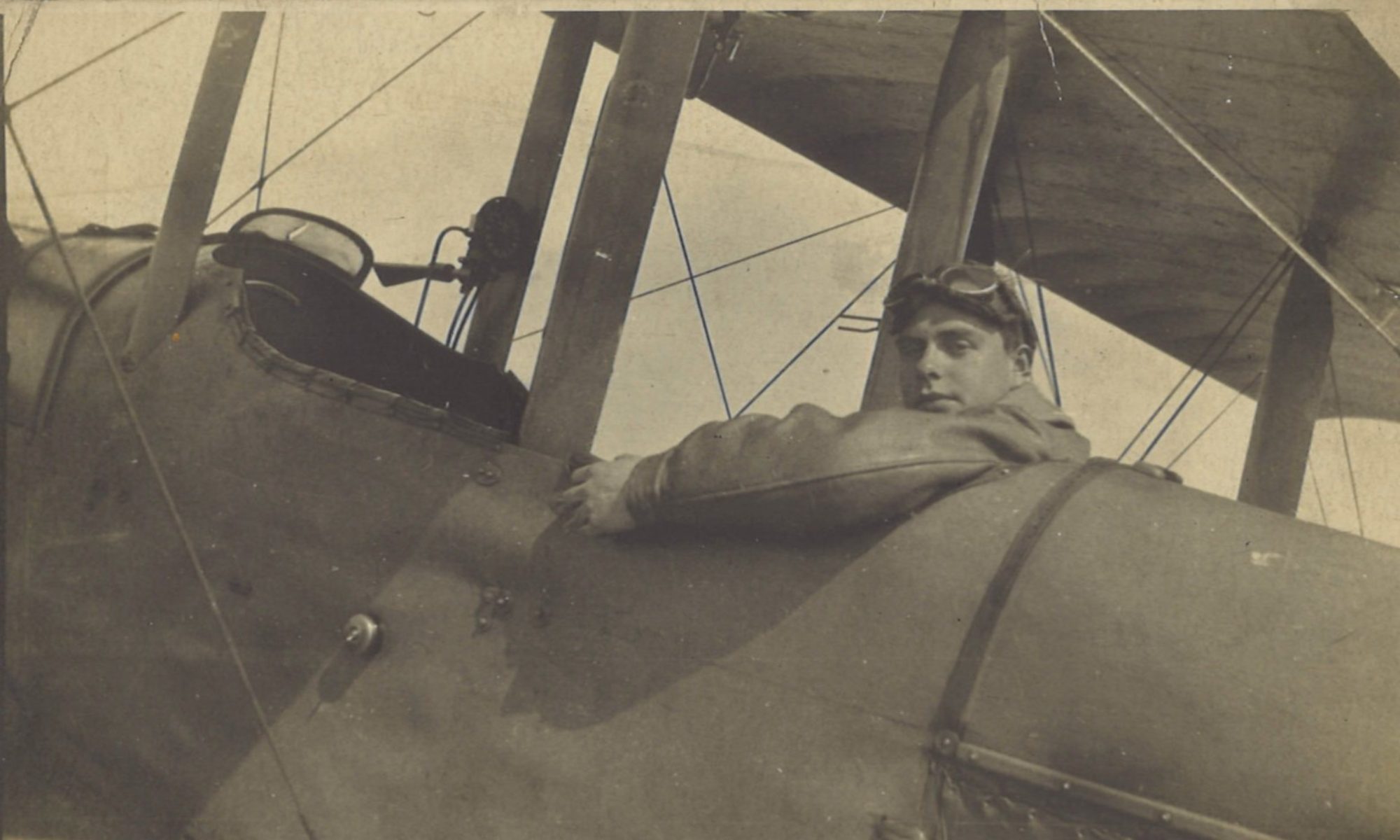
Friday 9 August 1918 – Propeller Shot

Greg’s diary contains the laconic entry “propeller shot” during counter battery patrol today, amid active ground machine gun fire.  He also sees propaganda balloons sailing away.  And the Squadron CO’s daily orders contain a reminder about discipline.

Log Book

Log BookLog Book

Date: 9.8.18 
Time: 11.30 
Rounds Lewis: 400 
Rounds Vickers: 300 
Bombs: 4 
Time on RE8s: 113 hrs 55 mins 
RE8: 2526 
Observer: Lt Hodgson 
Time: 2 hrs 50 mins 
Height: 2500 
Course/Remarks: C.B.P. M.Guns active.  Bumpy.

Diary

Diary

Friday Aug 9th.  C.B.P. 11.30 to 2.15.  Ground machine guns active.  Propeller shot.  Saw four of our propaganda balloons go sailing over Hunland.

We can see that it was an active day for small arms fire, both received – not least by the shot propeller – and given (700 rounds fired between the Lewis and Vickers guns).

Propaganda Balloons

According to Sergeant Major Herbert A. Friedman, writing for the www.psywarrior.com website:

Early in the war when the Germans threatened to put leaflet-dropping pilots before a firing squad, the British mastered the art of dropping the leaflets and newspapers from unmanned balloons. The leaflet balloon was invented by Mr. A. Fleming who stated that 48,000 were produced. He treated the paper in such a way that the balloons could stay afloat for three days when filled with hydrogen.

Captain L. C. Pittmann tells more about the balloons in an article entitled “Propaganda by Balloon” published in The Royal Engineers Journal, April 1919. Some of his comments are:

“In March 1918, the Royal Engineers took up the supervision and manufacture of these balloons and releases…the balloons dispatched to France two to three times a week (a staff of nearly 100 girls was specially employed on this work). During the period of Match, 1918, to the signing of the Armistice, over 35,000 balloons and 20 million leaflets attached to releases were dispatched from France. As many as 400 balloons, each carrying 500 to 1,500 leaflets, have been sent over the lines in a single day.

The Germans did their utmost to prevent the circulation of the leaflets, and as much as five marks was offered for each leaflet brought to headquarters, but many Germans were captured with leaflets in their possession…”

Greg writes that the balloons went “sailing over Hunland”. This says something about the direction of the prevailing wind.  The other side of the coin was that returning British aircraft often had to fly into the wind.  Apart from the slower speed that implied, they had to allow enough fuel to get home.

On Discipline

Today’s daily orders from the CO of 42 Squadron contained a reminder about discipline in the infant Royal Air Force.  Allied to this, proper saluting was “an index to the standard of discipline in a unit”:

6 Discipline:-  The necessity for a high standard of discipline in the R.A.f. is pointed out by the Air Council in the following terms:-

(1) "The Royal Air Force is now forming its traditions, and this stage of development will affect its whole future history.  It has shown before the world the highest standard of intelligence, courage, initiative and devotion in the face of the hardest tests.  The binding and inspiring force of discipline must not be absent - it must be developed to the highest possible extent.  In the R.A.F. loss of life by accident is due to a lack of a measured sense of discipline more than to any other cause."

(2) Attention is also directed to the necessity of ensuring that proper attention is paid by all ranks to correct bearing, dress and saluting.  The manner of saluting in the R.A.F. has been promulgated in A.M.W.O.517 of 1-7-18, and smartness and correctness in saluting are an index to the standard of discipline in a unit.

Wednesday 7 August 1918 – Something in the Air

Although Greg’s early Counter Battery Patrol was curtailed by a dud engine, and he only flew for 1¼ hrs, something was clearly afoot.  In a ‘hot air gust’ in the squadron, three machines were on the line all day.

Log Book

Log BookLog Book

Date: 7.8.18 
Time: 6.00 
Rounds Lewis: - 
Rounds Vickers: - 
Bombs: 4 
Time on RE8s: 110 hrs 20 mins 
RE8: 2649 
Observer: Lt Hodgson 
Time: 1 hr 15 mins 
Height: 2500 
Course/Remarks: C.B.P.  Three machines on line.  Eng dud.

Diary

Diary

Wednesday Aug. 7th. Rec’d Ma’s letter.  Great hot air gust in Squadron.  Three machines on line all day.  CBP at 5.30am. Dud engine, landed on drome after 1¼ hrs.

Hot Air Gust

Here’s this term again.  He used it because there was lots of aircraft activity, with three machines being kept on the line at any one time.  So the squadron must truly have been busy. Possibly it was an intensive reconnaissance effort in anticipation of the Allies’ final offensive.

There’s more on the term in these two earlier posts:

Sunday 21 July 1918 – No Windy Shoot

Thursday 4 July 1918 – Hot-Air Bomb Raid


Tuesday 6 August 1918 – Windy and Bumpy

At least it wasn’t raining on this windy and bumpy – and as it happened uneventful – counter battery patrol day.

Log Book

Log BookLog Book

Date: 6.8.18 
Time: 9.50 
Rounds Lewis: 300 
Rounds Vickers: 200 
Bombs: - 
Time on RE8s: 109 hrs 05 mins 
RE8: E27 
Observer: Lt Hodgson 
Time: 2 hrs 10 mins 
Height: 2500 
Course/Remarks: C.B.P. Very windy & bumpy

Diary

Tuesday August 6th.  Ltr fr D.  CBP.  Very windy & bumpy, nothing much doing.

Monday 5 August 1918 – CBP, Dud, Cloudy, Raining

Another miserable day, cloudy and raining, in which Greg achieved 40 minutes of Counter-Battery Patrol work in the afternoon – while firing off 400 rounds from the two guns.

Log Book

Log BookLog Book

Date: 5.8.18 
Time: 3.50 
Rounds Lewis: 200 
Rounds Vickers: 200 
Bombs: - 
Time on RE8s: 106 hrs 55 mins 
RE8: E27 
Observer: Lt Hodgson 
Time: 40 mins 
Height: 1500 
Course/Remarks: C.B.P.  Cloudy.  Dud.

Diary

Diary

Monday August 5th.  CBP 3.50pm.  Dud, raining and cloudy.


Sunday 4 August 1918 – CBP and Aborted Shoot

Back to the core activities of a counter-battery patrol and a shoot.  The patrol was over and around Merville, as today’s Squadron Record Book entry shows, but the shoot was aborted because of low clouds.

Log Book

Log BookLog Book

Date: 4.8.18 
Time: 1.20pm 
Rounds Lewis: 400 
Rounds Vickers: - 
Bombs: 2 
Time on RE8s: 106 hrs 15 mins 
RE8: E27 
Observer: Lt Hodgson 
Time: 2 hrs 35 mins 
Height: 2000 
Course/Remarks: C.B.P.  Cloudy.  Machine guns active.

Diary

Diary

Sunday Aug 4th.  CBP & Shoot (1 pm).

Unable to do shoot because of (very) low clouds.  Called up battery & afterwards sent UL [Weather unfit for Counter Battery work]. Hun ground machine guns active.

Despite not being able to do the shoot, Greg’s patrol was fairly active over and around Merville:

Squadron Record Book

Squadron Record Book
Click for larger image
Type and Number: R.E.8.2500 [sic, should be 27] 
Pilot and Observer: P. Lt Gregory. O. Lt Hodgson 
Duty: Artillery Patrol 
Start: 13.20 
Return: 15.55 
Results and Remarks: 
13.25. 2-25lb bombs dropped at K.34.a.6.5.  Bursts observed. 
13.25. fire in building at K.29.c.2.2. 
13.30. sent U.L. U.R. U.D. C.20. [Weather unfit for counter-battery work, registration or photography.] 
13.35. C.W.S. sent X. 
13.45. called up 323 S.B. and got triangle out. [wait] Clouds came at 1500’ so sent U.L. Clouds, before starting shoot.
14.30.  C.W.S. sent Q.6.  No flashes seen in Q.6.
14.34. 1. E.K.B. [enemy kite balloon] N. of ESTAIRES.
14.35. 200 rounds L.G. into Q.8.d. from 1800’.
15.10. C.W.S. sent L.14.  No flashes seen there.
15.15. to 15.30. 100 rounds L.G. into Q.8.d. from 1700’
Concentrations. [Concentrations of artilley fore, as opposed to barrages]
14.00. Square K.35.b.  M.P.I. [mean point of impact] good.
14.50. Houses in area Q.4.b.15.37.  M.P.I. good.
         "    "   "    K.34.c.65.15.  "     "
         "    "   "    K.34.c.99.20.  "     "
15.35. Southern half of MERVILLE, K.29.c & d.
A.A. normal.  M.G.s active
Vis. good.  Obs. By P. & O.

The following map contains the points and squares mentioned above . 

Merville and surroundings from a 1:40,000 map
Merville and surroundings from a 1:40,000 map. Click for larger image. Credit: IWM/TNA/GreatWarDigital.

For a map reading primer, see:

Counter Battery Patrols and Zone Calls

Thursday 1 August 1918 – Good Time in St Omer

An intended early counter battery patrol was cancelled in view of the weather.  So Greg had the day off and went to St Omer.  A “good time”; but a close encounter with some bombs at night.

Diary

Diary

August 1st 1918.  Thursday.  CBP at 5.30am.  Too dud to take off, heavy fog and ground mist.

Went to St Omer at 11.am & came back at 7.  Good time, quite a change from camp. 

Bomb raid at night.  10 bombs dropped near us.

St Omer

St Omer was something of an aviation hub during the First World War.  It was the largest British airfield on the Western Front, and the centre of operations for the RFC and then the RAF.  There was also an associated hinterland of supply facilities.  Socially, it was quite a buzz too.  Nonetheless, as Cross & Cockade International reports, there was a variety of views on the merits of the place:

The town itself seems to have brought out mixed reactions. Major Edward (Mick) Mannock, described St Omer as a ‘nasty town, mainly composed of estaminets, old women, and dirty – very dirty children’, while Lieutenant Harry van Goethem, who arrived with 10 Squadron at St Omer in July 1915, appears to have relished his brief time billeted there describing his visit as ‘historic’. He particularly enjoyed the Café Vincent and ‘the wonderful waitress (Jeanne) whose fair coiffe was the admiration of countless thousands of British officers. “Given the number of squadrons for whom a night out in St Omer was a regular social event –  being recognised as a meeting place for members of any squadron within a reasonable distance – it may be concluded that for the majority of RFC personnel it was an agreeable destination. (https://www.crossandcockade.com/StOmer/)

From Greg’s brief report, he evidently shared the majority view.

Wednesday 31 July 1918 – CBP, and Big Huns Overhead

A successful shoot with 237 Siege Battery (at last), was almost compromised by a German aircraft.  And later there was a German bombing raid, possibly by Gotha bombers.

Log Book

Log BookLog Book

Date: 31.7.17 
Time: 10.35 
Rounds Lewis: 100 
Rounds Vickers: - 
Bombs: - 
RE8: E27 
Observer: Lt. Hodgson 
Time: 2 hrs 50 m 
Height: 4500 
Course/Remarks: CBP & shoot with 237 SB. Successful.

Diary

DiaryDiary

Wednesday July 31st.  CBP at 10.30.

Took up a shoot with 237 SB.  Called them up at 11, but there was a Hun overhead & did not put out groundstrips.  Shoot successful, battery firing wide during battery fire, so re-ranged them & then came home.

Dozens of Huns knocking about.  Hun bombing raid at night.  Three or four big Huns overhead.  No bombs dropped anywhere near.

Shoot with 237 Siege Battery

During his counter battery patrol, Greg took up a shoot with 237 Siege Battery.  He must have been relieved to have a successful shoot with this battery, as previous attempts with them on 21 July and 28 July 1918 had failed.

A German aircraft overhead nearly compromised the shoot, since the battery could not communicate with the aircraft by putting out the usual ground strips (see the article on Shoots for an explanation). 

Hun Bombing Raid at Night

It was an active day for enemy aircraft.  Rely Aerodrome seems not to have been the target, but the ‘big Huns’ – possibly Gotha G.IV or G.V bombers such as illustrated below – were plainly heard. This was the kind of aircraft that used to bomb London.

Gotha G.IV or G.V bomber
Gotha G.IV or G.V bomber, with twin pusher engines, seen above trenches. Click for larger image. Credit: Greg’s War Collection.

Tuesday 30 July 1918 – Nothing Doing On the Line

A two hour counter battery patrol, but nothing doing on the line.

Log Book

Log BookLog Book

Date: 30.7.17 
Time: 6.0 
Rounds Lewis: 100 
Rounds Vickers: 100 
Bombs: - 
RE8: E27 
Observer: Lt. Hodgson 
Time: 2 hrs 0 m 
Height: 2500 
Course/Remarks: CBP. Very dud. Eng rough.

Diary

Diary

Tuesday July 30th.  6pm.  CBP.  Pretty dud, engine nothing great.  Absolutely nothing doing on the line.

For the first time in a week, though, both aircraft guns were fired.  Greg and Lt Hodgson fired 100 rounds from each.

More on counter battery patrols here:

Counter Battery Patrols and Zone Calls

Monday 29 July 1918 – Very Misty

Another dies non for artillery observation as it was very misty.

Log Book

Log BookLog Book

Date: 29.7.17 
Time: 12.50 
Rounds Lewis: - 
Rounds Vickers: - 
Bombs: - 
RE8: E27 
Observer: Lt. Hodgson 
Time: 20 m 
Height: 1500 
Course/Remarks: CBP. Weather test.  V. heavy ground mist. NG.
  • CBP = Counter battery patrol
  • NG = No good.

Diary

Diary

Monday July 29th.  CBP 1pm.  Went up but came down, very misty.  Unable to observe anything so came down.

More on CBPs here:

Counter Battery Patrols and Zone Calls

Friday 26 July 1918 – Shelled in St Venant

Yesterday’s windy weather was followed today by rain, which forced Greg down from a counter battery patrol.  A subsequent exploration of St Venant  didn’t go entirely to plan, thanks to the German artillery…

Log Book

Log BookLog Book

Date: 26.7.17 
Time: 5.45 
Rounds: - 
Bombs: 4 
RE8: E27 
Observer: Lt. Hodgson 
Time: 1 hr 30 m 
Height: 3000 
Course/Remarks: CBP.  Forced down by rainstorm.

Diary

Diary

Friday July 26th.  CBP (5.30am).  1½ hours.  Forced down by rain.

Went down to St Venant in the afternoon.  While exploring in some of the houses Fritz started shelling.  Cleared out pretty quickly.  Managed to pick up piece of shell as souvenir.

More on CBP here:

Counter Battery Patrols and Zone Calls

Earlier visits to St Venant here:

Saturday 20 July 1918 – Shoot and Visit to St Venant

Monday 22 July 1918 – Another Shoot with 213 SB

© Copyright 2018- Andrew Sheard and licensors. All rights reserved.

Website powered by green energy