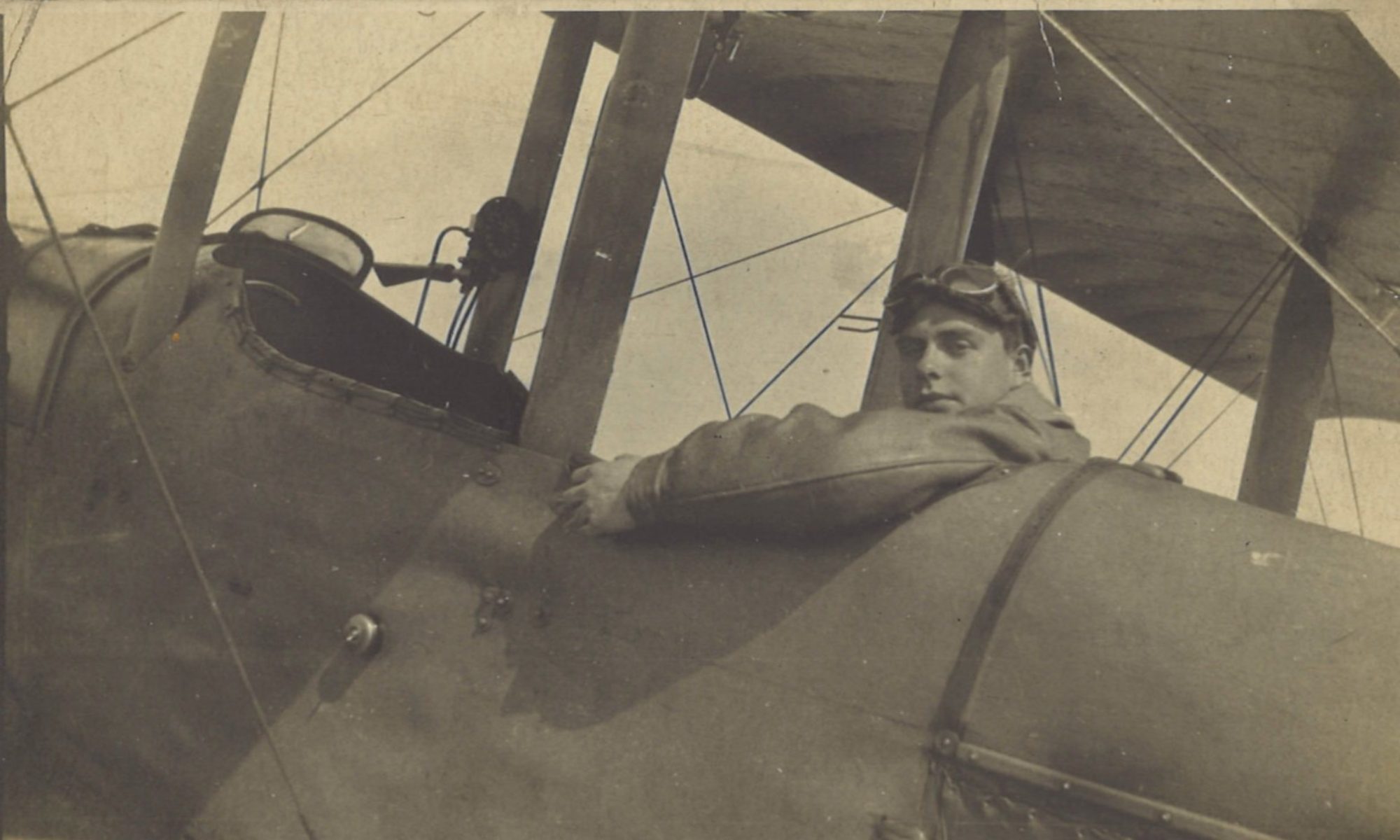
Tuesday 28 May 1918 – Three Air Combats for 42 Sqn

Meanwhile in France (again)…

…almost 70 miles (110 km) to the north of the battle at Cantigny, 42 Squadron was having a busy day dealing with enemy aircraft, with three ‘Combats in the Air’ reports being filed about activity over Calonne and Le Sart, either side of the River Lys to the west of Merville, itself 17 miles (30 km) west of Lille:

Calonne and Le Sart
Calonne and Le Sart, near Merville, from 1:40,000 scale map. Click for larger image. Map credit IWM/GreatWarDigital

1. Capt. Davis and Lt Chatterton

This crew had a tough time against 12 aircraft only three days ago on 25 May 1918

Air combat report
Air combat report – click for larger image
Time: 5.15 a.m.  
Locality: CALONNE
Pilot: Capt. A. E. Davis  
Observer: Lieut. J. Chatterton, M.C. 

Three small two-seater Fighters, and one with slight extensions on top plane.  

While doing a shoot 4 E.A. appeared over CALONNE.  I turned West but one machine dived on our tail and fired continuously.

Observer fired about 100 rounds into this E.A. which then turned away.  The second then dived and also fired continuously.  Observer fired another drum at about 200 yards into this E.A. which also turned East.

A third machine then dived on us but after firing about 100 rounds on us the whole formation withdrew East.

Vickers gun fired about 50 rounds at E.A. after they had turned East.

2. Lt. Welsh & 2/Lt. Watkins

Air combat report
Air combat report – click for larger image
Time: 10.30 a.m.  
Locality: LE SART
Pilot: Lieut A. W. Welsh 
Observer: 2/Lieut H. Watkins 

Two seater, possibly Aviatik  

R.E.A. [Reconnaissance Enemy Aircraft] obviously trying to bomb our trenches dropped 3 at LE SART, during which time he was fired at back by back and then front gun.  He immediately flew back over MERVILLE to ESTAIRES.

3. Lts. Puckle and Nicolson

This was another crew that had seen air combat recently: on 19 May 1918 and  22 May 1918.

Air combat report
Air combat report – click for larger image
Time: 4.35 p.m.  
Locality: CALONNE 
Pilot: Lieut H. Puckle 
Observer: Lieut J. F. W. Nicolson 

Four two seaters, one with extensions, type unknown.  Machine which fired on our tail had two guns.  Machines had a blue bottom plane (underneath) and large blue patch under the fuselage.  Very small black crosses.   

While flying over CALONNE 4 E.A. two seaters were sighted.  Pilot fired 25 rounds into 1 E.A., then gun jambed.  E.A. then turned on R.E.8. and got one on the tail.  Observer fired 250 rounds into this E.A. which turned East and flew with the others towards MERVILLE. 

One machine had a kidney-shaped tail (not the one with extensions) thus: [see image]  The extensions on the only E.A. which had them were short and square.


Saturday 25 May 1918 – 42 Sqn in Air Combat

Meanwhile in France…

…it was another day of aerial combat for an RE8 of 42 Squadron, which was – alarmingly – outnumbered 12 to 1 but survived:

Air combat report
Air combat report – click for larger image
Time: 12.10 p.m.  
Locality: K.28 
Pilot: Capt. A. E. Davis 
Observer: Lieut. J. Chatterton, M.C. 

12 single seater machines, type unknown.
Machines had extension on top planes and slight
dihedral.

 
At 12.10pm two formations of six machines each 
appeared over MERVILLE.  One machine dived on us and
fired about 50 rounds.  Observer fired a burst of 25
rounds with Lewis into this machine which then 
turned away.  A second E.A. then dived and followed 
us down to 4000 feet, firing all the time.  Observer
fired another 70 rounds into this machine which did
a sharp "Immelmann" and turned East. Vickers [the 
pilot's gun] fired about 50 rounds at machines 
retreating.

K.28

“K.28” refers to a 1,000 yd x 1,000 yd square just west of Merville, itself 17 miles (30 km) west of Lille:

K.28, near Merville map.
K.28, near Merville, from 1:10,000 scale map. Click for larger image. Map credit IWM/GreatWarDigital

The centre of K.28 was a mile or so behind, i.e. to the east of, the German front line at the time.

“Immelmann”

The “Immelmann Turn” is associated with and was possibly devised by the German Pilot Max Immelmann.

According to Wikipedia:

In World War I aerial combat, an Immelmann turn was a maneuver used after an attack on another aircraft to reposition the attacking aircraft for another attack.

After making a high-speed diving attack on an enemy, the attacker would then climb back up past the enemy aircraft, and just short of the stall, apply full rudder to yaw his aircraft around. This put his aircraft facing down at the enemy aircraft, making another high-speed diving pass possible. This is a difficult maneuver to perform properly, as it involves precise control of the aircraft at low speed. With practice and proper use of all of the fighter’s controls, the maneuver could be used to reposition the attacking aircraft to dive back down in any direction desired.

The manoeuvre is illustrated in a 1918 RNAS handbook as follows:

Immelmann Turn
The Immelmann Turn, illustrated by E. L. Ford, from ‘Practical Flying’, RNAS, 1918

Immelmann famously flew Fokker Eindeckers, including the E.III as pictured (probably at Upavon in Wiltshire) in this post:

Wednesday 1 May 1918 – The Enemy Close at Hand


© Copyright 2018- Andrew Sheard and licensors. All rights reserved.

Website powered by green energy