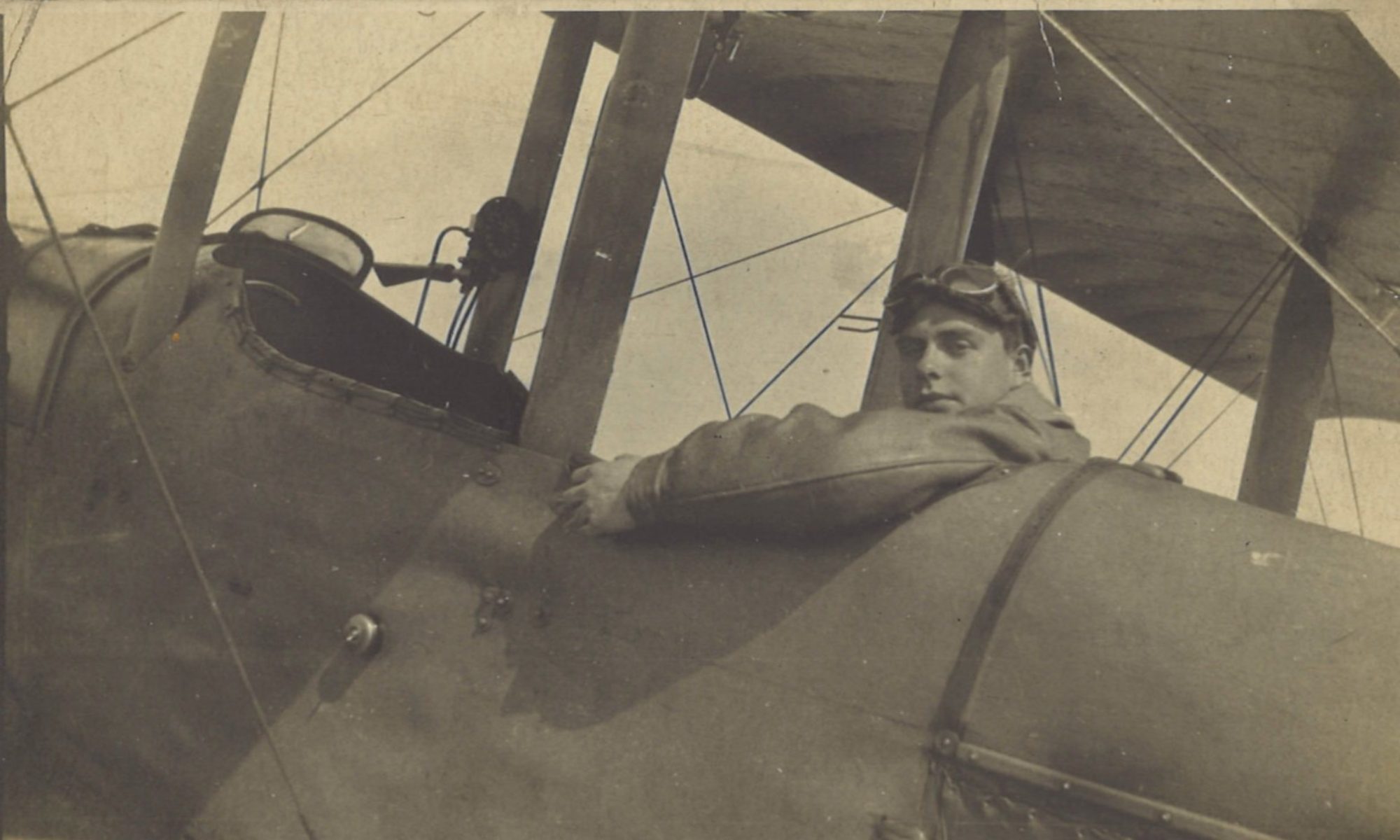
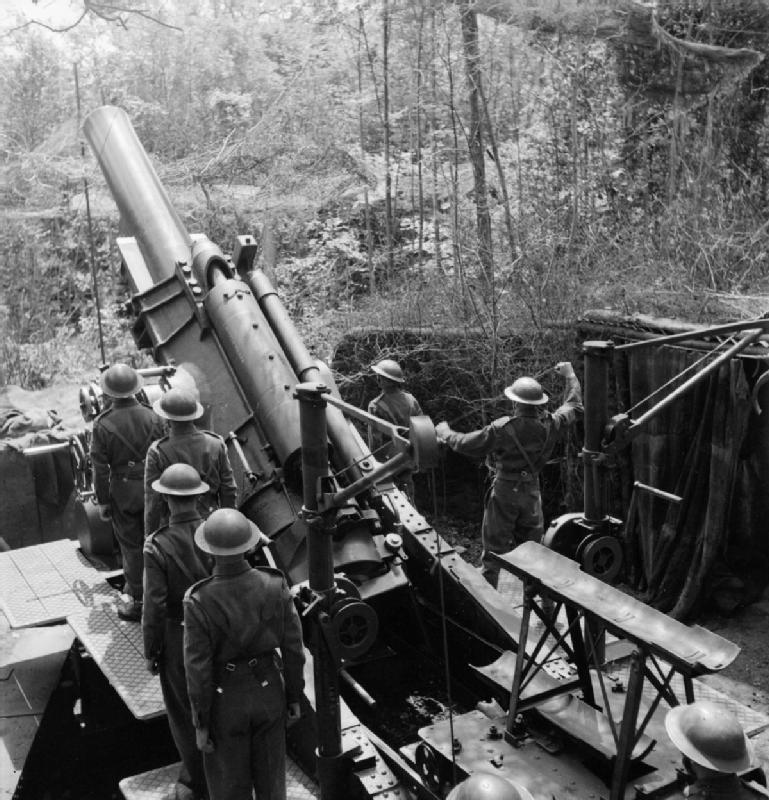
Today was a shoot with the big gun – or more properly the big 12 inch howitzer – of 524 Siege Battery RGA. Thirty 12 inch rounds in the record time of 1 hr 22 mins.
Log Book
Date: 18.8.18
Time: 6.20
Rounds Lewis: -
Rounds Vickers: -
Bombs: 2
Time on RE8s: 132 hrs 35 mins
RE8: E27
Observer: Lt Hodgson
Time:  2 hrs
Height: 4000
Course/Remarks: Shoot with 524 S.B.  12” How.  30 rounds in 1 hr 22 m.
Diary
Sunday Aug 18th. Down for dusk patrol. Did a shoot instead, with 514 S.B., 12” How. Got off 30 rounds in record time.
Squadron Record Book
Squadron Record Book. Click for larger image.
Type and Number: R.E.8.27
Pilot and Observer: P. Lt Gregory. O. Lt Hodgson
Duty: Art Obs on H.B. Destructive.
Hour of Start: 18.20
Hour of Return: 20.20
Remarks: S. with 524 S.B. (1-12”) on H.B. at R.3.d.58.39. [East of Lestrem] (P).
Called 18.34. K 18.36. L 18.39. G 18.42.
29 ranging rounds:- 1OK, 3Y, 5Z, 9A, 4B, 7W.
O.K. on ranging pit and O.K. on No3 pit by a shot at Z8 causing an explosion.
Total No of rounds fired 29, av. Rate of fire 2.45.
CI sent 20.7.
18.23 2EKB north of ESTAIRES.
18.30 2-25lb bombs dropped at K.36.d.1.6. Two bursts obs.
19.23 ) KK )
19.42 ) KK ) Flashes at G.22.c.4.7 approx [West of Sailly]
19.44 ) KK )
19.48.Three flaming onion batteries firing at G.8.c. & G.14.a.
19.58 Green Very lights from K.18.d.2.9 and L.19.a.
Fires in CROIX DU BAC and STEENWERCK burning continuously.
Vis:good. Height 4000’. Obs by P & O.
12 Inch Howitzer
Greg does not record whether the 12″howitzer used by 524 SB was railway mounted or static, but both of these monsters are shown in action in this footage from the Imperial War Museum’s collection:
Updated with Squadron Record Book info and corrected to say that 524 SB was operating a single 12″ Howitzer, as shown by the SRB – 28 September 2018 16:30
Two unusual sights reward Greg for his 3 am start for a dawn patrol: a flashing lighthouse (yes, really) and the rather more dangerous ‘flaming onions’.
Sunday July 14th.  Dawn patrol 3pm – 6pm [sic; am intended].

Took off in dark with 4 Coopers and two parachute flares.

Found a hun lighthouse flashing O. South of Bac St. Maur.

Dropped the four bombs and pushed the two flares down the launching tube.

The first flare dropped straight through the tube & did not light; the second flare exploded with a flash like lightning & then hung in the air & fizzled away like a Roman candle.  Rather a washout; did not light up the ground at all.

Saw a barge on the river and also about half a dozen transport on the road.
So the parachute flares were something of a failure. There’s more on the lighthouse in the Squadron Record Book, which also reports the flaming onions which, curiously, Greg didn’t mention in his diary.
Squadron Record Book
Type and Number: R.E.8.27

Pilot and Observer: P. Lt Gregory. O. Lt Pring

Duty: Dawn Reconn.

Hour of Start: 3.0

Hour of Return: 6.0

Remarks:
3.20 4-25lb bombs dropped on crossroads at L.26.central.  All bursts observed.
3.25 2 Parachute Flares dropped behind MERVILLE.  Only one lighted, and 100 rounds L.G. fired into houses in K.35.b. [see map for this and other references] from 2000’.
3.30 fire in buildings at K.36.a.4.4.
3.20 to 4.0 large single orange light, probably lighthouse, on hill S. of BAC ST MAUR flashing letter O. at intervals of about 5 seconds.  Seen from ESTAIRES. [see below]
4.0 train in Station N. of LAVENTIE.
4.0 barge stationary on river at G.21.d.7.4.
4.5 sent F.D. to C.W.S.  [Sent the weather message 'Fit for Photography' to Central Wireless Station]
4.20 seven lorries parked on road at L.30.a.8.8.
4.25 sent K.K. [Flashes seen]  2 flashes seen along road in M.2.a.
4.40 called C.W.S.  No answer.
4.50 one more flash in M.2.a.  Sent K.K.
4.55 1 E.K.B. [enemy kite balloon] N. of ESTAIRES.
5.10 C.W.S. sent X.
5.25 1 E.K.B. S. of ESTAIRES.
5.45 C.W.S. sent X.  A.A. normal.
5.40 300 rounds L.G. and 100 V.G. fired into trenches N. & S. of CALONNE from 1700’.
3.35 flaming onions seen about L.3. [See below]

Vis. good.  Obs. By P. & O.
Merville and district map extract showing locations in record entry. Click for larger image. Credit: IWM/TNA/GreatWarDigital
Lighthouse on Hill South of Bac St Maur
Can this really be plausible? A lighthouse at Bac St Maur on the River Lys? Well, yes, quite plausible. But it wouldn’t have been anything to do with river traffic: it would have been an aerial lighthouse. Both sides in the First World War used them to guide aircraft returning from missions. According to the informative ‘Aerial Lighthouses‘ page on Mr Mycetes‘ website, something of a network of them grew up after the war as commercial air traffic became more common. But they were largely dismantled at the beginning of the Second World War. Afterwards they were never rebuilt, as radio and radar had taken their place.
Actually, the more difficult thing to understand is the reference to the lighthouse being on a hill south of Bac St Maur. It’s pretty flat land round there. The River Lys at Bac St Maur is 14 m above sea level, and going south from there the nearest high ground is near Aubers, where the 40 m contour line runs. Aubers is about 5 miles (8km) to the south. Greg saw the lighthouse from Estaires, almost 4 miles (6½ km) WSW of Bac St Maur. So it seems is reasonable to think in terms of distances on this scale for the location of the lighthouse. Near Aubers has to be a good candidate for where it was.
What it actually was, was a 37 mm revolving-barrel anti-aircraft gun used by the Germans. From a technical standpoint, it was a Gatling type, smooth bore, short barreled automatic revolver. Nicknamed a ‘lichtspucker’ (light spitter), it was designed to shot flares at low velocity in rapid sequence across a battle area. The gun had five barrels and had capabilities of launching 37 mm artillery shells five thousand feet. To help maximize chances of connecting with a target, all five rounds were discharged as rapidly as possible, thus producing the “flaming onion” visual and effect. Anti-aircraft artillery of the time fired very slowly. Because the flaming onion fired rapidly, many pilots thought the rounds were attached to a string and feared being shredded by it in the process. Not designed for anti-aircraft use, the weapon did not have purpose-designed ammunition, however, the flares would have been dangerous to fabric-covered aircraft.