Tuesday 23 July 1918 – Dud Day – Wrote Home

Albert Gertrey in Airco DH.6.

Log Book

Log BookLog Book

Date: 23.7.17 
Time: - 
Rounds: - 
Bombs: - 
RE8: - 
Observer: - 
Time: - 
Height: - 
Course/Remarks: Weather dud, raining.

Diary

Tuesday July 23rd.  Wrote home, Dad & Albert.  Dud day.

Possibly ‘Albert’ was Albert Gertrey, whom Greg knew from training in Yatesbury:

Albert Gertrey in Airco DH.6.
Albert Gertrey in Airco DH.6

More on flying training at Yatesbury here:

Flying Training

More on ‘dud’ here:

Monday 10 June 1918 – Pretty Dud Day

Sunday 7 July 1918 – Elevator Rocking Bar Shot

On a murky and misty day – “frightfully dud” was the verdict – Greg was down for a Counter Battery Patrol/Artillery Patrol in the morning but signalled that the weather was unfit.  He dropped one bomb, had an elevator rocking bar shot, made a bad landing and bust the prop.  Then he took another machine up, but the weather was still bad.

Log Book

Log BookLog Book

Date: 7.7.18 
Hour: 8.15 
Machine type: RE8 
No.: E27 
Passenger: Lt Pring 
Time: 30 mins 
Height: 1500 
Course/Remarks: CBP. V Dud.  Elevator rocking bar shot.
Date: 7.7.18 
Hour: 9.45 
Machine type: RE8 
No.: 2327 
Passenger: Lt Pring 
Time: 1 hr 10 m 
Height: 1500 
Course/Remarks: CBP. Very misty & cloudy.

Diary

Diary

Sunday July 7th 1918. Wrote AD [?]. Sent field card home.

8.15-8.45 Took off with four bombs.  Could only get one of them off.  Frightfully dud morning, low clouds and heavy mist.  Got the right hand elevator rocking bar shot.  Overshot on landing & ran into some boxes & broke propeller.  1 bomb.

9.15-11.0 Took up Hutchinson’s bus with a shoot.  Too dud. Good landing.

Squadron Records

The day’s flying is fleshed out a bit in the official report:

Squadron Record Book

Type and Number: R.E.8.27

Pilot and Observer: P. Lt Gregory. O. Lt Pring

Duty: Artillery Patrol

Hour of Start: 8.15am

Hour of Return: 8.45am

Remarks: 
8.30am 1-25lb bomb dropped at K.34.b.5.5. [Rue de Bournoville, Merville] Burst unobserved. 

8.35am sent U.L. U.R. U.D. C.8.  [Unfit for counter-battery work; unfit for artillery registration; unfit for photography; clouds at 800 ft] Very heavy ground mists and fog.  Machine hit on elevator rocking bar.  No E.A. A.A. or E.K.B.  [No enemy aircraft, anti-aircraft fire or enemy kite balloons]

Vis. very poor.  Obs. By P. & O.

Because there were no enemy aircraft and no anti-aircraft fire, it looks as if the rocking bar must have been hit with small arms fire from the ground.  Something of a lucky hit for the shooter at 1500 ft through cloud.

Type and Number: R.E.8.2327

Pilot and Observer: P. Lt Gregory. O. Lt Pring

Duty: Artillery Patrol

Hour of Start: 9.55am

Hour of Return: 10.55am

Remarks: 
10.0am small explosion at E.30.d.4.4. [La Couronne, between Vieux Berquin and Neuf Berquin] 

10.5am sent U.L. U.R. U.D. C.15.  [Unfit for counter-battery work; unfit for artillery registration; unfit for photography; clouds at 1500 ft] Clouds in places below 1200'. Very thick mist prevented observation. No E.A. A.A. or E.K.B.  [No enemy aircraft, anti-aircraft fire or enemy kite balloons]

Vis. very poor.  Obs. By P. & O.

Wrote AD [?]. Sent field card home.

So there was time left for correspondence.  Not sure who “AD” is – or even if it is AD.  If it were AG (which is just possible), it could be either Alice Gregory (Greg’s sister) or Albert Gertrey (Greg’s fellow student from flying training in Yatesbury).
Sunday 5 May 1918 – Penultimate Flying Day at Yatesbury

Greg’s last-but-one day at Yatesbury, and the last on which he would fly DH.6s saw a couple of outings around the aerodrome, for aerial fighting and general practice:

Log book entry
Log book entry
Date: 5.5.18 
Hour: 8.0 
Machine type and No.: DH 5155 
Passenger: – 
Time: 55 m 
Height: 2000 
Course: Aerodrome 
Remarks: Aerial fighting
Date: 5.5.18 
Hour: 3.5 
Machine type and No.: DH 5463 
Passenger: – 
Time: 50 m 
Height: 2000 
Course: [Aerodrome] 
Remarks: Practice

Perhaps Greg would miss friends he’d made at Yatesbury.  A later entry in his diary suggests that he was in touch for a while with Albert Gertrey, at least.  And maybe Holmes and Jones were particular friends, too:

Friday 15 March 1918 – First Flights in a DH.6

Flight's log book entry

Two flights for Greg today, both in a DH.6, which was his principal basic training aircraft:

Log book header

Flight's log book entry
Flight’s log book entry
Date: 15.3.18 
Hour: 10.30 
Instructor: [Thomas]
Machine Type and No: DH7666
Passenger: CE Gregory 
Time: 50 min 
Height: 1200 
Course: [Aerodrome] 
Remarks: Dual

Log book header

Flight's log book entryFlight’s log book entry

Date: 15.3.18 
Hour: 5.10 
Instructor: [Thomas]
Machine Type and No: DH7666 
Passenger: CE Gregory 
Time: 25 min 
Height: 1200 
Course: [Aerodrome] 
Remarks: Dual

So today was the first day of instruction proper, as opposed to air experience.

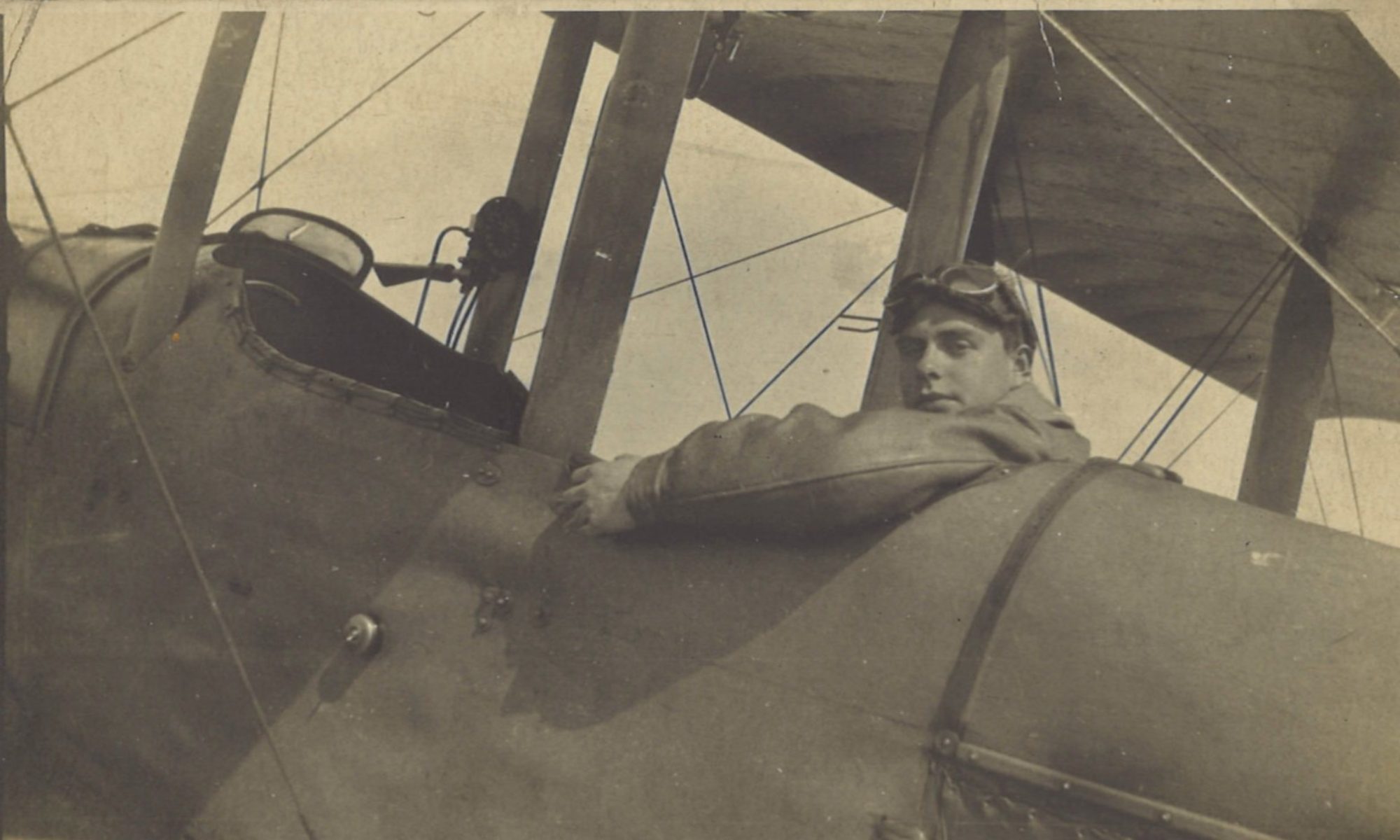
Quite possibly it was today that the photograph that’s used for the main image for this blog was taken:

Greg in DH.6
Greg in student’s seat in Airco DH.8 at Yatesbury.  Image: Greg’s War Collection

This seems to a posed shot taken of student pilots generally. Greg’s co-student Albert Gertrey is seen here in the same pose, and probably the same aircraft.

Albert Gertrey in Airco DH.6.
2nd Lt. Albert Gertrey in Airco DH.6. Image: Greg’s War Collection

The DH.6 was designed by Geoffrey de Havilland, who had moved to The Aircraft Manufacturing Company Limited (‘Airco’).  Airco’s successor in business today is BAE Systems, who have this to say about it:

The DH6 was first flown in late 1916 and was an angular tractor biplane with a resolutely rectangular wing plan-form allowing the individual wing panels to be interchangeable. As a result, the 1919 edition of Jane’s All the World’s Aircraft conferred the following description: ‘it has rather the appearance of having been built by the mile and cut off to order’. Performance was limited by the low power and the high drag of the rather crude engine installation.
Most aircraft used the Royal Aircraft Factory 1A engine but supply shortages led to the 90hp Curtiss OX-5 and 80hp Renault engine being used is some production batches.
The two prototypes A5175 and A5176 were fitted with fins and rudders of the archetypal de Havilland shape, whereas production machines featured a more angular rudder, without an aerodynamic balance.
The type also featured a heavily cambered wing leading edge to ensure benign stalling characteristics. This (and possibly the low performance) led to the type acquiring the soubriquet ‘Clutching Hand’ although many also considered this appropriate due to its forgiving nature when flown by inexperienced pilots. Other nicknames included ‘skyhook’ and ‘flying coffin’ (the latter not on account of its safety record, but rather because of the shape of the cockpit opening).  In fact some maverick instructors actually claimed it to be useless as a trainer because it was too easy to fly.
At least 2,282 DH6 were built, including those sub-contracted to the following companies: The Gloucestershire Aircraft Co. Ltd; The Grahame-White Aviation Co. Ltd; Harland & Wolff; Kingsbury Aviation Co. Ltd; Morgan & Co. Ltd; Ransomes, Sims & Jeffries Ltd; and Savages Ltd.
In 1917, the training role within the RFC was revamped with the aim of making flight instructors into specially trained pilots.   After initial use of the DH6, it was replaced with the much larger Avro 504K and surplus aircraft were transferred to the Royal Naval Air Service as anti-submarine patrol aircraft.  It was in this role that the DH6 found another surprising accolade as it was found that in the unfortunate occurance of an enforced ‘ditching’, the aircraft remained afloat for up to 10 hours.
However, it was severly underpowered which resulted in the majority of convoy escorts being flown solo, a complicated arrangement considering most air to ship communication was via an Aldis lamp.   By the end of the conflict over 1,000 aircraft were still in service albeit in second-line roles.

https://www.baesystems.com/en/heritage/airco-dh6—–

The RAF 1a engine was an 8.8 litre V8, developing 108 hp/80 kW.

© Copyright 2018- Andrew Sheard and licensors. All rights reserved.

Website powered by green energy