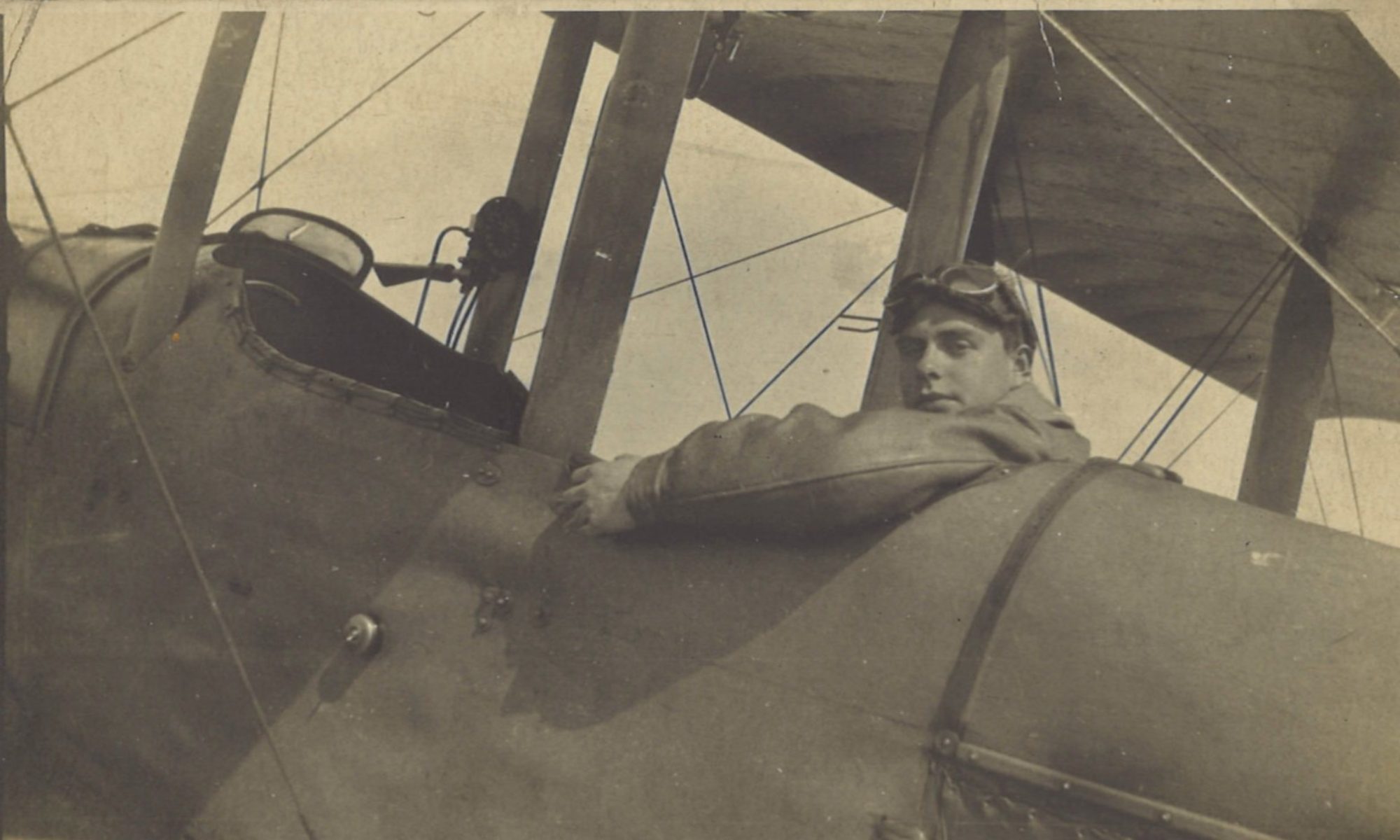
Saturday 2 November 1918 – Near Disaster Behind Enemy Lines

In a day that came close to ending in disaster, Greg and Capt. Gordon were down to do a shoot – the last time in the war that Greg was down to do one.  But it was unsuccessful, presumably because of poor weather.  In a subsequent adventure behind enemy lines, a rifle shot from a German soldier at an occupied chateau nearly did for both of them.  Unsurprisingly, they found that strafing an occupied chateau is dangerous.

Log Book

Log BookLog Book

Date: 2.11.18 
Time Out: 13.00 
Rounds Fired – Lewis: 400 
Rounds Fired – Vickers: 100 
Bombs: 4 
Time on RE8s:  187 hrs 5 mins 
RE8: 2517 
Observer: Cpt. Gordon 
War Flying: 1 hrs 55 mins 
Height: 3500 
Course/Remarks:  Shoot 6” How (99). Unsucc.  Pet. tank shot.

Unsuccessful Shoot

We have no further details of the shoot, other than it was with 99 Siege Battery RGA, who were firing 6-inch howitzers, and that it was unsuccessful. (Greg had shot with 99 Siege Battery previously, on 22 August 1918 and 24 August 1918.) The intended target must have been something east of the River Scheldt/Escaut, as that was where the British front line was only yesterday.  Given what we know from the rest of the day’s event, it seems likely that it was the weather that washed out the shoot.

Petrol Tank Shot

The laconic, three last words of the log book entry cover are a very sparse indication of what Greg and Capt. Gordon got up to next.  It became something of a Gregory family story.  It’s worth bearing in mind that Capt. Gordon was not only Greg’s observer this day, but was also his senior officer.

Rob Parsons, Greg’s son-in-law and my stepfather, recalls Greg recounting the events of that murky afternoon like this:

Gordon had decided that flying conditions were still good enough to go and annoy the Hun, even if it was only a spot of defenestration.  So off they went, with a very reluctant pilot, in search of a little sport.  Just as Greg was hoping he could say the fuel state meant they must turn for home, out of the murk appeared the perfect target in the form of a German-occupied Chateau.  So he obediently descended to the level of the upper floor, through the windows of which Gordon emptied the drum of his Lewis gun.  Meanwhile, as Greg climbed away and turned for home, Gordon had changed the drum and ordered him to go back because he “hadn’t done downstairs!”

It was during this second pass that, not surprisingly, the Huns started to shoot back.  As he began to climb away, Greg recalled seeing a German on one knee, in classic toy soldier pose with rifle, shooting at him from the corner of the Chateau.  That’s when a shot punctured the fuel tank and he began to be drenched with fuel.  Fortunately, the aircraft didn’t catch fire.  Anyway, he instinctively opened the throttle as far as it would go and began to climb as hard as he could.  There the throttle stayed until he ran out of fuel.

Until then of course, he was being sprayed with fuel and he said he was close to getting frostbite.  The fact that he returned safely is proof that he gained enough height to cross the enemy lines without being potted at by otherwise unoccupied Huns in the trenches.  They made it back, and the aircraft was back in service the next day.

So, eight days before the war was over, it nearly ended very badly.

Sidelights

The log book and family recollection are all we have to go on for these events (oh that the Squadron Record Book were available!) Nonetheless, there are a few interesting sidelights that illuminate what went on.

Rounds Fired

First, note the number of rounds fired, as recorded in the log book.  100 rounds were fired from the Vickers gun, which was pilot-operated and forward facing.  And Capt. Gordon fired 400 rounds from the Scarff ring-mounted Lewis gun in the rear compartment.  Greg never recorded more rounds fired in from the Lewis gun a single patrol. This was certainly consistent with a major shoot up, at least in small arms terms.

The Petrol Tank

Secondly, consider the position of the petrol tank. The tank was an elliptical-sectioned cylinder running fore-and-aft, and mounted immediately behind the dashboard.  In this photo of the front cockpit of replica RE8 A3930 at the RAF Museum, London, the pale grey bottom of the tank is just visible below the bottom lip of the dashboard.  And the fuel filler cap is further forward on the top.

Front cockpit of replica RE8 A3930 at the RAF Museum, London.
Front cockpit of replica RE8 A3930 at the RAF Museum, London. The bottom of the grey fuel tank is visible below the dashboard. Fuel filler cap on top. Click for larger image.

The position of the tank can also be seen in the top left drawing from The Vintage Aviator Limited’s RE8 Gallery collection here.

So the tank was essentially above the pilot’s legs.  It was therefore no surprise that petrol from the punctured tank drenched Greg with fuel.  He was extraordinarily lucky that a fire didn’t break out.  He was also lucky that the bullet didn’t hit him.

An Extraordinarily Safe Job?

Thirdly, it may not be accidental that Capt. Gordon did not apparently write to his mother about the events of today.  One wonders whether he recalled that only yesterday he had written to her:

This is an extraordinary safe job & no one gets hurt at it.   So don’t you worry, dear old bird.

Given that he had himself been hit in the (wooden) leg on an earlier flight, and only one week ago today Greg’s propeller had been split by shrapnel, it is clear that a good deal of luck was involved in ‘not getting hurt’ – or worse.  Today’s events underlined that.  But no doubt Capt. Gordon was writing more to reassure his mother than to be candid.

A Mere Bagatelle

Where was the chateau that they shot up?  The log book doesn’t record it; Greg was no longer writing his diary; and of course we don’t have the SRB entry for the day.  However, with a bit of deduction and a liberal amount of conjecture, it may have been the deliciously named Château Bagatelle at Wattripont on the road running northeast from Tournai towards Renaix (Ronse).

The evidence is this.  Wattripont is a plausible distance from Ascq – 19 miles (30.5 km).  It’s about the same distance beyond the British front line as the line was from Ascq.  And it’s in a plausible location, in fact almost familiar territory.  Greg’s recent reconnaissance and counter-battery patrols had been reporting on locations north and northeast of Tournai.  Only two days ago on 31 October 1918, he had reported fires and explosions in DB zone.  Wattripont is in EB zone, 6,000 yards to the east, as can be seen on this map:

Map of Wattripont, and its location in relation to Ascq.
Wattripont, and its location in relation to Ascq, showing the relationship between zones DB and EB. Adapted from a map accompanying General Haig’s despatches on the final British offensive. Click for larger image. Map credit: IWM/TNA/Great War Digital.

And Wattripont has a good candidate chateau with two floors: the now comfortable looking Château Bagatelle:

Château Bagatelle
Château Bagatelle, now a comfortable looking hotel and spa. Click to visit their website and see more present day photographs. Photo credit: Château Bagatelle.

So just maybe this was the chateau in question.

Another Near Disaster

Today’s near disaster was just days before the armistice.  It bookends another near disaster five months ago, when Greg crashed on his first day on the Western Front on 4 June 1918.  Though that time he couldn’t blame the enemy.

Tuesday 4 June 1918 – Near Disaster on the First Day on the Front

Friday 1 November 1918 – Shoot with Capt. Gordon

In what would turn out to be Greg’s last successful shoot of the war, Capt. Cedric Foskett Gordon was Greg’s observer for the first time today.  Captain Gordon was one of the senior officers of B Flight, 42 Squadron and was evidently a remarkable character.

Log Book

Log Book

Date: 1.11.18 
Time Out: 13.15 
Rounds Fired – Lewis: - 
Rounds Fired – Vickers: - 
Bombs: - 
Time on RE8s:  185 hrs 10 mins 
RE8: 2407 
Observer: Cpt. Gordon 
War Flying: 2 hrs 15 mins 
Height: 7000 
Course/Remarks:  Shoot Portuguese. Successful.

“Shoot Portuguese” 

This is nothing to do with shooting Britain’s Portuguese allies, of course.  Rather, it is everything to do with observing a shoot involving Portuguese artillery. 

For reasons explained in yesterday’s post, no Squadron Record Book entry is available for today:

Counter Battery Patrols and Zone Calls

Because of that, we don’t know much about the shoot.  The battery, though, was evidently one of the few remaining Portuguese artillery units.  The Portuguese Expeditionary Corps had suffered badly on the first day of the Battle of the Lys, on 9 April 1918.  As a result of this, by the end of the war Portugal had only nine artillery pieces left, according to the Passion and Compassion 1914-1918 website.  Two of them were heavy howitzers: a British 6″ siege piece, and a similarly sized Franco-Portuguese  15 cm T.R. Schneider-Canet-du-Bocage.  Given that Greg’s shoots tended to be with heavy (siege) artillery batteries, it was possibly that it was with these howitzers that he was observing and directing artillery fire today.

What might the target have been?  We don’t know.  Maybe it was one of the usual suspects: a hostile battery (Greg’s most frequent target), an ammunition dump, trenches, or a strategically important crossroads.  Or it might have been something unusual, thrown up by the unprecedented circumstances in these last, heady days of the war.  In any event, the target must have been east of the River Scheldt/Escaut, along which the British front line still ran in Greg’s sector. Some miles both to the north and and to the south of Tournai, though, further eastward progress had been made:

Map of the British Front on the morning of 1 November 1918.
The British Front on the morning of 1 November 1918. Adapted from a map accompanying General Haig’s despatches on the final British offensive. Click for larger image. Map credit: IWM/TNA/Great War Digital.

Captain Cedric Foskett Gordon MC, CdG

Greg’s observer today was Captain Gordon.  Capt. Gordon was one of the two commanding officers of B Flight of 42 Squadron. He was evidently quite a character.

The following brief distillate of Capt. Gordon’s life comes, with permission, from Matt Ball’s informative Sevenoaks WW1 blog (see main link below or here):

Early Life and Wartime

Cedric Gordon was educated at Lancing College, were he excelled in sports. In 1910, he was commissioned into the North Staffordshire Regiment. He was sent to France on the outbreak of war and was wounded twice. In 1915 he was awarded the Military Cross for leading an attack on a village.  

His second injury was the most serious and resulted in his losing a leg. You might be forgiven for thinking that this would be the end of his war service but Cedric joined the Royal Flying Corps and continued his wartime service as an observer and air gunner on the Western Front. He was subsequently awarded the Croix de Guerre in 1917, was mentioned in dispatches four times and awarded the military class of the OBE in 1919.

According to a nephew,  quoted in his obituary, Cedric was shot at during one flight with the bullet shattering his wooden leg. On landing, he was said to have found the stray bullet in his pocket and was confined to bed until the camp carpenter had made him a new leg.

Post War

After the war, and having gained his pilot’s licence despite his wooden leg, Cedric was sent to Russia with British forces to aid the White Russians in the Crimea in their fight against the Bolsheviks. He was awarded the Distinguished Flying Cross and received the Order of St Ann and the Order of St Stanislas from the Russians. After leaving Russia, he flew in Palestine, where during one flight for reconnaissance work, he was forced to land in the desert and was, according to his obituary ‘picked up by a band of friendly Arabs’.

Cedric later worked for British intelligence in mainland China, before returning to England and taking command of the RAF Bloom Centre. During the Second World War, he was eventually put in charge of the South East Air Training Corps and was also a member of the Home Guard.

Retirement

On his retirement, he returned to Lancing College, where his brother Edward was a Master, to become Bursar. Later in life he became well known in Sevenoaks for his involvement in the local scouting movement.

The above comes from this post:

No doubt it was Capt. Gordon’s unusual circumstances that meant he was one of two officers in B Flight to hold the rank of Captain.  The other was Capt. Bill Ledlie (of whom more here). 

First Day Back

As it turns out, 1 November 1918 was Capt. Gordon’s first day back at the squadron at Ascq. For part of October he had been on leave in the UK. When he returned, he found that his dog (who rejoiced in the name of Waso) was missing.  His own account of the day and the latter part of his journey back is preserved in a letter to his mother.  This letter is one of a number kindly made available by Cedric Gordon’s nephew, Keith Gordon.  As Matt Ball notes in another post on the Sevenoaks WW1 blog (see below, but also linked here):

What emerges from these letters is a strong sense of a close, spirited family, each with at least one nickname (Cedric’s was ‘beast’ owing to his general strength), and a spirit of adventure embodied by Cedric himself. No doubt some of his insouciance is designed to reassure his worried mother, to whom all of these letters are addressed… 

With that as background, here is the text of Cedric Gordon’s letter of 1 November 1918:

All Saints Day (1 November) letter to darlingest Mother from 42 Squadron, RAF, BEF  

I have arrived at last.  

To go on where I left off.  O’Keefe & I went & lunched at an estaminet where we had an excellent fish, some veal & a bottle of red wine, all of which made me far more contented with the world at large.   This done, we returned to our vigil at the Town Mayor’s office & at about 3pm our Tender finally arrived.   After a long & uneventful journey we arrived at the Squadron about 7pm.  

Waso was reported missing, believed to have been stolen by a general belonging to the Corps.   This was rather depressing, but the major who commanded 42 Sqn promised to take me round to the Corps with a view to returning my hound.   I had dinner with HQ Mess & then went round to my Flight Mess (B Flight) & found them full of good cheer & beer.   We had quite an amusing evening.   I have got a very nice billet.   There are quite a number (at present unknown) of French people living here.   They have provided me with a very nice room upstairs & a large bed, sheets etc & a very small basin!   The natives speak very bad French & I can’t make a great deal of headway with them, however they are very friendly.  

This morning…

…I rose about 7.30am & sorted out my hut, such of it as hasn’t been lost during my absence.   I spent the morning playing about with a Lewis gun & this afternoon I went up for a short time.   This is an extraordinary safe job & no one gets hurt at it.   So don’t you worry, dear old bird.  

This evening…

…I went down with Hunter (the OC) to the Corps to interview this General man who had acquired Waso.   I looked through the glass door & saw old Waz inside, so softly I opened the door & Waso came bounding out.   She was awfully pleased to see me, almost as pleased as I was to see her.   After a bit I got hold of the General who was a very nice fellow.   He said he found her many miles away & had adopted her.   I expect someone had picked her up in a lorry or some vehicle & dropped her off after a bit.  

He was very loath to part with her & said he was very fond of her, which is not surprising.   However, he gave her up & I promised him a puppy when the next instalment arrives, & we parted friends.   Normally people go to bed here about 8.30pm, which is rather dull.   They are, on the whole, a very comic crowd, but there are several very nice fellows.  

I have missed you…

…most awfully.   It is rotten leaving you, however before very long now the war will be over & Waso & I will return to the family.   No more news at present.   Very fondest love darlingest.   Best love to Karf who, together with my old Mother, made my leave absolutely splendid.   I hope Am is well.   God bless you darlingest.

Photos

Greg had a few photos of Capt. Gordon in his collection.  The two of them must have been in touch after the war, as that is evidently when at least a couple of the photos were taken. I’m grateful to Keith Gordon for his help with identifying the locations of the last two.

Captain Cedric Foskett Gordon
Captain Cedric Foskett Gordon. Credit: Greg’s War Collection. Click for larger image.
Captain Cedric Foskett Gordon
Captain Cedric Foskett Gordon. Credit: Greg’s War Collection. Click for larger image.
Captain Cedric Foskett Gordon
Captain Cedric Foskett Gordon. This was a post-war photograph from the time he was a member of the Mission to South Russia (1919 – 1920). Credit: Greg’s War Collection. Click for larger image.
Captain Cedric Foskett Gordon
Captain Cedric Foskett Gordon. This was a post-war photograph, taken during his return to UK from South Russia. Credit: Greg’s War Collection. Click for larger image.

A Telling Tale

To get a further flavour of Cedric Gordon’s character, here is a link to Matt Ball’s second post on Cedric Gordon, which contains the text of several more letters.  The last of the letters, dated 24 September, is worth reading in particular. It is about a scouting excursion on the ground beyond the lines.


© Copyright 2018- Andrew Sheard and licensors. All rights reserved.

Website powered by green energy