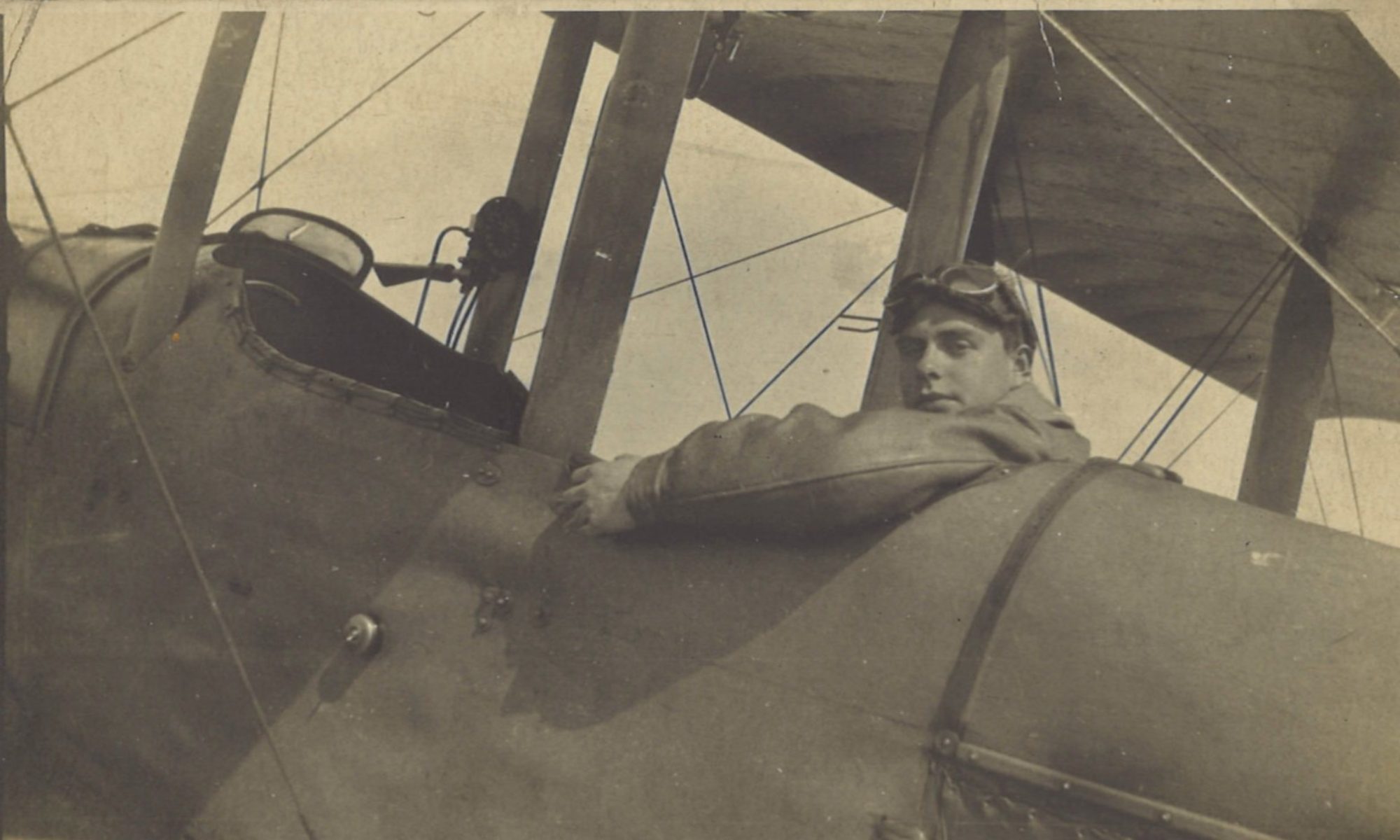
Wednesday 10 July 1918 – Shadows over Target

An aviator’s life on the Western Front in 1918 was bedevilled by two factors – in addition to the small matter of the enemy, that is.  They were mechanical unreliability (of armaments, engines and other equipment) and the weather.  Today, Greg’s engine was better than it was yesterday, but it was another day for the weather to assert itself, as a Counter Battery Patrol evolved into a Shoot.  Even fair weather can cause problems, in the form of shadows over the target, and that was before the rainstorm approached.

Log Book

Log BookLog Book

Date: 10.7.18 
Hour: 3.40 
Machine type: RE8 
No.: E27 
Passenger: Lt Pring 
Time: 1 hr 45 
Height: 5000 
Course/Remarks: CBP & shoot with 14 SB. Successful.  Rainstorm.  Eng better.

Diary

Diary

Wednesday July 10th. CBP at 5.30pm (1hr 45 m). 5000 ft.

Took up a shoot with 14 Siege Battery (6” Hows).

Shoot successful.  Large number of W’s owing to clouds throwing shadows over target.

Archie pretty hot, unable to go over target.

Engine running better.

Two bombs dropped.

Target at L.20.a

So weather-related problems are not confined to bad weather as such:  shadows from clouds over the target meant that a large number of the battery’s rounds were unobserved – hence the ‘W’, for washout.  And then came a rainstorm…

Squadron Record Book

Type and Number: R.E.8.27

Pilot and Observer: P. Lt Gregory. O. Lt Pring

Duty: Art Obs 14 S.B. (6” How) on L.C.21. [northeast of Merville; see below]

Hour of Start: 5.40pm

Hour of Return: 7.25pm

Remarks:

SUCCESSFUL. Called up 5.48pm.  K. 5.50.  L. 5.55.  G. 5.58.  V. 6.45.  Time G. to V. 45 mins.

OBSERVED:- M.C.3.  M.C.5.  1 O.K.  1 Y.  8 A.  11 B.  4 C.  1 D.  11 W.  37 ranging rounds.  M.O.K. sent during B.F.  One direct hit on ranging pit which was badly damaged.  No 1 Pit believed damaged but owing to A.A. could not properly inspect target.  Shoot by P.  Height 5000’.

MISC INF. 5.56pm 2-25lb bombs dropped at K.28.c.5.3.  Both bursts observed.  7.5pm sent C.I. [going home] owing to approaching storm. A.A. active.  Vis. good but shadowy.
Obs. By P. & O.

Successful Shoot, Despite Shadows over Target

This was Greg’s second shoot with 14 Siege Battery. This link is to the post that recounts the first, which was just over a week ago on 2 July:

Tuesday 2 July 1918 – Shoot with 14SB

The ‘G to V’ time – the time taken to range the howitzers – was 45 minutes, down from 1 hr 20 mins last time, which will have pleased Greg, the Squadron Commander and the Battery Commander.  Eleven ‘washouts’ – unobserved shells – wasn’t so good, but explained by the shadows from the clouds.

Target LC 21 was in the 500 yard square L.20.a, northeast of Merville, but Greg dropped his two bombs on the other side of town.  He dropped them on the Rue d’Aire going west out towards Haverskerque.  The time was 5.56pm, just as he was about to begin ranging the guns (‘G’ – the ‘fire’ signal – was at 5:58pm).  The battery itself was probably located a mile or two further west, near Haverskerque.

1:20,000 map of Merville dated 22 May 1918
1:20,000 map of Merville dated 22 May 1918. Numbered squares are 1,000 yards across. Red markings are German trenches, tramways and other works.

One hundred years after Greg bombed the Rue d’Aire, I drove along it.  I can report that the road has been repaired.

For more details on how a shoot operated, see this page:

Observation of Artillery Fire – A Shoot

To see how zone numbers such as LC 21 were allocated to targets, see “Assigning a Zone Number to the Target” on this page:

Counter Battery Patrols and Zone Calls


Monday 8 July 1918 – Jolly Good Shoot

Although Greg’s ‘bus’ – RE8 E27 – had had its propeller fixed, all was still not well, as the engine was backfiring. But what seems to have been the decisive factor in making the morning’s scheduled Counter Battery Patrol a washout was the weather.  The day improved with a ‘jolly good shoot’ with 174 Siege Battery (6″ Howitzers) in the evening.

Log Book

Log BookLog Book

Date: 8.7.18 
Hour: 8. 
Machine type: RE8 
No.: E27 
Passenger: Lt Pring 
Time: 30 mins 
Height: 2000 
Course/Remarks: CBP. Heavy fog.  Came down. Eng. Pretty dud.
Date: 8.7.18 
Hour: 6.30 
Machine type: RE8 
No.: E27 
Passenger: Lt Pring 
Time: 2 hr 10 mins 
Height: 5000 
Course/Remarks: Shoot with 174.  Successful. Eng. missing

Diary

Diary

Monday July 8th 1918. CBP 8-11.

Very cloudy & misty, took off without bombs & went to look at the line & came back after 30 minutes.

Engine missing, seemed inclined to backfire.

6.30pm.  Went up and did a shoot on a Hun battery at K.35.d.1.2

Jolly good shoot.  Both pits badly knocked about, one direct hit on one, which went up in the air.

One shell dropped in the river, great big column of water about 500 ft.

The Hun battery that was the target of the ‘jolly good shoot’ with 174 Siege Battery RGA  was on the southern edge of Merville, just above what is now Merville-Calonne Airport.  Its position is shown on the following map, along with the positions of the house and factory referred to in the Squadron Record Book report below.

Map of position of battery at K.35.d.1.2
Position of battery at K.35.d.1.2 etc on a 1:20,000 map dated 27 June 1918. Each square with a number in its centre (like 35) is 1,000 yards. Map credit: IWM/TNA/GreatWarDigital
 Modern 1:25,000 map of shoot
The equivalent extract from a modern 1:25,000 map. Credit: GreatWarDigital.

Squadron Record Book

Squadron Record Book

Type and Number: R.E.8.27

Pilot and Observer: P. Lt Gregory. O. Lt Pring

Duty: Art Obs 174 S.B. (6” How) on H.B. at K.35.d.10.20

Hour of Start: 6.40pm

Hour of Return: 8.30pm

Remarks: SUCCESSFUL. Called up 6.50pm.  K. 6.52pm.  L 6.54.  G. 6.58.  V 8.0. Time G. to V. 1 hr 2 mins. [time taken to range guns]

OBSERVED:- M.A.9.  M.A.2. 1 O.K. 12.A. 13 B. 12 C. 1 D. 39 ranging rounds.  2 M.O.K. during B.F.  [Two mean points of impact of salvos were direct hits during battery fire] Both pits badly damaged.  Fire caused in house at K.35.b.5.2. Shoot by P.  Height 5000’.

MISC INF.  6.50pm large fire in Factory at K.35.b.4.4. burning continuously.  200 rounds fired into MERVILLE STATION.  Vis. fair.  Obs. By P. & O.

More details about shoots and how to interpret Squadron Record Book reports of them:

Observation of Artillery Fire – A Shoot


Tuesday 2 July 1918 – Shoot with 14SB

Hot on the heels of his first shoot yesterday, Greg is on another one today, this time with 14 Siege Battery RGA (6″ howitzers).  It was recorded as successful, but he had to cut short the observation because of engine trouble.  And later in the day an “artillery chap” was taken up for a test flight – presumably after the engine had been looked at.

Log Book

Log BookLog Book

Log BookLog Book

Date: 2.7.18 
Hour: - 
Machine type: RE8 
No.: E27 
Observer: Lt Pring 
Time: 2 hrs 10 
Height: 6000 
Course/Remarks: Shoot with 14SB [14 Siege Battery].  Successful.
Date: 2.7.18 
Hour: - 
Machine type: RE8 
No.: E27 
Passenger: Art. Chap 
Time: 30 mins 
Height: 3500
Course/Remarks: Test flight

Diary

Diary

Tuesday 2nd July 1918. Shoot with 14 SB. 6” hows. 48 Ranging rounds.  Sent CI engine, after one MOK.  Saw an MT in hunland.

CI was the signal for “Am returning to landing ground”.  MOK meant that the mean point of impact of a salvo fired by the artillery battery was a direct hit.  An MT was a motor transport.

Squadron Record Book

Squadron Record BookSquadron Record Book.

Type and Number: R.E.8.27

Pilot and Observer: P. Lt Gregory. O. Lt Pring.

Duty: Art Obs 14 S.B. (6" How) on H.B. [Hostile battery] at L.19.b.26.37.

Hour of Start: 12.10pm

Hour of Return: 2.20pm

Remarks: 
SUCCESSFUL. Called up 12.30pm. K. 12.35pm. L. 12.37pm. G. 12.40pm. V. 2.0pm. G. to V. 1 hr 20 mins
OBSERVED:- M.C.2 M.B.3 2 Y. 1 Z. 6 A. 17 B. 10 C. 5 D. 1 E. 6 W. 48 ranging rounds. "V" out and 1 M.O.K. sent. 2 explosions at 1.15pm and 2.10pm.
Shoot by P. Height 6000'.
MISC INF. 1.10pm fire K.23.d.5.5 burning intermittently. 1.30pm 1 M.T. on NEUF BERQUIN-ESTAIRES Road going towards ESTAIRES. 1.30pm fire Q.18.a.5.7. 2.5pm 100 rounds fired into MERVILLE STATION. Vis. fair, cloudy after 2.0pm Obs. by P. & O.

Here’s where the action was, on the eastern side of Merville:

Shoot of 2 July 1918
Location of hostile battery and other points of note in shoot of 2 July 1918. Map credit: IWM/TNA/GreatWarDigital

So even while the shoot was going on, both Pilot and Observer were watching. They reported all they could see from their vantage point.  Always the ‘eye in the sky’.


Monday 1 July 1918 – Greg’s First Shoot

After Friday’s washout because the weather wasn’t fit, Greg had his first stint of observation of artillery fire – a shoot.

Log Book

Log BookLog Book

Date: 1.7.18 
Hour: - 
Machine type: RE8 
No.: E27 
Observer: Lt Watkins 
Time: 3 hrs 
Height: 6000 
Course/Remarks: Shoot on KD90.  Successful. 145 SB.

Diary

Monday 1 July 1918. Shoot with 145 SB. 8” hows. on KD.90.  Direct hit on No 3 pit.

Shoot on KD90

Greg’s shoot was with 145 Siege Battery, a Royal Garrison Artillery Battery of (probably four) 8″ howitzers.  Their target, which would probably have been located in an earlier Counter Battery Patrol (explained here), was in zone KD and was the the object of interest given the serial number 90.  

KD90 was a German battery, also probably of four pieces, each in its own emplacement or ‘pit’.  It was located just southeast of the railway station at Merville, off what is now the Rue Loridan.

KD90
KD90 was the zone number given to a hostile battery, just southeast of Merville.  This is an extract from a 1:20,000 scale map, dated 27 June 1918.  Credit IWM/TNA/GreatWarDigital
KD90 today
The equivalent extract from a modern 1:25,000 map. Credit: GreatWarDigital.

The site of KD90 today is unexceptional.  Just a few ramshackle farm buildings on a quiet country lane on the edge of a small town.  But where this photo was taken would not have been a good place to stand at 3:00pm on Monday 1 July 1918:

KD90 today
KD90, on Rue Loridan, just outside Merville, today

Squadron Record Book

In his diary, Greg records the shoot as successful.  This was also the verdict in the Squadron Record Book.  It’s the first entry on the (hard to read) page.  Transcript (and translation) below.

42 Squadron Record Book for 1 July 1918
Extract from 42 Squadron Record Book for 1 July 1918. Click for larger image.
Type and Number: R.E.8.27

Pilot and Observer: P. Lt Gregory. O. Lt Watkins.

Duty: Art Obs 145 S.B. (8" How) on K.D.90.

Hour of Start: 2.10pm

Hour of Return: 5.15pm

Remarks: 
SUCCESSFUL. Called up 2.20pm. K. 2.25pm. L. 2.37pm. G. 2.43pm. V. 4.0pm. G. to V. 1-17mins
OBSERVED:- 1 O.K. 1 Y. 2 Z. 8 A. 16 B. 6 C. 2 D. 7 W. 42 ranging rounds. "V" out and 3 M.O.K. sent.
Direct hit on No. 3 Pit. T. out 5.5pm.
Shoot by P. Height 6000'.
MISC INF. 2.50p O.K. on house at K.36.d.0.7.
4.25pm and 4.55pm called C.W.S. X. out. A.A. very active in back areas.  No movement seen North of CANAL. No trains.  Obs. fired 600 rounds into NEUF BERQUIN, MERVILLE STATION and EPINETTE. Pilot fired 100 rounds into MERVILLE STATION.  Vis. good at first, poor later. Obs. by P. & O.

Translation of Remarks:

Remarks: SUCCESSFUL. 
Called up [B: Are you receiving my signal?] 2.20pm. 
K. [Yes] 2.25pm. 
L. [Battery ready to fire] 2.37pm. 
G. [First 'Fire' command] 2.43pm. 
V. [Observe for fire for effect; ie Battery Commander is satisfied that guns are now ranged, and will now fire 'for real' - please observe] 4.0pm. 
G. to V. [Time taken to range battery] 1-17mins 

OBSERVED:- 1 O.K. [Direct hit]
1 Y. [Within 10 yards]
2 Z. [Within 25 yards]
8 A. [Within 50 yards]
16 B. [Within 100 yards]
6 C. [Within 200 yards]
2 D. [Within 300 yards]
7 W. [Washout - unobserved]
42 ranging rounds. 

"V" out and 3 M.O.K. [3 Mean-points-of-impact (of salvos) are direct hits] sent. 

Direct hit on No. 3 Pit. 

T. out [Battery telling aircraft to go home] 5.5pm. 

Shoot by P. [Pilot did the observing of the shoot; the Observer would have been fully occupied watching for enemy aircraft] Height 6000'. 

MISC INF. 2.50p O.K. [direct hit] on house at K.36.d.0.7. [Map reference of house just next to hostile battery at KD90] 

4.25pm and 4.55pm called C.W.S. [The Central Wireless Station of the squadron] X. out. [Change target] A.A. very active in back areas. No movement seen North of CANAL. No trains. Obs. fired 600 rounds into NEUF BERQUIN, MERVILLE STATION and EPINETTE. Pilot fired 100 rounds into MERVILLE STATION. Vis. good at first, poor later. Obs. by P. & O. [Pilot and Observer both contributed to miscellaneous info.]

More on Shoots

For more details on how a shoot worked in practice, including an example of the exchange of communications between the aircraft and the battery, see:

Observation of Artillery Fire – A Shoot

The House at K.36.d.0.7

The house at K.36.d.0.7 that was the subject of an “O.K.” (direct hit) is actually just next to the hostile battery designated as KD90.  A touch of collateral damage.

The house at K.36.d.0.7,
The house at K.36.d.0.7, near KD90, from a 1:20,000 scale map, dated 27 June 1918.  Credit IWM/TNA/GreatWarDigital

L’Épinette

As noted in the following post, which is about Greg’s previous outing with Lt. Watkins, there was some kind of well defended German post or position at l’Épinette:

Wednesday 19 June 1918 – Fruitless Reconnoitre

Merville Station

Merville Station was on the receiving end of .303 fire from both Greg’s Vickers gun and Lt. Watkins’ Lewis gun.  Today, the trains are long gone, but the buildings and fragments of the track remain:

Merville Station Approach, June 2018
Merville Station Approach, June 2018. Click for larger image.
The tracks at Merville Station, June 2018
The tracks at Merville Station, June 2018. Click for larger image.


Monday 27 May 1918 – Last Day of Training

So this was it. The last day of training in a (relatively) safe environment, with no-one wishing you harm, and no one shooting at you from the ground or the air.

The last day at Hursley Park/Worthy Down was evidently something of a recap, with a shoot (complete with ground strips) and zone calls being rehearsed.  Not a bad thing, either.

Log book entry
Last log book entry during training
Date: 27.5.18 
Hour: – 
Machine type and No.: RE 6650 
Passenger: – 
Time: 1 hr 15 m 
Height: 3000 
Course: Shoot. Gr. Str. & Zonecalls 
Remarks: Successful

More on shoots:

Saturday 4 May 1918 – Shoot, but No Photos

More on ground strips:

Friday 5 April 1918 – Landings and Ground Strips

More on zone calls:

Monday 29 April 1918 – Zone Calls

Farewell to Hursley Park and Worthy Down.  From now on, it was for real.

Sunday 26 May 1918 – Two Shoots

On his penultimate flying day at Hursley Park/Worthy Down, Greg is in intensive training for his work with the artillery on the Western Front.  Two shoots today, one marred by a dodgy engine (a problem that would be recurrent on active service) and the other recorded as successful.

Log book entry
Log book entry
Date: 26.5.18 
Hour: 9.45 
Machine type and No.: RE 4479 
Passenger: – 
Time: 35 m 
Height: 2000 
Course: Shoot 
Remarks: Engine missing badly
Date: 26.5.18 
Hour: 10.45 
Machine type and No.: RE 4529 
Passenger: – 
Time: 1 hr 15 m 
Height: 3000 
Course: Shoot 
Remarks: Successful

More on shoots here:

Saturday 4 May 1918 – Shoot, but No Photos

Saturday 25 May 1918 – Another Shoot

In his last three days of flying from Worthy Down while training at Hursley Park, Greg has another shoot:

Log book entry
Log book entry
Date: 25.5.18 
Hour: 4.15 
Machine type and No.: RE 6650 
Passenger: – 
Time: 1 hr 0 m 
Height: 3000 
Course: Shoot 
Remarks: Successful

The timing, although late in the day at 4:15 pm, was early enough to avoid the murky weather moving in from the west by evening:

Weather map for 25 May 191
Met Office weather charts for morning and evening of 25 May 1918. Click for larger image. Contains public sector information licensed under the Open Government Licence v1.0

More on shoots here:

Saturday 4 May 1918 – Shoot, but No Photos

Tuesday 21 May 1918 – Closer to Conditions on the Front

Greg returns to the Hampshire skies this afternoon for a fairly lengthy (2 hr) outing that will more closely resemble conditions on the front:

Log book entry
Log book entry
Date: 21.5.18 
Hour: 2.30 
Machine type and No.: RE      
Passenger: – 
Time: 2 hr 0 m 
Height: 3000 
Course: Shoot. Gr. Str. & Recon. 
Remarks: Successful

Greg had already had a practice shoot at Yatesbury a couple of weeks ago:

Saturday 4 May 1918 – Shoot, but No Photos

The basic procedure of a shoot was covered in that post, as was the use of ground strips, also covered here:

Friday 5 April 1918 – Landings and Ground Strips

But this time the flight was longer, with the sortie lasting more like the 2-3 hours that would be typical for a shoot in Greg’s squadron on the Western Front.   Greg would have been flying in figure-of-eight patterns, as suggested in the SS 131 booklet “Co-operation of Aircraft with Artillery”, Revised Edition, as issued by the General Staff in December 1917:

Figure-of-eight circuits
Figure-of-eight circuits flown when observing a shoot. The points ‘G’ are when the aircraft signals ‘Fire’.  The battery’s ground aerial is laid parallel to the ‘corrections’ leg.

And as a coda, there was some reconnaissance to end the day.

Sunday 19 May 1918 – 42 Sqn in Air Combat

Meanwhile in France…

While Greg was at Hursley Park, an RE8 of 42 Sqn RAF saw aerial combat this day while Lts Puckle (Pilot) and Nicolson (Observer) were on artillery registration duty at 6:30am.  “Artillery registration” was more informally known as a “shoot” – the process of directing fire from a battery onto a target, typically a hostile battery, as practised by Greg at Yatesbury on 4 May 1918:

Saturday 4 May 1918 – Shoot, but No Photos

Lts Puckle and Nicolson’s report was as follows:

Time: 6.30am Locality: Between NIEPPE FOREST and 
                       MERVILLE

Pilot: Lt H. Puckle Observer: Lt J. F. W. Nicolson
Two seater, either an Albatros or resembling one

The E.A. was first fired on when flying north from 
MERVILLE and 500 feet above us.  Two drums were fired
at him when he turned and flew towards MERVILLE, 
and in flying somewhat across his track 1½ drums were
fired, and the E.A. disappeared into the haze over 
ESTAIRES apparently undamaged.

Merville and the Nieppe Forest Map
Merville and the Nieppe Forest. Scale: 1:40,000 in original print; each numbered square is 1,000 yds (914 m). Map credit: IWM/TNA/RGS/GreatWarDigital

The area between the Nieppe Forest and Merville, on the River Lys.  Merville is 17 miles (30 km) west of Lille. Map credit: Imperial War Museum/Great War DigitalSo no harm done (or inflicted).  But a nervous moment for the crew of an RE8, which was not built for elective aerial combat.  The risks were never far away.

The combat report was signed by Major H. J. F. Hunter MC, who on 17 April 1918 had taken over as the new CO of 42 Sqn from Major R. G. Gould MC.  Major Hunter would be in charge when Greg was posted to the squadron in June.

© Copyright 2018- Andrew Sheard and licensors. All rights reserved.

Website powered by green energy