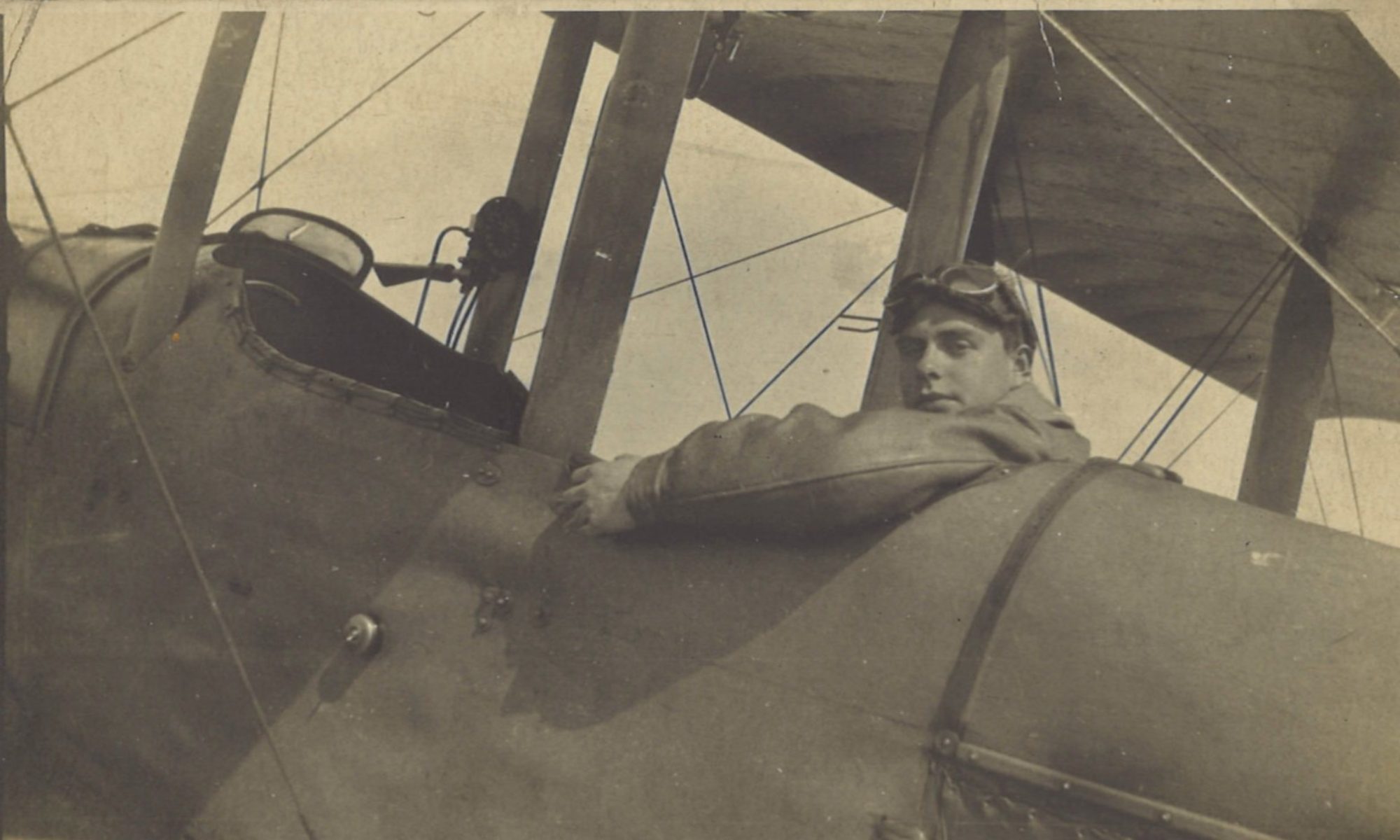
Monday 1 July 1918 – Greg’s First Shoot

After Friday’s washout because the weather wasn’t fit, Greg had his first stint of observation of artillery fire – a shoot.

Log Book

Log BookLog Book

Date: 1.7.18 
Hour: - 
Machine type: RE8 
No.: E27 
Observer: Lt Watkins 
Time: 3 hrs 
Height: 6000 
Course/Remarks: Shoot on KD90.  Successful. 145 SB.

Diary

Monday 1 July 1918. Shoot with 145 SB. 8” hows. on KD.90.  Direct hit on No 3 pit.

Shoot on KD90

Greg’s shoot was with 145 Siege Battery, a Royal Garrison Artillery Battery of (probably four) 8″ howitzers.  Their target, which would probably have been located in an earlier Counter Battery Patrol (explained here), was in zone KD and was the the object of interest given the serial number 90.  

KD90 was a German battery, also probably of four pieces, each in its own emplacement or ‘pit’.  It was located just southeast of the railway station at Merville, off what is now the Rue Loridan.

KD90
KD90 was the zone number given to a hostile battery, just southeast of Merville.  This is an extract from a 1:20,000 scale map, dated 27 June 1918.  Credit IWM/TNA/GreatWarDigital
KD90 today
The equivalent extract from a modern 1:25,000 map. Credit: GreatWarDigital.

The site of KD90 today is unexceptional.  Just a few ramshackle farm buildings on a quiet country lane on the edge of a small town.  But where this photo was taken would not have been a good place to stand at 3:00pm on Monday 1 July 1918:

KD90 today
KD90, on Rue Loridan, just outside Merville, today

Squadron Record Book

In his diary, Greg records the shoot as successful.  This was also the verdict in the Squadron Record Book.  It’s the first entry on the (hard to read) page.  Transcript (and translation) below.

42 Squadron Record Book for 1 July 1918
Extract from 42 Squadron Record Book for 1 July 1918. Click for larger image.
Type and Number: R.E.8.27

Pilot and Observer: P. Lt Gregory. O. Lt Watkins.

Duty: Art Obs 145 S.B. (8" How) on K.D.90.

Hour of Start: 2.10pm

Hour of Return: 5.15pm

Remarks: 
SUCCESSFUL. Called up 2.20pm. K. 2.25pm. L. 2.37pm. G. 2.43pm. V. 4.0pm. G. to V. 1-17mins
OBSERVED:- 1 O.K. 1 Y. 2 Z. 8 A. 16 B. 6 C. 2 D. 7 W. 42 ranging rounds. "V" out and 3 M.O.K. sent.
Direct hit on No. 3 Pit. T. out 5.5pm.
Shoot by P. Height 6000'.
MISC INF. 2.50p O.K. on house at K.36.d.0.7.
4.25pm and 4.55pm called C.W.S. X. out. A.A. very active in back areas.  No movement seen North of CANAL. No trains.  Obs. fired 600 rounds into NEUF BERQUIN, MERVILLE STATION and EPINETTE. Pilot fired 100 rounds into MERVILLE STATION.  Vis. good at first, poor later. Obs. by P. & O.

Translation of Remarks:

Remarks: SUCCESSFUL. 
Called up [B: Are you receiving my signal?] 2.20pm. 
K. [Yes] 2.25pm. 
L. [Battery ready to fire] 2.37pm. 
G. [First 'Fire' command] 2.43pm. 
V. [Observe for fire for effect; ie Battery Commander is satisfied that guns are now ranged, and will now fire 'for real' - please observe] 4.0pm. 
G. to V. [Time taken to range battery] 1-17mins 

OBSERVED:- 1 O.K. [Direct hit]
1 Y. [Within 10 yards]
2 Z. [Within 25 yards]
8 A. [Within 50 yards]
16 B. [Within 100 yards]
6 C. [Within 200 yards]
2 D. [Within 300 yards]
7 W. [Washout - unobserved]
42 ranging rounds. 

"V" out and 3 M.O.K. [3 Mean-points-of-impact (of salvos) are direct hits] sent. 

Direct hit on No. 3 Pit. 

T. out [Battery telling aircraft to go home] 5.5pm. 

Shoot by P. [Pilot did the observing of the shoot; the Observer would have been fully occupied watching for enemy aircraft] Height 6000'. 

MISC INF. 2.50p O.K. [direct hit] on house at K.36.d.0.7. [Map reference of house just next to hostile battery at KD90] 

4.25pm and 4.55pm called C.W.S. [The Central Wireless Station of the squadron] X. out. [Change target] A.A. very active in back areas. No movement seen North of CANAL. No trains. Obs. fired 600 rounds into NEUF BERQUIN, MERVILLE STATION and EPINETTE. Pilot fired 100 rounds into MERVILLE STATION. Vis. good at first, poor later. Obs. by P. & O. [Pilot and Observer both contributed to miscellaneous info.]

More on Shoots

For more details on how a shoot worked in practice, including an example of the exchange of communications between the aircraft and the battery, see:

Observation of Artillery Fire – A Shoot

The House at K.36.d.0.7

The house at K.36.d.0.7 that was the subject of an “O.K.” (direct hit) is actually just next to the hostile battery designated as KD90.  A touch of collateral damage.

The house at K.36.d.0.7,
The house at K.36.d.0.7, near KD90, from a 1:20,000 scale map, dated 27 June 1918.  Credit IWM/TNA/GreatWarDigital

L’Épinette

As noted in the following post, which is about Greg’s previous outing with Lt. Watkins, there was some kind of well defended German post or position at l’Épinette:

Wednesday 19 June 1918 – Fruitless Reconnoitre

Merville Station

Merville Station was on the receiving end of .303 fire from both Greg’s Vickers gun and Lt. Watkins’ Lewis gun.  Today, the trains are long gone, but the buildings and fragments of the track remain:

Merville Station Approach, June 2018
Merville Station Approach, June 2018. Click for larger image.
The tracks at Merville Station, June 2018
The tracks at Merville Station, June 2018. Click for larger image.


Sunday 30 June 1918 – CBP – Weather OK, Engine Bad

An improvement in the weather meant that today’s Counter Battery Patrol could go ahead more or less as planned, but it was marred by engine trouble.  (If it’s not one thing, it’s the other.)  So Air Mechanic Corkhill came up for a test ride in the afternoon.  And there was time for some correspondence.

Log book

Log bookLog book

Date: 30.6.18 
Hour: 10.30 
Machine type: RE8 
No.: E27 
Observer: Lt Watkins 
Time: 1 hr 5 m 
Height: 4500 
Course/Remarks: CBP. Engine very bad.

Date: 30.6.18 
Hour: 5 
Machine type: RE8 
No.: E27 
Observer: AM Corkhill 
Time: 30 m 
Height: 2500 
Course/Remarks: Engine test.

Diary

Diary

Sunday June 30th. C.B.P with Lt Watkins.  Engine nothing great, sent FL FR UD (10.30am).

Received parcel of mags & stockings.  Wrote home.

5.30 pm. Took up mechanic with E.27 for engine test.  Engine apparently OK.

“Sent FL FR UD”

This was the weather report that Greg sent at 10:30am:

  • FL – fit for counter battery work
  • FR – fit for registration (of artillery fire)
  • UD – unfit for photography


Wednesday 19 June 1918 – Fruitless Reconnoitre

On another damp day around the River Lys, Greg takes Lt Watkins as observer, since Roche has flu. Central Wireless Station tells them to reconnoitre an area by l’Épinette, southeast of Merville.  But they didn’t see any guns firing and the damp air leads to water in the carburettor again.

Log Book

Log BookLog Book

Date: 19.6.18 
Hour: 3.30 
Machine type: RE8 
No.: E27 
Observer: Lt Watkins 
Time: 1 hr 10 m 
Height: 3000 
Course/Remarks: CBP. Came down due to water in 
                carburettor.

Diary

Diary

Wednesday June 19th. E27. Roche got an attack of the ‘flu’.  Took up Watkins as observer, saw one Hun.

Asked C.W.S. for a target & got R VII.  Went over to reconnoitre square R7 but owing to smoke from a fire just to windward was unable to see any guns firing in that square.  Weather pretty dud & damp.

“Asked C.W.S. [Central Wireless Station] for a target”

CWS was the squadron’s Central Wireless Station.  This station operated one of the squadron’s two radio receivers.  The other was at Station Headquarters for practice and tests.  As the General Staff’s “Co-operation of Aircraft with Artillery” booklet (SS 131) explains:

…the Central Wireless Station should be at some central position in the corps area sufficiently far back to prevent jambing. This station acts as a link between the squadron commander and his machines working on the line, and is of great value in preventing incipient failures in their initial stages.  … Its utility is largely dependent on quick telephone communication to the squadron and to batteries.  Whenever possible, therefore, it should be located near Corps Heavy Artillery Headquarters, whose direct lines run to the above units.  At this station are also taken weather reports, hostile aircraft reports and, in case of sudden enemy bombardments or attacks, calls for reinforcing machines.

Square R7

This would be square R7 in Sheet 36A (zone RA), 2 miles (3.2 km) SSE of Merville, near Lestrem.  At the time, there was some kind of well defended German post or position there, at l’Épinette:

Map of R7
Extract of 1:20,000 ‘Harassing Fire’ map showing Square R7 of 1:40,000 Sheet 36A and l’Épinette. This was the square given by the Central Wireless Station. Red markings show German trenches and wire entanglements. Black marking show centres of activity, occupied areas and numbered targets. Triangles indicate dumps, and the flag shows a headquarters position. The map is dated 27 June 1918, with trenches correct to 16 June 1918.

Nowadays, l’Épinette is on the southern edge of Merville-Calonne Airport:


Tuesday 28 May 1918 – Three Air Combats for 42 Sqn

Meanwhile in France (again)…

…almost 70 miles (110 km) to the north of the battle at Cantigny, 42 Squadron was having a busy day dealing with enemy aircraft, with three ‘Combats in the Air’ reports being filed about activity over Calonne and Le Sart, either side of the River Lys to the west of Merville, itself 17 miles (30 km) west of Lille:

Calonne and Le Sart
Calonne and Le Sart, near Merville, from 1:40,000 scale map. Click for larger image. Map credit IWM/GreatWarDigital

1. Capt. Davis and Lt Chatterton

This crew had a tough time against 12 aircraft only three days ago on 25 May 1918

Air combat report
Air combat report – click for larger image
Time: 5.15 a.m.  
Locality: CALONNE
Pilot: Capt. A. E. Davis  
Observer: Lieut. J. Chatterton, M.C. 

Three small two-seater Fighters, and one with slight extensions on top plane.  

While doing a shoot 4 E.A. appeared over CALONNE.  I turned West but one machine dived on our tail and fired continuously.

Observer fired about 100 rounds into this E.A. which then turned away.  The second then dived and also fired continuously.  Observer fired another drum at about 200 yards into this E.A. which also turned East.

A third machine then dived on us but after firing about 100 rounds on us the whole formation withdrew East.

Vickers gun fired about 50 rounds at E.A. after they had turned East.

2. Lt. Welsh & 2/Lt. Watkins

Air combat report
Air combat report – click for larger image
Time: 10.30 a.m.  
Locality: LE SART
Pilot: Lieut A. W. Welsh 
Observer: 2/Lieut H. Watkins 

Two seater, possibly Aviatik  

R.E.A. [Reconnaissance Enemy Aircraft] obviously trying to bomb our trenches dropped 3 at LE SART, during which time he was fired at back by back and then front gun.  He immediately flew back over MERVILLE to ESTAIRES.

3. Lts. Puckle and Nicolson

This was another crew that had seen air combat recently: on 19 May 1918 and  22 May 1918.

Air combat report
Air combat report – click for larger image
Time: 4.35 p.m.  
Locality: CALONNE 
Pilot: Lieut H. Puckle 
Observer: Lieut J. F. W. Nicolson 

Four two seaters, one with extensions, type unknown.  Machine which fired on our tail had two guns.  Machines had a blue bottom plane (underneath) and large blue patch under the fuselage.  Very small black crosses.   

While flying over CALONNE 4 E.A. two seaters were sighted.  Pilot fired 25 rounds into 1 E.A., then gun jambed.  E.A. then turned on R.E.8. and got one on the tail.  Observer fired 250 rounds into this E.A. which turned East and flew with the others towards MERVILLE. 

One machine had a kidney-shaped tail (not the one with extensions) thus: [see image]  The extensions on the only E.A. which had them were short and square.


© Copyright 2018- Andrew Sheard and licensors. All rights reserved.

Website powered by green energy