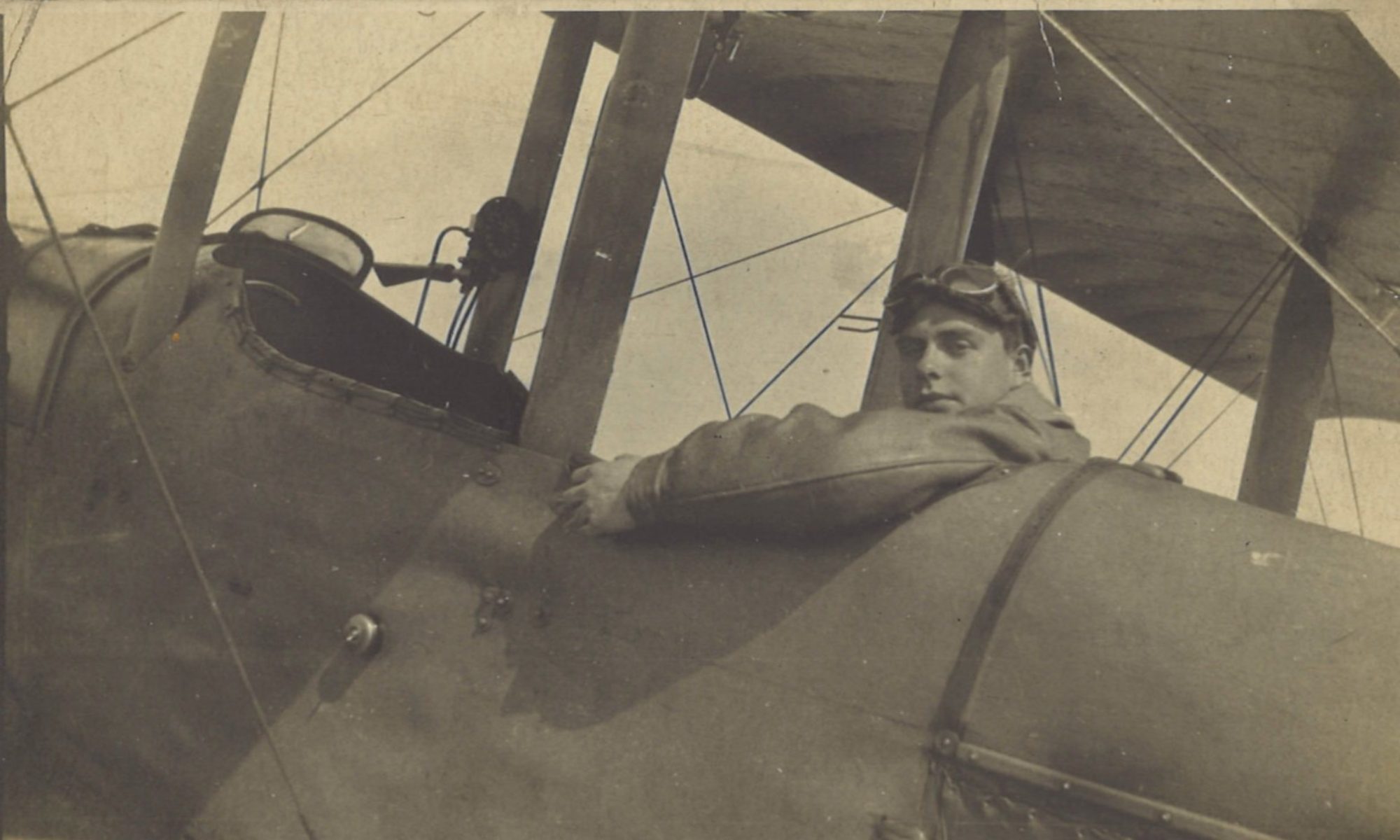
Monday 15 July 1918 – Machine Gun & Kitten

A day of contrasts:  Greg does battle with a machine gun post in the morning, and takes a kitten called Snowball up for a test flight later in the day.  Then he visits St Omer.

Log Book

Log BookLog Book

Date: 15.7.18 
Hour: 11.45-1.30 
Machine type: RE8 
RE8: 2526 
Observer: Lt. Hodgson 
Time: 1 hr 45 m 
Height: 2000 
Course/Remarks: CBP. 4 Cooper bombs. 650 rds Vickers & Lewis
Date: 15.7.18 
Hour: 5.35-6.20 
Machine type: RE8 
RE8: E27 
Observer: Lt. Hodgson 
Time: 45 m 
Height: 2000 
Course/Remarks: Engine test – Eng OK

Diary

Diary

Monday July 15th.  E27 dud.  C.B.P. 10.30 to 1.30. (Actually 11.45-1.30.)  Eventually took up Martin’s bus as E27 was hopelessly dud.

Managed to find a Hun machine gun firing at us from the ground.

Strafed him pretty badly, but could not make him shut up.  Rotten weather – cloudy & poor visibility.

E27 repaired.  Took her up in the evening for a test with Lt Hodgson as passenger, also kitten Snowball.  Snowball apparently enjoyed the trip but objected to the wind.  Did most of the journey under Hodgson’s coat.

Visited St. Omer.

More details of the patrol, and the location of the machine gun post, are in the Squadron Record Book:

Squadron Record Book

Squadron Record Book extract
Squadron Record Book extract – Click for larger image
Type and Number: R.E.8.2526
Pilot and Observer: P. Lt Gregory. O. Lt Hodgson
Duty: Artillery Patrol
Hour of Start: 11.45
Hour of Return: 13.30
Remarks: 11.55. 4-25lb bombs dropped on K.36.a.5.6.  All bursts observed, two on the railway.
12.15. C.W.S. sent R.A.  [see map below] R.A. kept under observation, but no flashes seen.  
12.15. sent U.L. U.R. U.D.  [Unfit for counter-battery work, artillery registration or photography]
12.30. explosion at Q.3.c.4.7. S. of the siding.  [see map] 
12.33. one flash seen in Q.B.10.  K.K. sent.  No more flashes seen at this place.  
13.10. C.W.S. sent X.  250 rounds V.G. fired into trenches round CALONNE. [see map] 300 rounds L.G. into trenches and back areas, and 100 rounds L.G. at active M.G. post at K.26.c.6.4.  [see maps] 
Height 12/1800’.  E.A. nil.  A.A. normal.  Vis. poor to fair.  Obs. P. & O.
Merville and surroundings
Merville and surroundings. 1:40,000 scale in original. Each numbered square is 1,000 yards. Click for larger image. Credit: IWM/TNA/GreatWarDigital

Here is a larger scale map showing the position of the machine gun post at K.26.c.6.4, which is right on the German front line.  The British front line is about 250 yards away.

Extract from 1:20,000 map
Extract from 1:20,000 map, enlarged. Each numbered square is 1,000 yds. German positions/works in red; British in blue. Machine gun position marked. Click for larger image. Credit: IWM/TNA/GreatWarDigital

Nothing more is recorded either of Kitten Snowball or of Greg’s visit to St Omer that evening.

Sunday 14 July 1918 – Lighthouse & Flaming Onions

Two unusual sights reward Greg for his 3 am start for a dawn patrol: a flashing lighthouse (yes, really) and the rather more dangerous ‘flaming onions’.

Log Book

Log book

Date: 14.7.18 
Hour: 3.15-6.00 
Machine type: RE8 
RE8: E27 
Observer: Lt. Pring 
Time: 2 hrs 45 m 
Height: 3000 
Course/Remarks: Dawn Patrol. 2 Parachute flares. 4 Coopers.

Diary

Diary

Sunday July 14th.  Dawn patrol 3pm – 6pm [sic; am intended].

Took off in dark with 4 Coopers and two parachute flares.

Found a hun lighthouse flashing O. South of Bac St. Maur.

Dropped the four bombs and pushed the two flares down the launching tube.

The first flare dropped straight through the tube & did not light; the second flare exploded with a flash like lightning & then hung in the air & fizzled away like a Roman candle.  Rather a washout; did not light up the ground at all. 

Saw a barge on the river and also about half a dozen transport on the road.

So the parachute flares were something of a failure.  There’s more on the lighthouse in the Squadron Record Book, which also reports the flaming onions which, curiously, Greg didn’t mention in his diary.

Squadron Record Book

Type and Number: R.E.8.27

Pilot and Observer: P. Lt Gregory. O. Lt Pring

Duty: Dawn Reconn.

Hour of Start: 3.0

Hour of Return: 6.0

Remarks: 
3.20 4-25lb bombs dropped on crossroads at L.26.central.  All bursts observed. 
3.25 2 Parachute Flares dropped behind MERVILLE.  Only one lighted, and 100 rounds L.G. fired into houses in K.35.b. [see map for this and other references] from 2000’.  
3.30 fire in buildings at K.36.a.4.4.  
3.20 to 4.0 large single orange light, probably lighthouse, on hill S. of BAC ST MAUR flashing letter O. at intervals of about 5 seconds.  Seen from ESTAIRES. [see below] 
4.0 train in Station N. of LAVENTIE.  
4.0 barge stationary on river at G.21.d.7.4.  
4.5 sent F.D. to C.W.S.  [Sent the weather message 'Fit for Photography' to Central Wireless Station]
4.20 seven lorries parked on road at L.30.a.8.8.  
4.25 sent K.K. [Flashes seen]  2 flashes seen along road in M.2.a.  
4.40 called C.W.S.  No answer.  
4.50 one more flash in M.2.a.  Sent K.K.  
4.55 1 E.K.B. [enemy kite balloon] N. of ESTAIRES.  
5.10 C.W.S. sent X.  
5.25 1 E.K.B. S. of ESTAIRES.  
5.45 C.W.S. sent X.  A.A. normal.  
5.40 300 rounds L.G. and 100 V.G. fired into trenches N. & S. of CALONNE from 1700’.  
3.35 flaming onions seen about L.3. [See below]

Vis. good.  Obs. By P. & O.


Merville and district map
Merville and district map extract showing locations in record entry. Click for larger image. Credit: IWM/TNA/GreatWarDigital

Lighthouse on Hill South of Bac St Maur

Can this really be plausible?  A lighthouse at Bac St Maur on the River Lys?  Well, yes, quite plausible.  But it wouldn’t have been anything to do with river traffic: it would have been an aerial lighthouse.  Both sides in the First World War used them to guide aircraft returning from missions.  According to the informative ‘Aerial Lighthouses‘ page on Mr Mycetes‘ website, something of a network of them grew up after the war as commercial air traffic became more common.  But they were largely dismantled at the beginning of the Second World War.  Afterwards they were never rebuilt, as radio and radar had taken their place.

Actually, the more difficult thing to understand is the reference to the lighthouse being on a hill south of Bac St Maur.  It’s pretty flat land round there.  The River Lys at Bac St Maur is 14 m above sea level, and going south from there the nearest high ground is near Aubers, where the 40 m contour line runs.  Aubers is about 5 miles (8km) to the south.  Greg saw the lighthouse from Estaires, almost 4 miles (6½ km) WSW of Bac St Maur.  So it seems is reasonable to think in terms of distances on this scale for the location of the lighthouse.  Near Aubers has to be a good candidate for where it was.

Flaming Onions

The War History Online website explains flaming onions as follows:

What it actually was, was a 37 mm revolving-barrel anti-aircraft gun used by the Germans. From a technical standpoint, it was a Gatling type, smooth bore, short barreled automatic revolver. Nicknamed a ‘lichtspucker’ (light spitter), it was designed to shot flares at low velocity in rapid sequence across a battle area. The gun had five barrels and had capabilities of launching 37 mm artillery shells five thousand feet. To help maximize chances of connecting with a target, all five rounds were discharged as rapidly as possible, thus producing the “flaming onion” visual and effect. Anti-aircraft artillery of the time fired very slowly. Because the flaming onion fired rapidly, many pilots thought the rounds were attached to a string and feared being shredded by it in the process. Not designed for anti-aircraft use, the weapon did not have purpose-designed ammunition, however, the flares would have been dangerous to fabric-covered aircraft.

Another variety of peril to be faced.

Saturday 13 July 1918 – Just Missed by a Shell

A couple of short Counter Battery/Artillery Patrols today, but Greg’s verdict was “nothing much doing”.  Apart from a close encounter with a passing shell, that is.

Log Book

Log BookLog Book

Date: 13.7.18 
Hour: 8.30 
Machine type: RE8 
No.: E27 
Passenger: Lt Pring 
Time: 40 mins 
Height: 1800 
Course/Remarks: CBP. Nothing much doing
Date: 13.7.18 
Hour: 9.55 
Machine type: RE8 
No.: 4962 [sic, probably 2649 intended]
Passenger: Lt Hodgson 
Time: 1 hr 5 m 
Height: 1800 
Course/Remarks: CBP. Nothing much doing

Diary

Saturday July 13th 1918. CBP 8-11

8.30-9.10 & 9.55-11.0

Nothing much doing.  Got one fearful bump, machine did a half roll, out of control for a few seconds,

Our artillery very active so pressure bump due to a passing shell.  Height 1800 ft.

As the following extract from the Squadron Record Book shows, at 1800 ft Greg was flying just below the cloud base at 2000 ft. This is at the low end of the heights flown for counter battery work (more typically 3000 ft or above), and well below the 5000 or 6000 ft flown when directing artillery fire in a shoot.  At 1800 ft, it could easily have been a passing howitzer shell from a British battery that passed close by the aircraft – possibly one being fired at sub-square K.36.c, south of Merville – see below.

Squadron Record Book

Type and Number: R.E.8.27

Pilot and Observer: P. Lt Gregory. O. Lt Pring

Duty: Artillery Patrol

Hour of Start: 8.30am

Hour of Return: 9.40am

Remarks: 
8.40am C.W.S. sent X. 8.45am sent U.L. F.R. U.D. C.20. [Unfit for counter battery work or photography; fit for registration of artillery; clouds at 2000 ft]
8.45am fire at FARM at K.16.b.7.4 [Rennet Farm, north of Merville] burnt for over an hour.

Vis. fair. Obs. By P. & O.


Type and Number: R.E.8.2649

Pilot and Observer: P. Lt Gregory. O. Lt  Hodgson

Duty: Artillery Patrol

Hour of Start: 9.55am

Hour of Return: 11.0am

Remarks: 
10.25am C.W.S. sent K.35 [south of Merville]. Went over to reconnoitre this square.  Flash seen in K.36.c. [also south of Merville] but as this area was being heavily shelled no N.F. [now firing] sent.  
10.15am smoke seen on railway near BAC ST MAUR, suspected train.  Owing to vis, unable to find out which way it was proceeding.

Vis. fair. Obs. By P. & O.
Merville and Rennet Farm on an extract of a 1:20,000 map dated 23 June 1918. German trenches and other works in red. Each numbered square is 1,000 yards. Map credit: IWM/TNA/GreatWarDigital.

Friday 12 July 1918 – General Birdwood Visits

After his 2 am return from Paris-Plage, Greg was probably glad not to have an early start.  In fact, he didn’t have much of a start at all as his aircraft’s engine had an oil leak, and he didn’t fly.  The big event of the day was a visit by General Birdwood, commander of the Fifth Army.

Diary

DiaryDiary

Friday July 12th 1918.  Found that the oil filter on my engine was leaking, so engine was taken out of E27.

Weather pretty dud, heavy rain in morning, afternoon fine but very windy.

General Birdwood came round in the morning (commanding 5th Army) and spoke to us all. Seemed a nice chap.

Watch the Birdy

General Sir William Birdwood visited 42 Squadron at Rely, not many miles from his headquarters at Upen d’Aval, just west of Thérouanne.  Michael Seymour looks at the the man and the reasons for his visit, and finds a resonance with Greg’s characterisation of him as “a nice chap”:

General Birdwood

Daily Orders Show Greg Confirmed in Rank

In other news, the day’s Daily Orders from Major Hunter report that Greg is no longer on probation but has been confirmed in rank as a (temporary) 2nd Lieutenant:

Daily Orders extract
Daily Orders extract – 12 July 1918

The Daily Orders are written in their customarily elegant way.  Rob (Parsons) thinks that it would almost certainly have been the Orderly Room Clerk who was the scribe.  There would have been a Sergeant in charge, responsible for all the written records, disciplinary procedures etc. And then there would have been a Squadron Adjutant, possibly as a secondary duty.

To give a flavour of administrative operation of the squadron that day, here is a complete copy of the the day’s Daily Orders.  Note the incorrect date on the top right of the first page.  It was definitely 12 July that the orders relate to.  But the clerk’s mind seems to have wandered back to May!

Thursday 11 July 1918 – A Trip to the Seaside

A day off!  And a trip to the seaside at Paris-Plage that didn’t go entirely to plan…

Diary

Diary

Thursday July 11th 1918. The first of a series of tenders to the seaside went down to Paris-Plage. 

I was picked out.

Tender left mess at 1.30 & owing to driver not knowing the way arrived at Paris-Plage at 5 pm.

Raining most of the way, but fine at Paris-Plage – which is quite a nice little place on the coast near Etaples.  Had a walk around, dined at the Continental Hotel, & left at 9.30.

Arrived in camp at 2 am.  Got lost on way home.

Paris-Plage

About a 45 mile (72 km) journey by road from Rely,  and near Étaples, the town is today formally known as Le Touquet-Paris-Plage, often shortened to Le Touquet.  The early years of the 20th century witnessed its development, and it became a fashionable resort for Parisians – hence the name.  

Map showing Paris-Plage
‘Western Theatre of War’ map extract showing Paris-Plage in relation to Rely, Merville  and the Lys Sector. Map credit: IWM/TNA/GreatWarDigital

It took Greg 3½ hours to get there and 4½ hours to get back.  Not a great rate of net progress in either direction!  Presumably driving was more difficult on the return journey because of a general lack of illumination in the dark.  Étaples was still liable to German air raids, much as Greg had experienced when he was first posted to France – less than six weeks earlier, but an age ago:

Friday 31 May 1918 – Across to France


Wednesday 10 July 1918 – Shadows over Target

An aviator’s life on the Western Front in 1918 was bedevilled by two factors – in addition to the small matter of the enemy, that is.  They were mechanical unreliability (of armaments, engines and other equipment) and the weather.  Today, Greg’s engine was better than it was yesterday, but it was another day for the weather to assert itself, as a Counter Battery Patrol evolved into a Shoot.  Even fair weather can cause problems, in the form of shadows over the target, and that was before the rainstorm approached.

Log Book

Log BookLog Book

Date: 10.7.18 
Hour: 3.40 
Machine type: RE8 
No.: E27 
Passenger: Lt Pring 
Time: 1 hr 45 
Height: 5000 
Course/Remarks: CBP & shoot with 14 SB. Successful.  Rainstorm.  Eng better.

Diary

Diary

Wednesday July 10th. CBP at 5.30pm (1hr 45 m). 5000 ft.

Took up a shoot with 14 Siege Battery (6” Hows).

Shoot successful.  Large number of W’s owing to clouds throwing shadows over target.

Archie pretty hot, unable to go over target.

Engine running better.

Two bombs dropped.

Target at L.20.a

So weather-related problems are not confined to bad weather as such:  shadows from clouds over the target meant that a large number of the battery’s rounds were unobserved – hence the ‘W’, for washout.  And then came a rainstorm…

Squadron Record Book

Type and Number: R.E.8.27

Pilot and Observer: P. Lt Gregory. O. Lt Pring

Duty: Art Obs 14 S.B. (6” How) on L.C.21. [northeast of Merville; see below]

Hour of Start: 5.40pm

Hour of Return: 7.25pm

Remarks:

SUCCESSFUL. Called up 5.48pm.  K. 5.50.  L. 5.55.  G. 5.58.  V. 6.45.  Time G. to V. 45 mins.

OBSERVED:- M.C.3.  M.C.5.  1 O.K.  1 Y.  8 A.  11 B.  4 C.  1 D.  11 W.  37 ranging rounds.  M.O.K. sent during B.F.  One direct hit on ranging pit which was badly damaged.  No 1 Pit believed damaged but owing to A.A. could not properly inspect target.  Shoot by P.  Height 5000’.

MISC INF. 5.56pm 2-25lb bombs dropped at K.28.c.5.3.  Both bursts observed.  7.5pm sent C.I. [going home] owing to approaching storm. A.A. active.  Vis. good but shadowy.
Obs. By P. & O.

Successful Shoot, Despite Shadows over Target

This was Greg’s second shoot with 14 Siege Battery. This link is to the post that recounts the first, which was just over a week ago on 2 July:

Tuesday 2 July 1918 – Shoot with 14SB

The ‘G to V’ time – the time taken to range the howitzers – was 45 minutes, down from 1 hr 20 mins last time, which will have pleased Greg, the Squadron Commander and the Battery Commander.  Eleven ‘washouts’ – unobserved shells – wasn’t so good, but explained by the shadows from the clouds.

Target LC 21 was in the 500 yard square L.20.a, northeast of Merville, but Greg dropped his two bombs on the other side of town.  He dropped them on the Rue d’Aire going west out towards Haverskerque.  The time was 5.56pm, just as he was about to begin ranging the guns (‘G’ – the ‘fire’ signal – was at 5:58pm).  The battery itself was probably located a mile or two further west, near Haverskerque.

1:20,000 map of Merville dated 22 May 1918
1:20,000 map of Merville dated 22 May 1918. Numbered squares are 1,000 yards across. Red markings are German trenches, tramways and other works.

One hundred years after Greg bombed the Rue d’Aire, I drove along it.  I can report that the road has been repaired.

For more details on how a shoot operated, see this page:

Observation of Artillery Fire – A Shoot

To see how zone numbers such as LC 21 were allocated to targets, see “Assigning a Zone Number to the Target” on this page:

Counter Battery Patrols and Zone Calls


Tuesday 9 July 1918 – Nothing Doing…Well, Almost

Down for a Counter Battery Patrol, but not such an busy day today on account of the weather.  Greg’s diary verdict was “absolutely nothing doing”, but his sortie involved bombing Greve Farm and a couple of shoot-ups.  His threshold of what constituted “something” had obviously risen.

Log Book

Log BookLog Book

Date: 9.7.18 
Hour: 7.15 
Machine type: RE8 
No.: E27 
Passenger: Lt Pring 
Time: 1 hr 30 mins 
Height: 7000 
Course/Remarks: CBP. Low clouds at first.  Nothing doing.  Eng. missing

Trouble with the engine again.

Diary

Tuesday July 9th 1918. CBP 5.30-8.30.

Got off at 7.15 owing to low clouds.  Came down at 8.45 – absolutely nothing doing.

Went and had a look at the Hun battery I did a shoot on.  Seemed to have been very badly knocked about. 4 bombs.

Unfortunately there are no photographs of the badly knocked about Hun battery, the reconnaissance of which didn’t merit an mention in the Squadron Record Book Report:

Squadron Record Book

Type and Number: R.E.8.27

Pilot and Observer: P. Lt Gregory. O. Lt Pring

Duty: Artillery Patrol

Hour of Start: 7.15am

Hour of Return: 8.45am

Remarks: 
7.35am 4-25lb bombs dropped for farm at K.24.d.4.7. [Greve Farm, just on the northeast edge of Merville] 4 bursts observed, 1 on road at K.24.d.3.8 [behind the farm]. 

7.45am called C.W.S.  X out.

7.45am sent U.L.  F.R.  U.D. [Unfit for counter-battery work or photography, but fit for artillery registration]

7.55am 200 rounds L.G. into Goods Station at MERVILLE

8.10am called C.W.S.  X out.

8.25am 100 rounds L.G. [Lewis Gun] into CALONNE.  No movement of any kind seen.  No E.A. or A.A. [Enemy aircraft or anti-aircraft fire] Vis: low clouds at first, fair later.  Obs. by P. & O.
Merville from a 1:20,000 map dated 22 June 1918, showing Greve Farm
Merville from a 1:20,000 map dated 22 June 1918. Each square with a central number is 1,000 yds. Credit: IWM/TNA/GreatWarDigital

Greve Farm

Greve Farm lies on the edge of Merville on Rue Ferdinand Capelle, which goes northeast towards Neuf Berquin.  Here is the farm today:


Monday 8 July 1918 – Jolly Good Shoot

Although Greg’s ‘bus’ – RE8 E27 – had had its propeller fixed, all was still not well, as the engine was backfiring. But what seems to have been the decisive factor in making the morning’s scheduled Counter Battery Patrol a washout was the weather.  The day improved with a ‘jolly good shoot’ with 174 Siege Battery (6″ Howitzers) in the evening.

Log Book

Log BookLog Book

Date: 8.7.18 
Hour: 8. 
Machine type: RE8 
No.: E27 
Passenger: Lt Pring 
Time: 30 mins 
Height: 2000 
Course/Remarks: CBP. Heavy fog.  Came down. Eng. Pretty dud.
Date: 8.7.18 
Hour: 6.30 
Machine type: RE8 
No.: E27 
Passenger: Lt Pring 
Time: 2 hr 10 mins 
Height: 5000 
Course/Remarks: Shoot with 174.  Successful. Eng. missing

Diary

Diary

Monday July 8th 1918. CBP 8-11.

Very cloudy & misty, took off without bombs & went to look at the line & came back after 30 minutes.

Engine missing, seemed inclined to backfire.

6.30pm.  Went up and did a shoot on a Hun battery at K.35.d.1.2

Jolly good shoot.  Both pits badly knocked about, one direct hit on one, which went up in the air.

One shell dropped in the river, great big column of water about 500 ft.

The Hun battery that was the target of the ‘jolly good shoot’ with 174 Siege Battery RGA  was on the southern edge of Merville, just above what is now Merville-Calonne Airport.  Its position is shown on the following map, along with the positions of the house and factory referred to in the Squadron Record Book report below.

Map of position of battery at K.35.d.1.2
Position of battery at K.35.d.1.2 etc on a 1:20,000 map dated 27 June 1918. Each square with a number in its centre (like 35) is 1,000 yards. Map credit: IWM/TNA/GreatWarDigital
 Modern 1:25,000 map of shoot
The equivalent extract from a modern 1:25,000 map. Credit: GreatWarDigital.

Squadron Record Book

Squadron Record Book

Type and Number: R.E.8.27

Pilot and Observer: P. Lt Gregory. O. Lt Pring

Duty: Art Obs 174 S.B. (6” How) on H.B. at K.35.d.10.20

Hour of Start: 6.40pm

Hour of Return: 8.30pm

Remarks: SUCCESSFUL. Called up 6.50pm.  K. 6.52pm.  L 6.54.  G. 6.58.  V 8.0. Time G. to V. 1 hr 2 mins. [time taken to range guns]

OBSERVED:- M.A.9.  M.A.2. 1 O.K. 12.A. 13 B. 12 C. 1 D. 39 ranging rounds.  2 M.O.K. during B.F.  [Two mean points of impact of salvos were direct hits during battery fire] Both pits badly damaged.  Fire caused in house at K.35.b.5.2. Shoot by P.  Height 5000’.

MISC INF.  6.50pm large fire in Factory at K.35.b.4.4. burning continuously.  200 rounds fired into MERVILLE STATION.  Vis. fair.  Obs. By P. & O.

More details about shoots and how to interpret Squadron Record Book reports of them:

Observation of Artillery Fire – A Shoot


Sunday 7 July 1918 – Elevator Rocking Bar Shot

On a murky and misty day – “frightfully dud” was the verdict – Greg was down for a Counter Battery Patrol/Artillery Patrol in the morning but signalled that the weather was unfit.  He dropped one bomb, had an elevator rocking bar shot, made a bad landing and bust the prop.  Then he took another machine up, but the weather was still bad.

Log Book

Log BookLog Book

Date: 7.7.18 
Hour: 8.15 
Machine type: RE8 
No.: E27 
Passenger: Lt Pring 
Time: 30 mins 
Height: 1500 
Course/Remarks: CBP. V Dud.  Elevator rocking bar shot.
Date: 7.7.18 
Hour: 9.45 
Machine type: RE8 
No.: 2327 
Passenger: Lt Pring 
Time: 1 hr 10 m 
Height: 1500 
Course/Remarks: CBP. Very misty & cloudy.

Diary

Diary

Sunday July 7th 1918. Wrote AD [?]. Sent field card home.

8.15-8.45 Took off with four bombs.  Could only get one of them off.  Frightfully dud morning, low clouds and heavy mist.  Got the right hand elevator rocking bar shot.  Overshot on landing & ran into some boxes & broke propeller.  1 bomb.

9.15-11.0 Took up Hutchinson’s bus with a shoot.  Too dud. Good landing.

Squadron Records

The day’s flying is fleshed out a bit in the official report:

Squadron Record Book

Type and Number: R.E.8.27

Pilot and Observer: P. Lt Gregory. O. Lt Pring

Duty: Artillery Patrol

Hour of Start: 8.15am

Hour of Return: 8.45am

Remarks: 
8.30am 1-25lb bomb dropped at K.34.b.5.5. [Rue de Bournoville, Merville] Burst unobserved. 

8.35am sent U.L. U.R. U.D. C.8.  [Unfit for counter-battery work; unfit for artillery registration; unfit for photography; clouds at 800 ft] Very heavy ground mists and fog.  Machine hit on elevator rocking bar.  No E.A. A.A. or E.K.B.  [No enemy aircraft, anti-aircraft fire or enemy kite balloons]

Vis. very poor.  Obs. By P. & O.

Because there were no enemy aircraft and no anti-aircraft fire, it looks as if the rocking bar must have been hit with small arms fire from the ground.  Something of a lucky hit for the shooter at 1500 ft through cloud.

Type and Number: R.E.8.2327

Pilot and Observer: P. Lt Gregory. O. Lt Pring

Duty: Artillery Patrol

Hour of Start: 9.55am

Hour of Return: 10.55am

Remarks: 
10.0am small explosion at E.30.d.4.4. [La Couronne, between Vieux Berquin and Neuf Berquin] 

10.5am sent U.L. U.R. U.D. C.15.  [Unfit for counter-battery work; unfit for artillery registration; unfit for photography; clouds at 1500 ft] Clouds in places below 1200'. Very thick mist prevented observation. No E.A. A.A. or E.K.B.  [No enemy aircraft, anti-aircraft fire or enemy kite balloons]

Vis. very poor.  Obs. By P. & O.

Wrote AD [?]. Sent field card home.

So there was time left for correspondence.  Not sure who “AD” is – or even if it is AD.  If it were AG (which is just possible), it could be either Alice Gregory (Greg’s sister) or Albert Gertrey (Greg’s fellow student from flying training in Yatesbury).

Saturday 6 July 1918 – Dud Day with a Joy Ride

Greg was down to do a shoot but it didn’t happen, presumably because of the weather.  The only flying was a brief joy ride with an infantry officer in the evening.  A good opportunity to catch up on correspondence.

Log Book

Log BookLog Book

Date: 6.7.18 
Hour: - 
Machine type: RE8 
No.: E27 
Passenger: Inf. Chap 
Time: 15 mins 
Height: 2000 
Course/Remarks: Joy ride.

Diary

Diary

Saturday July 6th 1918.  Wrote Home.  Down for a shoot.  Too dud all day, but took up an infantry officer for a joy ride in the evening.

More on “dud” here:

Monday 10 June 1918 – Pretty Dud Day

© Copyright 2018- Andrew Sheard and licensors. All rights reserved.

Website powered by green energy