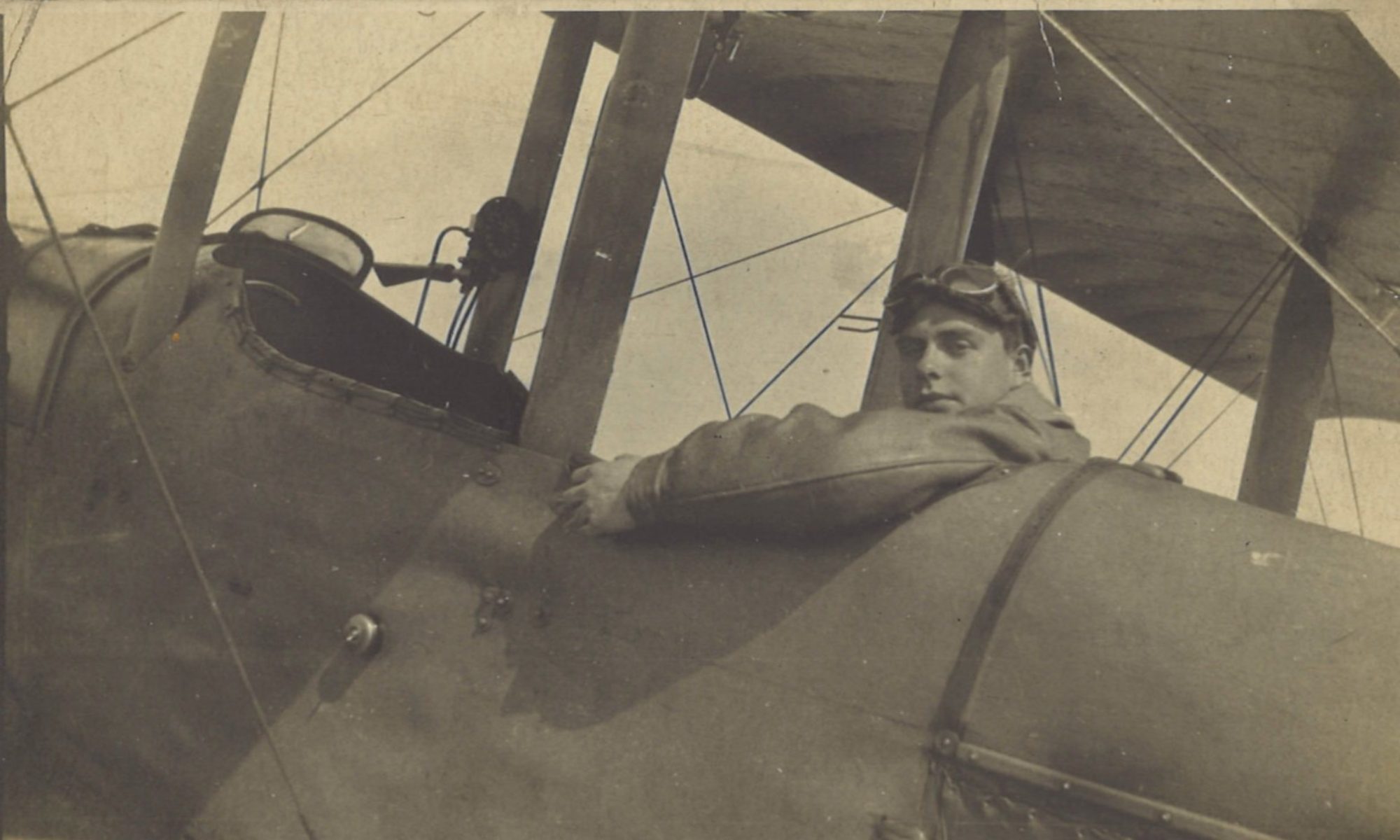
An early start today: a 4:00am take off for a dawn reconnaissance/counter battery patrol, which saw some action. Greg obviously enjoyed himself.
Log Book
Date: 5.7.18
Hour: 4. am
Machine type: RE8
No.: E27
Passenger: Lt Pring
Time: 2 hrs 15
Height: 5000
Course/Remarks: Dawn CBP.  Good time.
Diary
Friday July 5th 1918  Dawn Counter Battery Patrol.  Took off at 4 am just before daylight.

Went over to Estaires, saw a train standing by Estaires – pulled off the bombs & missed it by about 100 yards so turned to let observer fire 100 rounds into it.  Train moved off Eastwards.

Half an hour later saw a lorry moving up to Merville.  Dived on him & let him have 50 rounds from the front gun, then turned and observer gave him 100 rounds, after which the lorry ran off the road into the hedge.  Fired off the rest of the rounds into Fritz’s huts around Merville.

Got seven Archie holes through plane.
Archie
With seven holes through the plane, Archie (anti-aircraft fire) was definitely pretty hot. Archie explained here:
Squadron Record Book extract for 5 July 1918 (1). Click for larger imageSquadron Record Book extract for 5 July 1918 (2). Click for larger image
Duty: Dawn Reconn:

Hour of Start: 4.0am

Hour of Return: 6.25am

Remarks: 4.20am cloud, suspected gas, drifting Eastwards over L.9 & 15. 4.20am fire L.5.a.4.3. 4.25am train in L36a. 4-25lb bombs and 100 rounds Lewis fired at it.  Bursts seen 100 yards S. of train which proceeded East. 4.30am sent N.D. 4.35am C.W.S. sent X. 4.40am sent K.K. 4.45am train proceeding East from ESTAIRES. 4.48am lorry at K.24.d.5.7 proceedings towards MERVILLE. 150 rounds fired at it from both guns.  Turned off the road into the hedge.  4.50am K.K. flash in M.2. 4.55am trains at LAVANTIE and BAC ST MAUR.  4.55am A.A. firing from K.22.c.8.4. 5.0am C.W.S. sent X. 5.10am train in A.13 proceeding East.  5.15am 1 E.K.B. N. and behind ESTAIRES.  5.20am and 5.45am explosions at L.5.c.7.7.  5.25am explosion at Q.30.a.5.2. 5.40am C.W.S. sent L.C. No flashes seen in that zone.  5.45am train at BAC ST MAUR. 5.50am train at G.32.c proceeding towards ESTAIRES. 6.5am 1. E.K.B. S. of ESTAIRES.  250 rounds Vickers fired into various targets including houses behind MERVILLE. 400 round Lewis at various targets.  A.A. normal. E.A. nil. Vis. fair, ground mist. Obs. By P. & O.
So it was a busy patrol, but also evidently an exhilarating one – “good time” was the verdict.
Today was, unusually, the occasion of a whole-squadron mission. There was a “hot-air” bomb raid from which all returned but, alas, the intended target got away.
Thursday July 4th. 1918 Hot-air bomb raid on Fritz’s back area.
Someone reported lorries – consequently squadron goes over to bomb them.
None seen.  Archie jolly hot.  Dropped bombs near Estaires & fired off all the rounds into Fritz’s lines.  Quite a good show, everyone returned.
Hot-Air Bomb Raid
In what sense is Greg using the phrase ‘hot-air’? Full of sound and fury and signifying nothing, as the Bard had it, because the intended target wasn’t found?
Possibly. But I get the impression that Greg may have meant that the air was ‘hot’ because of all the aircraft, engines and bombs. In other words, he may have been conveying a sense of excitement rather than futility. In support of that theory, there is a later diary entry (for 21 July 1918), when he said that it was very windy all day and that he ‘hot aired’ it up into the atmosphere to do a shoot. Against it, I have found no mention of that sense of the phrase in the reference works and websites that I have consulted. Any useful further information will be rewarded with an honourable mention.
Header image: 42 Squadron Record Book extract for 4 July 1918
After two days of shoots, it was back to a counter battery patrol today, for which an entry in the Squadron Record Book is available. So we can see just what Greg and his Observer saw during the patrol. The entry in his diary doesn’t cover everything that was worth reporting officially.
Later in the day Greg paid a visit to two Siege Batteries. These were the batteries that he had been shooting with on the previous couple of days. A good time was had by all. Well, perhaps not quite all…Greg was well and truly taken for a ride.
Wednesday July 3rd. CBP 5.30am.
Bomb rack jambed – had to bring bombs back.
Fired 200 rds Vickers all over QB zone.
Sent an NF on guns firing at K30b2.4.
Saw several huns.
Two came very close, could see black crosses on tails.
Napier & Bonner had engine conk & crashed.
Went to see 14 and 145 SB.
Both had been good shoots.
145 people said theirs had been “the best for a few months”
Counter Battery Patrol/Artillery Patrol
Today’s counter battery patrol is the first for which not only Greg’s log book and diary are available but also for which we have the official report in 42 Squadron’s Record Book. So here is a more detailed look at what Greg saw and did on patrol that morning. He was sending signals of features of interest every five or ten minutes. The Squadron Record Book entry is hard to read, so a transcription is given, along with some interpretative notes.
Squadron Record Book
42 Squadron Record Book entry for 3 July 1918. Click for larger image.
Type and Number: R.E.8.27

Pilot and Observer: P. Lt Gregory. O. Lt Pring.

Duty: Artillery Patrol

Hour of Start: 6.20am

Hour of Return: 8.40am

Remarks:
6.30am E.K.B. S of ESTAIRES.  6.40am sent 2 R.E.A. K.D. 6.55am sent K.D. N.F. K.30.b.2.4. Battery silenced.  7.10am sent 3 S.E.A. L.C.  7.15am fire Q.4.c.5.5.  7.20am 2E.K.B. S. of ESTAIRES. 7.30am C.W.S. sent Q.B.  No flashes observed Q.B.  7.35am 2E.K.B. E. of ESTAIRES.  7.40am fire at K.24.c.4.3.  7.45am fire Q.36.a.8.2.  7.50am 3 E.K.B. N. of ESTAIRES.  8.5am C.W.S. sent Q.B.  No flashes seen in Q.B.  Obs. Fired 100 rounds into MERVILLE.  Pilot 200 rounds into buildings in Q.B.  A.A. normal.  E.A. active. Vis. poor very cloudy.  Obs by P. & O.
Translation of Remarks
The map extract below shows the zones and map references mentioned in these interpretative notes.
Remarks:
6.30am E.K.B. S of ESTAIRES.  [Enemy kite balloon south of Estaires]

6.40am sent 2 R.E.A. K.D. [Two reconnaissance enemy aircraft in zone KD (Merville)]

6.55am sent K.D. N.F. K.30.b.2.4. Battery silenced.  [Signalled: in zone KD (Merville), enemy guns are now firing at map reference K.30.b.2.4 (east of the town centre).  That 'zone call' elicited a response (from the British artillery, probably) that silenced the enemy guns.]

7.10am sent 3 S.E.A. L.C.  [Three scout (fighter) enemy aircraft seen in zone LC, which is east of Merville]

7.15am fire Q.4.c.5.5.  [There is a fire burning at map reference Q.4.c.5.5, which is southwest of Merville]

7.20am 2 E.K.B. S. of ESTAIRES. [Two enemy kite balloons south of Estaires]

7.30am C.W.S. sent Q.B.  No flashes observed Q.B. [Central Wireless Station requested aircraft to investigate zone QB, south of Merville, but no flashes (which would indicate guns firing) were seen.]

7.35am 2 E.K.B. E. of ESTAIRES.  [Two enemy kite balloons east of Estaires]

7.40am fire at K.24.c.4.3.  [There is a fire burning at map reference K.24.c.4.3, northeast of Merville]

7.45am fire Q.36.a.8.2.  [There is a fire burning at map reference Q.36.a.8.2, south of Merville]

7.50am 3 E.K.B. N. of ESTAIRES.  Two enemy kite balloons north of Estaires]

8.5am C.W.S. sent Q.B.  No flashes seen in Q.B.  [Central Wireless Station again requested aircraft to investigate zone QB (south of Merville), but no flashes (which would indicate guns firing) were seen.]

Obs. Fired 100 rounds into MERVILLE.
Pilot 200 rounds into buildings in Q.B. [south of Merville].
A.A. [anti-aircraft fire] normal.
E.A. [enemy aircraft] active.
Vis. [visibility] poor very cloudy.
Obs by P. & O.
Map Extract Showing Principal Zones and References in Squadron Record Book Entry
Merville and surrounding area, showing zones and map references referred to in Squadron Record Book entry. Map credit: IWM/TNA/GreatWarDigital
Bringing the Bombs Home
No doubt a returning pilot would prefer not to have 100 lbs or so of high explosive fixed underneath his aircraft when he landed. So Greg probably paid extra attention to making a good landing. But it should be safe enough. As explained on the RE8 page linked below, the aircraft carried Cooper bombs. The detonator of the bomb was only exposed to the firing mechanism after the spinner in the nose rotated a plate. So in principle the bomb could not be activated unless it had fallen through the air. It was that which would cause the spinner to rotate. Nonetheless, who wouldn’t be a little more careful to land nicely?
There is no further mention in Greg’s diary of Napier and Bonner, whose engine ‘conked and crashed’.
Visit to 14 and 145 Siege Batteries of the Royal Garrison Artillery
‘The closest personal touch’
Greg had his first visit to artillery units later in the day. He visited the two siege batteries that he had had shoots with on the previous couple of days. They were 14 Siege Battery (6″ howitzers) on 2 July 1918 and 145 Siege Battery (8″ howitzers) on 1 July 1918. The authorities encouraged visits such as these. In fact, the General Staff’s booklet Co-operation of Aircraft with Artillery (December 1917 edition) [S.S. 131] said that visits should take before shoots, rather than after:
The necessity for the the closest personal touch between the Royal Artillery and the Royal Flying Corps cannot be too strongly urged.
A new observer should spend two or three days with a battery before he commences to range guns, and should see it firing with aeroplane observation. Similarly, Royal Artillery officers should, if possible, spend a few days with their corps squadron… [SS 131 p19]
Well, it didn’t happen in the prescribed sequence for Greg. Quite possibly, though, the 30 minute test flight with the ‘Art. Chap’ on 2 July 1918 was part of this programme of ‘the closest personal touch’.
Taken for a Ride
In any event, it was very probably on one of these two visits – and I would guess the first of them, which from the sequence in his diary looks as if it was to 14 Siege Battery – that Greg had something of an adventure. Rob Parsons (Greg’s son-in-law and my stepfather) recalls the telling of this story as follows:
It was arranged that Greg should visit one of the artillery batteries that he would be spotting for, in order to appreciate what it was like to be dependent on the information from the aircraft. It wasn’t long before he realised he was being subjected to a jolly jape, but he accepted that as a temporary 2nd Lieutenant faced with battle-hardened veterans he had to grin and bear it.
Greg was welcomed courteously by the CO, who insisted that in order to observe the battery in action it would be best if he was mounted on a horse a little distance from the guns. He would find the additional height an advantage, he was told. He explained that he had never been on a horse, but the kindly CO assured him that it was a docile old thing which would stand there placidly with Lt. Gregory on top.
All of which proved to be true…until the guns opened fire and the docile horse bolted in the direction of the enemy trenches. As he described it, he was conscious that there were gaps between the horse and Gregory, and Gregory and his tin hat, and that these disappeared and reappeared with ever increasing rapidity as the horse accelerated towards the relative peace of no-man’s land. Eventually he got the beast under control and managed to turn it on a reciprocal course. He returned it undamaged whence they had come. Naturally the whole battery was convulsed with mirth, but they parted on good terms, and to quote a character as yet undreamt of, “It was a grand day out”.
‘All’s Well that Ends Well’, that’s what I say
So Greg returned unscathed. Any wounded pride was no doubt soothed by the emollient words of 145 Siege Battery, who said that their shoot had been “the best for a few months”. And he probably was glad of a drink that evening.
Hot on the heels of his first shoot yesterday, Greg is on another one today, this time with 14 Siege Battery RGA (6″ howitzers). It was recorded as successful, but he had to cut short the observation because of engine trouble. And later in the day an “artillery chap” was taken up for a test flight – presumably after the engine had been looked at.
Date: 2.7.18
Hour: -
Machine type: RE8
No.: E27
Passenger: Art. Chap
Time: 30 mins
Height: 3500
Course/Remarks: Test flight
Diary
Tuesday 2nd July 1918. Shoot with 14 SB. 6” hows. 48 Ranging rounds. Sent CI engine, after one MOK. Saw an MT in hunland.
CI was the signal for “Am returning to landing ground”. MOK meant that the mean point of impact of a salvo fired by the artillery battery was a direct hit. An MT was a motor transport.
Squadron Record Book
Type and Number: R.E.8.27

Pilot and Observer: P. Lt Gregory. O. Lt Pring.

Duty: Art Obs 14 S.B. (6" How) on H.B. [Hostile battery] at L.19.b.26.37.

Hour of Start: 12.10pm

Hour of Return: 2.20pm

Remarks:
SUCCESSFUL. Called up 12.30pm. K. 12.35pm. L. 12.37pm. G. 12.40pm. V. 2.0pm. G. to V. 1 hr 20 mins
OBSERVED:- M.C.2 M.B.3 2 Y. 1 Z. 6 A. 17 B. 10 C. 5 D. 1 E. 6 W. 48 ranging rounds. "V" out and 1 M.O.K. sent. 2 explosions at 1.15pm and 2.10pm.
Shoot by P. Height 6000'.
MISC INF. 1.10pm fire K.23.d.5.5 burning intermittently. 1.30pm 1 M.T. on NEUF BERQUIN-ESTAIRES Road going towards ESTAIRES. 1.30pm fire Q.18.a.5.7. 2.5pm 100 rounds fired into MERVILLE STATION. Vis. fair, cloudy after 2.0pm Obs. by P. & O.
Here’s where the action was, on the eastern side of Merville:
Location of hostile battery and other points of note in shoot of 2 July 1918. Map credit: IWM/TNA/GreatWarDigital
So even while the shoot was going on, both Pilot and Observer were watching. They reported all they could see from their vantage point. Always the ‘eye in the sky’.
Following on from yesterday’s post about an aerial photo taken south of Mametz-en-Picardie, today we have another vertical aerial view from the Somme sector. This one is complete with fireworks resulting from a direct bomb hit on an ammunition train.
Aerial Views Then and Now
Direct Bomb Hit on Ammunition Train, southwest of Bray-sur Somme. See dagger for direction of north. Greg’s War Collection. Click for larger image.
And the view today from Google maps:
The view today of where the ammunition train was hit. North is in the same direction. Click for larger image, or here to go to a zoomable view in Google maps.
Bray-sur-Somme
Bray is 19 miles (31 km) east of Amiens and 10 miles (16 km) northeast of Villers Bretonneux. The location of this photograph is nearly co-incident with that of an earlier one of a kite balloon, taken on 15 May 1918:
The ammunition train appears to be in sidings near what looks like a dump or supply depot, which has its own railway spur. The following map extract has been stitched together from adjoining 1:20,000 trench maps.
The approximate position of the ammunition train, southwest of Bray. Extract formed from two 1:20,000 maps, dated June and July 1918. North is vertically upwards. Map credit: IWM/TNA/GreatWarDigital.
There is no sign of the railway tracks on a 1915 1:40,000 map (Sheet 62D). Neither, unsurprisingly, is there any sign on a modern 1:25,000 map of the area, given that the Google aerial view shows no obvious traces.
205 Squadron RAF
The negative number in the titling strip is 205.v.1541. I’m grateful to Timothy Slater (who blogs here and tweets here) for the following information in reply to a tweet of yesterday’s post:
@GregsWar both this photograph and your previous kite balloon photo were taken by 205 Sqn RAF (previously 5 Sqn RNAS). At the time they were flying DH4s on bombing missions for V Bde RAF. I can’t identify any obvious links between 205 & 42 Sqns though.
So today we have evidence of 205 Squadron’s precision bombing. A good day’s work.
Monday 1 July 1918. Shoot with 145 SB. 8” hows. on KD.90. Direct hit on No 3 pit.
Shoot on KD90
Greg’s shoot was with 145 Siege Battery, a Royal Garrison Artillery Battery of (probably four) 8″ howitzers. Their target, which would probably have been located in an earlier Counter Battery Patrol (explained here), was in zone KD and was the the object of interest given the serial number 90.
KD90 was a German battery, also probably of four pieces, each in its own emplacement or ‘pit’. It was located just southeast of the railway station at Merville, off what is now the Rue Loridan.
KD90 was the zone number given to a hostile battery, just southeast of Merville. This is an extract from a 1:20,000 scale map, dated 27 June 1918. Credit IWM/TNA/GreatWarDigitalThe equivalent extract from a modern 1:25,000 map. Credit: GreatWarDigital.
The site of KD90 today is unexceptional. Just a few ramshackle farm buildings on a quiet country lane on the edge of a small town. But where this photo was taken would not have been a good place to stand at 3:00pm on Monday 1 July 1918:
KD90, on Rue Loridan, just outside Merville, today
Squadron Record Book
In his diary, Greg records the shoot as successful. This was also the verdict in the Squadron Record Book. It’s the first entry on the (hard to read) page. Transcript (and translation) below.
Extract from 42 Squadron Record Book for 1 July 1918. Click for larger image.
Type and Number: R.E.8.27

Pilot and Observer: P. Lt Gregory. O. Lt Watkins.

Duty: Art Obs 145 S.B. (8" How) on K.D.90.

Hour of Start: 2.10pm

Hour of Return: 5.15pm

Remarks:
SUCCESSFUL. Called up 2.20pm. K. 2.25pm. L. 2.37pm. G. 2.43pm. V. 4.0pm. G. to V. 1-17mins
OBSERVED:- 1 O.K. 1 Y. 2 Z. 8 A. 16 B. 6 C. 2 D. 7 W. 42 ranging rounds. "V" out and 3 M.O.K. sent.
Direct hit on No. 3 Pit. T. out 5.5pm.
Shoot by P. Height 6000'.
MISC INF. 2.50p O.K. on house at K.36.d.0.7.
4.25pm and 4.55pm called C.W.S. X. out. A.A. very active in back areas.  No movement seen North of CANAL. No trains.  Obs. fired 600 rounds into NEUF BERQUIN, MERVILLE STATION and EPINETTE. Pilot fired 100 rounds into MERVILLE STATION.  Vis. good at first, poor later. Obs. by P. & O.
Translation of Remarks:
Remarks: SUCCESSFUL.
Called up [B: Are you receiving my signal?] 2.20pm.
K. [Yes] 2.25pm.
L. [Battery ready to fire] 2.37pm.
G. [First 'Fire' command] 2.43pm.
V. [Observe for fire for effect; ie Battery Commander is satisfied that guns are now ranged, and will now fire 'for real' - please observe] 4.0pm.
G. to V. [Time taken to range battery] 1-17mins

OBSERVED:- 1 O.K. [Direct hit]
1 Y. [Within 10 yards]
2 Z. [Within 25 yards]
8 A. [Within 50 yards]
16 B. [Within 100 yards]
6 C. [Within 200 yards]
2 D. [Within 300 yards]
7 W. [Washout - unobserved]
42 ranging rounds.

"V" out and 3 M.O.K. [3 Mean-points-of-impact (of salvos) are direct hits] sent.

Direct hit on No. 3 Pit.

T. out [Battery telling aircraft to go home] 5.5pm.

Shoot by P. [Pilot did the observing of the shoot; the Observer would have been fully occupied watching for enemy aircraft] Height 6000'.

MISC INF. 2.50p O.K. [direct hit] on house at K.36.d.0.7. [Map reference of house just next to hostile battery at KD90]

4.25pm and 4.55pm called C.W.S. [The Central Wireless Station of the squadron] X. out. [Change target] A.A. very active in back areas. No movement seen North of CANAL. No trains. Obs. fired 600 rounds into NEUF BERQUIN, MERVILLE STATION and EPINETTE. Pilot fired 100 rounds into MERVILLE STATION. Vis. good at first, poor later. Obs. by P. & O. [Pilot and Observer both contributed to miscellaneous info.]
More on Shoots
For more details on how a shoot worked in practice, including an example of the exchange of communications between the aircraft and the battery, see:
The house at K.36.d.0.7 that was the subject of an “O.K.” (direct hit) is actually just next to the hostile battery designated as KD90. A touch of collateral damage.
The house at K.36.d.0.7, near KD90, from a 1:20,000 scale map, dated 27 June 1918. Credit IWM/TNA/GreatWarDigital
L’Épinette
As noted in the following post, which is about Greg’s previous outing with Lt. Watkins, there was some kind of well defended German post or position at l’Épinette:
Merville Station was on the receiving end of .303 fire from both Greg’s Vickers gun and Lt. Watkins’ Lewis gun. Today, the trains are long gone, but the buildings and fragments of the track remain:
Merville Station Approach, June 2018. Click for larger image.The tracks at Merville Station, June 2018. Click for larger image.
Among Greg’s collection of photos from 1918 is a vertical aerial view dated 30 June 1918 and entitled “S. Mametz”, presumably an abbreviation for South [of] Mametz. My first thought was that this referred to the village of that name a couple of miles west of Aire-sur-la-Lys and not much further north from Rely. But, despite the village being on the doorstep of 42 Squadron’s airfield, I couldn’t reconcile the photo with a present day aerial view on Google maps.
It was only when I purchased a set of digitised trench maps of the Western Front and learnt to read First World War map references that I realised the answer. The line in the photo’s titling strip that reads 62d.F.11.12.17.18 is a reference to four 1,000yd squares on map sheet 62d – which lie just south of another village of the same name, near the Somme and a couple of miles east of Albert. So the photo relates to Mametz-en-Picardie, which is 44 miles (71 km) southeast of Rely, not Mametz-en-Artois.
Aerial ViewsThen and Now
Here are Greg’s photo and the equivalent view today on Google maps:
Aerial view of South of Mametz-en-Picardie on 30 June 1918. Click for larger image.Aerial view of the same location today (courtesy Google). Click for larger image, or here to go to the Google map view: https://goo.gl/maps/svHie4f59N32.
The settlement visible in both photographs is Carnoy. Mametz itself is just off-camera, to the top left.
It isn’t clear how the photo from the Somme theatre came to be in Greg’s collection. It isn’t particularly clear even why it was taken, other than for general reconnaissance purposes. Possibly it was taken for the forthcoming Final Allied Offensive. Mametz had seen major action two years previously in the Battle of the Somme, and in fact the village was taken from the Germans in fierce fighting on 1 July 1916. For an account of its capture, see this article from The Long, Long Trail website:
Since late March 1918, Mametz had been back in German hands. This was as a result of Operation Michael – their major push westwards towards Amiens in the Spring Offensives. It was not to be under British control again until it was liberated in August 1918. The Final Allied Offensive began on the 8th of that month.
Mametz is about 4 miles (6½ km) north of Bray-sur-Somme, where a German kite balloon was photographed on 15 May 1918:
The negative number in the titling strip is 205.v.1521. I’m grateful to Timothy Slater (who blogs here and tweets here) for the following information in reply to a tweet of this post:
@GregsWar both this photograph and your previous kite balloon photo were taken by 205 Sqn RAF (previously 5 Sqn RNAS). At the time they were flying DH4s on bombing missions for V Bde RAF. I can’t identify any obvious links between 205 & 42 Sqns though.
An improvement in the weather meant that today’s Counter Battery Patrol could go ahead more or less as planned, but it was marred by engine trouble. (If it’s not one thing, it’s the other.) So Air Mechanic Corkhill came up for a test ride in the afternoon. And there was time for some correspondence.
Sunday June 30th. C.B.P with Lt Watkins.  Engine nothing great, sent FL FR UD (10.30am).

Received parcel of mags & stockings.  Wrote home.

5.30 pm. Took up mechanic with E.27 for engine test.  Engine apparently OK.
“Sent FL FR UD”
This was the weather report that Greg sent at 10:30am:
The weather continued to interfere with the work of 42 Squadron. Following yesterday’s cancellation of a shoot, today the weather forced Greg down 10 minutes after take off for a Counter Battery Patrol. Also, Lt Ives is posted to the Home Establishment.
Saturday June 29th. CBP at 8.am with Lt Pring. Weather very dud, came down after 10 mins.
In Other News…
Today’s Routine Orders contain the news that Lt. Edward Leslie Ives, seconded from the West Yorkshire Regiment to the Royal Flying Corps and Royal Air Force, was posted on 28 June 1918 to the Home Establishment:
42 Squadron daily orders for 29 June 1918. Click for larger image
Lt Ives is seen here with Lt Whittles in their flying kit next to an RE8 at Rely:
Lts Ives and Whittles next to an RE8 at Rely. Click for larger image