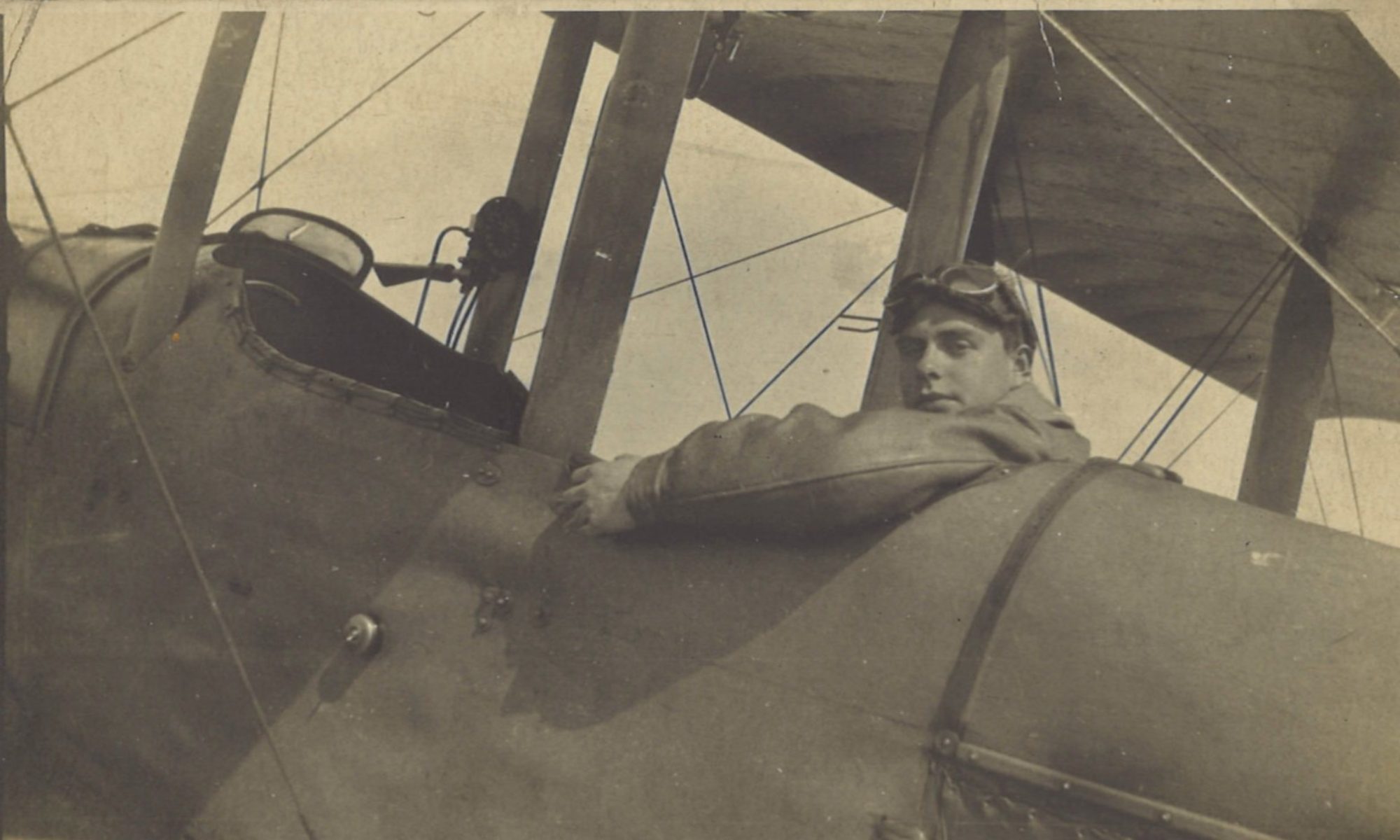
Thursday 27 June 1918 – CBP, Archie…and Sheet Tin

Another Counter Battery Patrol, in which Greg was twice switched to new targets, another four bombs dropped, some “pretty hot Archie”, and an intriguing order about sheet tin.

Log Book

Log BookLog Book

Date: 27.6.18 
Hour: - 
Machine type: RE8 
No.: E27 
Observer: Lt Kennedy 
Time: 2 hrs 5 m 
Height: 6000 
Course/Remarks: CBP. 4 bombs. Archie pretty hot.

Diary

DiaryDiary

Thursday June 27th. CBP 8 – 11 (8.40 – 10.45). Four bombs dropped, caused small fire.  Archie very persistent & pretty hot.

Sent FL FR FD & got to 6,000 ft.  Engine rough but picked up & ran very well.

Got X twice from CWS.


“Archie”…

…was anti-aircraft fire, as explained here:

Thursday 13 June 1918 – CBP and ‘Archie’

“Sent FL FR FD”…

…means that a series of favourable weather signals was sent, explained here,:

Saturday 15 June 1918 – CBP and Bombing

“Got X twice from CWS”…

…means that Greg twice was given the signal X from the squadron’s Central Wireless Station. ‘X’ meant ‘change to new target’. The X (formed of ground strips of cloth) would be followed by a description of the target. Sounds a bit like he felt was being messed around.

Sheet Tin

The day’s routine orders from the CO, Major Hunter MC, had an interesting entry about sheet tin, which was obviously of some value:

Recovery of sheet tin from Biscuit, Tea and other large tins

Arrangements having been made to sell all sheet tin which is in good condition and which is not required by the British Armies in France, it is necessary that as uniform a method of recovery as possible should be adopted.

Tins are to have their tops and bottoms removed entire, after which the bodies are to be opened up at the joints, i.e., at two diametrically opposite corners.  the sheets thus produced are to be pressed flat, bundled in twenties and tied with wire or hoop iron.  

The tops and bottoms are to be similarly bundled.

The joints can be opened by hating on an iron plate over a brazier.  When the solder in the joint runs, the parts of the tin can be shaken apart.

Special care is to be taken that only sufficient heat is used to make the solder run.  Too much heat will spoil the tinned surface and render it unfit for sale.

To prevent deterioration from rust, it is very important that tins should be dealt with as soon as received and should not be left exposed to damp after packing (4000/40 (Q.B.1).)
             (G.R.O. 4326, dated 21.6.18).

One might reasonably wonder why “the British Armies in France” might have any use for sheet tin themselves.  In fact, one use was to make reflective signal discs in the gas mask haversacks of the infantry:

Haversack signal disc used by Allied troops.
Haversack signal disc used by Allied troops. From Michael Meech, ‘A Short History of Contact Patrols’ Cross & Cockade International 40(2) 116-127 (2009)

The discs could be deployed by troops in forward positions, so that RAF patrol aircraft on infantry liaison duties (so-called ‘contact patrols’) could see their position and transmit this information to the relevant headquarters. 


Wednesday 26 June 1918 – Four Bombs on Houses

Another Counter Battery Patrol, and more bombs dropped today; and more water in the carburettor, so an early return:

Log Book

Log BookLog Book

Date: 26.6.18 
Hour: 11.00 
Machine type: RE8 
No.: E27 
Observer: Lt Roche 
Time: 1 hr 10 m 
Height: 3000 
Course/Remarks: CBP. 4 bombs. Returned due to engine.

Diary

Diary

Wednesday June 26th. CBP. Dropped four bombs on houses.  Late up & early down – water in carburettor.

Nothing to indicate where the bombs on houses were dropped, but it was probably somewhere in or around German-occupied Merville

2nd Lt Roche

This was to be 2nd Lt Anthony Berthon Roche’s last flight as Greg’s observer.  He was evidently still with 42 Squadron at least until 7 July 1918, according to the records of http://www.airhistory.org.uk/rfc/people_index.html, but Greg’s own papers contain no more information about him.

Tuesday 25 June 1918 – Direct Hit on Bridge

Back on Counter Battery Patrol after recovering from the flu, with Lt Roche (also recovered), meant a 5:30am start that was rewarded with a direct hit with a bomb on a bridge near Merville.  Mac (Lt. Hugh McDonald), who died yesterday, was buried later in the day.

Log Book

Log bookLog book

Date: 25.6.18 
Hour: 5.30 
Machine type: RE8 
No.: E27 
Observer: Lt Roche 
Time: 1 hr 30 m 
Height: 3000 
Course/Remarks: CBP. Direct hit on bridge. Wat. in Carb.

Diary

DiaryDiary

Tuesday June 25th. CBP at 5.30 am.  Very heavy mist.  Dropped bombs on bridge near Merville, (direct hit).  Observer fired 100 rounds behind Merville.

Heavy low bands of clouds appeared about 6.45 to windward.

Engine became very rough owing to water in carburettor so came home.  No Archie.  No Huns. 

Good landing.

Developed a cold as after effect of P.U.O.

Mac buried.

“Dropped bombs on bridge near Merville, (direct hit)”

An opportunistic departure from a counter battery patrol.  Which bridge was it?  Hard to tell, as there are so many, as this map extract shows:

Merville 20k map
Extract from a 1:20,000 map of Merville, May 1918 edition, with trenches revised to 19 June 1918. German works in red. Numbered squares are 1,000 yards. Map credit: IWM/TNA/GreatWarDigital

Merville still has still lots of bridges. One of today’s tourist information boards proudly says:

As the heart of the town is surrounded by water, it can only be reached by crossing one of the seventeen bridges.

It seems unlikely that even a direct hit with one of the 20 lb Cooper bombs that were carried by an RE8 would actually have brought a bridge down. And Greg would  surely have proudly said so if he had done.  (Spoiler alert: he did on a later occasion!)

Water in Carburettor

A recurrent problem, with the heavy mist and low cloud.

Lt. Hugh McDonald (Mac) Buried

Lt. Hugh McDonald lies buried at plot III.D.33 at Aire Communal Cemetery, next to his observer 2nd Lt. Cuthbert Alban Marsh at III.D.34.

Monday 24 June 1918 – Marsh & McDonald Died in Hospital

After yesterday‘s crash on take-off from Rely, Marsh and McDonald both died in hospital.  Greg did not fly – his final day off flying after the flu.

Diary

Monday June 24th. Marsh & Macdonald [sic, should be McDonald] both died in hospital.  Marsh buried in afternoon.  Did not fly.

So neither of them made it.  2nd Lt. Marsh, who had had such a lucky escape earlier in the month, had celebrated his 24th birthday just two days earlier, on 22 June 1918.  Lt. McDonald was 19, the same age as Greg.  A reminder, if one was needed, of how dangerous flying was even before anyone wished you harm.

“Marsh Buried in Afternoon”

2nd Lt. Cuthbert Alban Marsh lies buried at plot III.D.34 at Aire Communal Cemetery.

In memoriam Cuthbert Alban Marsh, died in hospital

Sunday 23 June 1918 – Feeling Groggy, Crash at Rely

Greg’s first day out of bed (just) after the flu was a bad day for the squadron, with a crash at Rely aerodrome.

Diary

Diary entry: crash at Rely

Sunday 23rd. Got up, & walked round a bit feeling groggy.  Macdonald [sic, should be McDonald] & Marsh spun into the ground & caught fire, both rescued & taken to hospital.

McDonald & Marsh Crash at Rely

Lt Hugh McDonald (as his name was spelt in the official report) was the pilot.

And 2nd Lt Cuthbert Alban Marsh was the observer, and was also Greg’s observer on his near-disastrous first day on the Front, when they crashed in crops at Trézennes.  On that occasion, Marsh was thrown clear:

Tuesday 4 June 1918 – Near Disaster on the First Day on the Front

Today, neither McDonald nor Marsh was so lucky.  An extract of the official casualty report said:

[C2348 RE8] Got into spin owing to loss of speed on a turn crashed and caught fire on t/o for artly obs [take off for artillery observation].

Thanks to http://www.airhistory.org.uk/rfc/home.html for the casualty information.

“Taken to Hospital”

There were two hospital facilities at Aire-sur-la-Lys at the time.  User mhifle of The Great War Forum says that the 54th Casualty Clearing Station came to Aire on 16 April 1918.  This CCS was also known as the ‘1/2nd London CCS’. He gives its previous locations with the BEF in France as:

  • Hazebrouck 1 April 1915 to 31 July 1915
  • Merville 1 Aug 1915 to 28 March 1918
  • Haverskerque 29 March 1918 to 15 April 1918

At Aire, the 54th CCS  joined No 39 Stationary Hospital, which was there from May 1917 to July 1918 according to The Long, Long Trail.  So McDonald and Marsh may have been taken to one of these hospital facilities.

“British Casualty Clearing Station”

The Greg’s War collection includes the following  aerial photograph captioned “British Casualty Clearing Station”, which is otherwise unidentified. 

British Casualty Clearing Station Aerial Photo
High-angle oblique aerial photograph from the Greg’s War Collection entitled “British Casualty Clearing Station”. Click for larger image.

It is possible that this was the 54th CCS at Aire (maybe with No 39 Stationary Hospital also in shot).  The landscape looks similar to that just west of Aire, upstream along the Lys valley, near the village of Mametz – Mametz (Pas de Calais) that is, not Mametz (Somme).

A high-angle oblique view created in Google maps. (It’s not entirely successful, as Google has not 3D-imaged the area.) The aspect is looking northeast from just south of the Route de Mametz. Click to go to Google maps to see the location.  

But I’m not entirely sure that this is the same place.  In this instance, it’s hard to tell how much the landscape has changed over the years. Without any hard evidence of where the photo was taken, and without even knowing just where in or around Aire the 54th CCS was located, I can only identify it provisionally.

Saturday 22 June 1918 – Greg’s Flu Continues

Another day in bed as Greg’s Spanish Flu, aka Merville Fever, continued.  Still no flying for him.  But what was the origin of Spanish Flu?  

Diary


Diary

Saturday June 22nd. Stayed in bed all day. 

Origin of Spanish Flu

After yesterday’s excursion into epidemiology, here’s a bit of a voyage into virology. (We’ll return to aviation soon enough.)

Let’s get one thing out of the way first: the origin of Spanish flu is probably not Spain.  It is generally thought that the name came about because Spain’s neutrality in the First World War merely permitted more extensive reporting of the pandemic.  See Trilla et al. Clinical Infectious Diseases 47(5) 668–673 (2008) (https://doi.org/10.1086/590567) for more.

We now know – but in 1918 they didn’t – that the causative agent of flu is a virus.  At the time, it was thought to be caused by a bacterium, Haemophilus influenzae, which is now known to be the cause of various other conditions, including some cases of bacterial meningitis.

Viruses

Like all viruses, influenza virus isn’t really a living entity.  It’s a package of genetic material (in this case RNA rather than DNA) wrapped up in a protein-studded lipid (fatty) coat.  It can’t reproduce on its own.  It can only replicate by infecting a host cell and hijacking the cell’s replication machinery.  The infected host then churns out vast quantities of progeny virus, and the cycle begins again.

Today we know what the virus looks like.  Here is an electron micrograph of a recreated form of the 1918 Spanish Flu virus: 


Negative stained transmission electron micrograph (TEM) showed recreated 1918 influenza virus particles (also known as virions). Photo Credit: Dr. Terrence Tumpey/ Cynthia Goldsmith, US Centers for Disease Control and Prevention’s Public Health Image Library (PHIL).  Public domain image.

Surface Proteins and Subtypes

Among the proteins studding the lipid coat of the virus particles (which are in the order of 100 nm in diameter), two that are important for the way that the virus infects its host cells are haemagglutinin (abbreviated HA or H) and neuraminidase (NA or N)Haemagglutinin is involved in the virus binding to the host cell, and neuraminidase assists in viral trafficking.  Here’s a schematic  picture of a flu virus particle:

Influenza virus
Schematic structure of influenza virus, showing haemagglutinin and neuraminidase on surface. Credit: Vincent Racaniello of the Virology Blog, Licensed under CCA 3.0.

Although there are three kinds of influenza virus, A, B and C, it is only influenza A that poses a serious threat to public health.  The 1918 so-called Spanish Flu was an example of influenza A.  We now know (see below) that it was a subtype known as H1N1, so called because it contains haemagglutinin of subtype 1 (of 16 known subtypes) and neuraminidase of subtype 1 (of 9). Formally, the Spanish Flu virus is therefore known as 1918 A(H1N1) influenza.

Reassortment

When a flu pandemic arises, it is often because of genetic reassortment of the virus. This arises when two different viruses infect the same individual (human or another susceptible species such as pigs or birds).  Because the RNA in the nucleus is in different segments, these segments can reassort to give a new genetic combination.  In this way, an H1N1 virus might reassort with an H5N3 virus to give an H5N1 virus, say (not a random example, but that is another story). And the human immune system might not have ‘seen’ this reassortment before – at least in the recent past – and therefore have no effective immunity against it.

And the Origin of Spanish Flu is…

…actually not clear.  It seems that the reassortment mechanism just discussed did not give rise to the  Spanish Flu virus in 1918. Taubenberger and colleagues, working in the mid-1990s with archival influenza autopsy materials collected in the autumn of 1918, sequenced the RNA of the virus and determined it to be an H1N1 subtype and similar to a bird flu virus from an unknown source.  (For a review, see Taubenberger & Morens “1918 Influenza: the Mother of All Pandemics” Emerg Infect Dis. 2006;12(1):15-22 (https://dx.doi.org/10.3201/eid1201.050979)). Similar to a bird flu virus, that is, but not exactly the same:  it had a mutation, or mutations, that enabled it to infect humans – and pigs.  So this proposed bird flu-like virus seems to have been new – immunologically speaking – both to us and to pigs. 

It has to be said that not everyone goes along with the Taubenberger bird virus origin theory.   A lively debate in the pages of Nature testifies to that.  And even Taubenberger says that it is not just a question of a single mutation arising in a pre-existing H1N1 bird flu.  That theory is discounted by the large number of mutations found between the 1918 virus and known bird flu viruses.  For the moment, the answer to the question “what is the origin of Spanish Flu?” is the unsatisfactory “we don’t really know”.  But the bird flu theory is still a contender. 

A Live Issue

Intriguingly, this is not merely a question of historical interest.  The legacy of the 1918 Spanish Flu is still with us today. The reason that Taubenberger & Morens called the Spanish Flu pandemic in 1918 “the mother of all pandemics” in the title of their 2006 review article is that, in their words :

All influenza A pandemics since that time, and indeed almost all cases of influenza A worldwide…, have been caused by descendants of the 1918 virus.

Yet another long shadow cast from the years of the Great War.

Friday 21 June 1918 – Spanish Flu

Greg’s flu – ‘Merville Fever’ as he called it yesterday – continued.   Today he said it was Spanish Flu.  Unsurprisingly, he did not fly.

Diary

Diary

Friday June 21st. Stayed in bed all day.  (Known in England as ‘Spanish Flu’.)

Spanish Flu

Greg equates what was evidently known within 42 Squadron as ‘Merville Fever’ with Spanish Flu.  Possibly the words in brackets in his diary entry were added at a later date.  But in any event, can he really have been talking about the same ‘Spanish Influenza’ that killed so many in 1918 and 1919? Especially  if, as he said yesterday, it was merely “a sort of ‘flu lasting three or four days”?

Perhaps surprisingly, the answer was quite probably ‘yes’ – for a couple of reasons.  (Nice bit of epidemiology coming up.)  

The W-Curve

First, he was the right age not to be too badly affected.  At 19 and in good health he would have had a fairly robust constitution.  Furthermore, the 1918-19 influenza pandemic did not affect all age groups equally.  Mortality was greatest among children under four and among the elderly – two immunocompromised groups –  as one might expect. Also, there was also a curious minor peak of mortality among those aged 25-34, but Greg’s age put him only on the lower slopes of that peak. 

Because of the minor peak among 25-34 year olds, a plot of mortality rate against age for the 1918-19 pandemic became known as the W-curve. This contrasts with the more expected U-curve that was seen in earlier years between pandemics:

“W-” and “U-” shaped combined influenza and pneumonia mortality, by age at death, per 100,000 persons in each age group, United States, 1911–1918. Influenza- and pneumonia-specific death rates are plotted for the interpandemic years 1911–1917 (dashed line) and for the pandemic year 1918 (solid line). Figure 2 from Taubenberger JK, Morens DM. 1918 Influenza: the Mother of All Pandemics. Emerg Infect Dis. 2006;12(1):15-22. https://dx.doi.org/10.3201/eid1201.050979

The Three Waves

Secondly, as shown by the following plot of mortality rate against time (not age of patient, as in the above figure) there were three waves of the 1918-19 influenza pandemic, of unequal lethality. They were:

  • A first, mild wave in June/July 1918;
  • The second, most severe wave in Autumn 1918; and
  • A third, moderately severe wave in Spring 1919.
Plot of morality rate against date for New York, London, Paris and Berlin. Reproduced from Nicholls H (2006) Pandemic Influenza: The Inside Story. PLOS Biology 4(2): e50. http://journals.plos.org/plosbiology/article?id=10.1371/journal.pbio.0040050

We see this three-wave pattern even more clearly from the UK data shown in Figure 1 of Taubenberger & Morens (2006), cited above:

Three pandemic flu waves:
Three pandemic waves of ‘Spanish Flu’: weekly combined influenza and pneumonia mortality, United Kingdom, 1918–1919.Figure 1 from Taubenberger & Morens (2006) https://dx.doi.org/10.3201/eid1201.050979


Greg’s illness was in the first wave, which had the least rate of mortality of the three waves. 

Not a Great Threat

So all in all, Spanish Flu – or Merville Fever – was by this stage not the great threat that it became, particularly for a young man of his age.  At the time, it was quite plausibly regarded as “a sort of ‘flu lasting three or four days”.  This is entirely in line with the observation by Taubenberger & Morens (2006) that:

Despite the extraordinary number of global deaths, most influenza cases in 1918 (>95% in most locales in industrialized nations) were mild and essentially indistinguishable from influenza cases today. 

Thursday 20 June 1918 – Merville Fever Strikes

With Lt Roche having contracted flu yesterday, today it was Greg’s turn to be struck down by ‘Merville Fever’.

Diary

Diary - Merville Fever Strikes

Thursday June 20th. Started with an attack of Merville Fever.  A sort of ’flu lasting three or four days.  Called P.U.O. (Placed Under Observation).

Had a letter from Kenneth & one from Alice. 

So no flying for Greg.  But two letters from the family in Holyhead must have cheered him up. 

Kenneth Gregory and Alice Gregory

Kenneth was an elder brother, a mining engineer who worked with their father managing the quarry on Holyhead mountain.  Alice was their sister, and a Queen Alexandra Nurse.  She was also, in Oscar Wilde’s memorable phrase, excessively pretty.

Alice Gregory, Greg’s sister, picking apples, probably in the orchard at the family home in Holyhead, North Wales. Click for larger image.  Photo: Greg’s War Collection

Wednesday 19 June 1918 – Fruitless Reconnoitre

On another damp day around the River Lys, Greg takes Lt Watkins as observer, since Roche has flu. Central Wireless Station tells them to reconnoitre an area by l’Épinette, southeast of Merville.  But they didn’t see any guns firing and the damp air leads to water in the carburettor again.

Log Book

Log BookLog Book

Date: 19.6.18 
Hour: 3.30 
Machine type: RE8 
No.: E27 
Observer: Lt Watkins 
Time: 1 hr 10 m 
Height: 3000 
Course/Remarks: CBP. Came down due to water in 
                carburettor.

Diary

Diary

Wednesday June 19th. E27. Roche got an attack of the ‘flu’.  Took up Watkins as observer, saw one Hun.

Asked C.W.S. for a target & got R VII.  Went over to reconnoitre square R7 but owing to smoke from a fire just to windward was unable to see any guns firing in that square.  Weather pretty dud & damp.

“Asked C.W.S. [Central Wireless Station] for a target”

CWS was the squadron’s Central Wireless Station.  This station operated one of the squadron’s two radio receivers.  The other was at Station Headquarters for practice and tests.  As the General Staff’s “Co-operation of Aircraft with Artillery” booklet (SS 131) explains:

…the Central Wireless Station should be at some central position in the corps area sufficiently far back to prevent jambing. This station acts as a link between the squadron commander and his machines working on the line, and is of great value in preventing incipient failures in their initial stages.  … Its utility is largely dependent on quick telephone communication to the squadron and to batteries.  Whenever possible, therefore, it should be located near Corps Heavy Artillery Headquarters, whose direct lines run to the above units.  At this station are also taken weather reports, hostile aircraft reports and, in case of sudden enemy bombardments or attacks, calls for reinforcing machines.

Square R7

This would be square R7 in Sheet 36A (zone RA), 2 miles (3.2 km) SSE of Merville, near Lestrem.  At the time, there was some kind of well defended German post or position there, at l’Épinette:

Map of R7
Extract of 1:20,000 ‘Harassing Fire’ map showing Square R7 of 1:40,000 Sheet 36A and l’Épinette. This was the square given by the Central Wireless Station. Red markings show German trenches and wire entanglements. Black marking show centres of activity, occupied areas and numbered targets. Triangles indicate dumps, and the flag shows a headquarters position. The map is dated 27 June 1918, with trenches correct to 16 June 1918.

Nowadays, l’Épinette is on the southern edge of Merville-Calonne Airport:


Tuesday 18 June 1918 – Water in Carburettor

Not for the first time (see yesterday’s post), the engine of Greg’s RE8 suffered from water in the carburettor. Today the problem was worse.

Log Book

Log BookLog Book

Date: 18.6.18 
Hour: 4 
Machine type: RE8 
No.: E27 
Observer: Lt Roche 
Time: 1 hr 
Height: 2500 
Course/Remarks: CBP. Cloudy. Water in carburettor.

Diary

Diary

Tuesday June 18th. E27. Counter Battery Patrol.  Clouds low, atmosphere very damp, engine struggling along with carburettor nearly full of water.  Eventually started backfiring, so made tracks for home.  Good landing.

This wouldn’t be the last occasion of water in the carburettor.

© Copyright 2018- Andrew Sheard and licensors. All rights reserved.

Website powered by green energy