Thursday 25 April 1918 – 42 Squadron RAF Moves to Rely

Meanwhile, in France…

42 Squadron RAF, Greg’s future squadron, moves the 4½ miles (7 km) southwest from Trèzennes (aka Trezennes  or Triezennes), just outside Aire-sur-la-Lys to Rely, Pas-de-Calais, on top of the low chalk hills to the southwest. 

42 Squadron’s move WNW from Trèzennes to Rely, Pas-de-Calais, shown on a modern map (courtesy Google).  Click for a larger, zoomable map (opens in new tab)

It was no doubt the continuing westward advance of German forces in Operation Georgette that occasioned the move to Rely, although by 25 April 1918 the line had practically been held some 6½ miles (10½ km) to the east of Trèzennes.  For more on Georgette and the Spring Offensives in General, see:

The Spring Offensives

Thursday 25 April 1918 – Formation Flying, Compass Course and Vacuum Control

Yatesbury-Marlborough-Swindon circuit

Three flights today: the first in an RE8 around the aerodrome – with an intriguing entry (‘Vacuum Control’) in the Remarks column – and two further afield flying in formation and on a compass course.

Log book entry

Log book entry

Date: 25.4.18 
Hour: 2.50 
Instructor: – 
Machine type and No.: RE 6647 
Passenger: – 
Time: 45 m 
Height: 4500 
Course: Aerodrome 
Remarks: Vacuum control
Date: 25.4.18 
Hour: 5.55 
Instructor: – 
Machine type and No.: DH6 7670 
Passenger: – 
Time: 55 m 
Height: 2000 
Course: Marlboro. Swindon. Aerod. 
Remarks: Formation
Date: 25.4.18 
Hour: 1.10 
Instructor: Lt Gowler 
Machine type and No.: RE 3551 
Passenger: – 
Time: 50 m 
Height: 2000 
Course: Compass course (Wootton Basset, Chippenham & 
        Devizes. 5 forced landings) 
Remarks: DUAL

Vacuum Control

So what was the ‘vacuum control’ of the first entry (but not the first flight) of the day?  I’m grateful to Duncan Curtis, who has provided this authoritative explanation:

‘Vacuum Control’ relates to a feature on some aircraft/engines, whereby the carburettor/s were equipped with vacuum controls. The vacuum control feature allows the pilot to adjust engine mixture for altitude: on early engines no adjustment; then on some engines manual adjustment; and finally all engines gained automatic adjustment via vacuum bellows (post-WW1).  For service types equipped with these engines (of which the RE8 was one), the pilot had to demonstrate correct operation prior to graduating ‘B’ on his operational type.

Requirements to graduate 'B' (from Higher Instruction), referring to Vacuum Controls in point 8.
Requirements to graduate ‘B’ (from Higher Instruction), referring to Vacuum Control in point 8. Click for larger image. Credit: Duncan Curtis
A page from the RE8 parts catalogue showing carburettors were fitted with vacuum control.
A page from the RE8 parts catalogue showing that Claudel and BB carburettors were fitted with vacuum control. Click for larger image. Credit: Duncan Curtis

[Topic updated 25 September 2018]

Formation Flying

The second aerial event of the day was some formation flying on a circuit from Yatesbury to Marlborough to Swindon and back, a distance of some 30 miles (48 km):

Yatesbury-Marlborough-Swindon Circuit
Yatesbury-Marlborough-Swindon flight shown on a modern map (courtesy Google). Click for a larger, zoomable map (opens in new tab)

Cross Country

The third entry in the log book, but actually the first flight of the day, was a cross-country compass course under dual control with Lt Gowler as instructor.  The course was a 34 miles (54 km) circuit from Yatesbury to Wootton Basset to Chippenham to Devizes and back.

Yatesbury-Wootton-Chipp-Devizes cross country route
Yatesbury-Wootton Bassett-Chippenham-Devizes cross country route shown on a modern map (courtesy Google). Click for a larger, zoomable map (opens in new tab)

Thursday 25 April 1918 – N’oublions jamais l’Australie

Villers-Brettoneux

Meanwhile in France…

In a remarkable military achievement on Anzac Day 1918, British and, particularly, Australian forces retook Villers-Bretonneux from German forces who had taken the town the previous day, in the Second Battle of Villers-Brettoneux.

Although this action was in the Somme sector before Greg arrived in France, an oblique aerial photograph of Villers-Bretonneux found its way into his collection.  It’s being published today on Anzac Day in honour of the events 100 years ago:

Villers-Brettoneux
Oblique aerial view of Villers-Brettoneux from the North East.  Click or tap for larger image (opens in new tab).  Image credit: Greg’s War Collection.

For comparison, here is a broadly similar, contemporary view generated from Google Maps:

Villers-Brettoneux on Google Maps
Villers-Brettoneux on Google Maps.  Click or tap for larger image (opens in new tab)

For more about the Second Battle of Villers-Brettoneux on 24 and 25 April 1918, see the new ‘Setting the Scene’ article:

https://gregswar.com/setting-scene-background-articles/the-battles-for-villers-bretonneux/


Wednesday 24 April 1918 – Shooting with Gun and Camera

A day of varied activity, and varying degrees of success.  First some aerial combat practice in a DH.6.  Secondly an outing in an RE8 to take photos and do a shoot – presumably an artillery shoot, as on 22 April – which this time was recorded as unsuccessful.

Log book entry

Log book entry

Date: 24.4.18 
Hour: 2.25 
Instructor: – 
Machine type and No.: DH6 9762 
Passenger: – 
Time: 45 m 
Height: 1500 
Course: Aerodrome 
Remarks: Fighting
Date: 24.4.18 
Hour: 4.40 
Instructor: – 
Machine type and No.: RE 5146 
Passenger: – 
Time: 1 hr 0 
Height: 2000 
Course: Photos & shoot 
Remarks: Unsucc.


Tuesday 23 April 1918 – Unsuccessful Photos (Again)

St George’s Day 1918 🏴󠁧󠁢󠁥󠁮󠁧󠁿 dawned with clear skies, turning overcast through the course of the morning – but no rain or mist.  So the weather was not to blame for the second unsuccessful attempt at photographs, which followed a routine practice flight.  Both flights were in RE8s:

Log book entry
Log book entry
Date: 23.4.18 
Hour: 7.40 
Instructor: – 
Machine type and No.: RE 4968 
Passenger: – 
Time: 40 mins 
Height: 2000 
Course: Aerodrome 
Remarks: Practice. 1 landing.
Date: 23.4.18 
Hour: 10.50 
Instructor: – 
Machine type and No.: RE 5148 
Passenger: – 
Time: 1 hr 5 m 
Height: 2000 
Course: Photos 
Remarks: Unsuccessful


Monday 22 April 1918 – First Practice Shoot

After more practice on landings, Greg spent the final flight of the day on artillery co-operation work, specifically a practice shoot – recorded as successful.

Log book entry

Log book entry

Date: 22.4.18 
Hour: 11.0 
Instructor: – 
Machine type and No.: BE2E 8646 
Passenger: – 
Time: 1 hr 
Height: 1000
Course: [Aerodrome] 
Remarks: Landings (5).
Date: 22.4.18 
Hour: 2.0 
Instructor: – 
Machine type and No.: BE2E 8646 
Passenger: – 
Time: 40 mins 
Height: 1000 
Course: [Aerodrome] 
Remarks: Landings (3).
Date: 22.4.18 
Hour: 6.35 
Instructor: – 
Machine type and No.: DH6 5155 
Passenger: – 
Time: 10 mins 
Height: 1000 
Course: [Aerodrome] 
Remarks: Practice
Date: 22.4.18 
Hour: 7.10 
Instructor: – 
Machine type and No.: DH6 7672 
Passenger: – 
Time: 1 hr 0 
Height: 2000 
Course: Practice shoot 
Remarks: Successful

Sunday 21 April 1918 – Landings, Landings

A day concentrating on landings in BE2e 1358:

Log book entry

Log book entry

Date: 21.4.18 
Hour: 3.10 
Instructor: – 
Machine type and No.: BE2E 1358 
Passenger: – 
Time: 25 mins 
Height: 1000 
Course: [Aerodrome] 
Remarks: Landings (four) 4.
Date: 21.4.18 
Hour: 6.15 
Instructor: –
 Machine type and No.: BE2E 1358 
Passenger: – 
Time: 25 mins 
Height: 1000 
Course: [Aerodrome] 
Remarks: Landings (4).


Saturday 20 April 1918 – Back in the Saddle

After six days on terra firma, Greg is back in the pilot’s seat of BE2e 8646 practising turns and landings.

Log book entry

Log book entry

Date: 20.4.18 
Hour: 8.45 
Instructor: – 
Machine type and No.: BE2E 8646 
Passenger: – 
Time: 1 hr 
Height: 1500 
Course: Aerodrome 
Remarks: Turns & landings (3).

Although the title of this post is ‘Back in the Saddle’, in reality what the pilot sat in was a wickerwork chair, much like this example from a Bristol F.2b fighter:

Brisfit wicker seat.
The wickerwork seat as found in many WW! aeroplanes. This one is from the Bristol F.2b fighter (‘Brisfit’) at the RAF Museum in Hendon, North London. Click or tap for larger image. 

Not much protection from groundfire, of course, but there again neither was the fabric-over-wood airframe.  No-one said it was going to be anything other than dangerous.

Thursday 18 April 1918 – In Holyhead, looking at the Mountain?

Holyhead Mountain

If Greg had been back home to Holyhead for these few days when there was no entry in his flying log book, he may have spent today at the family home in Porth-y-felin, getting ready to return to Yatesbury.  In those days, Porth-y-felin was a small settlement separated by farmland from the main port town of Holyhead.  This photograph was taken close to where they lived, and shows Holyhead Mountain:

Holyhead Mountain
Holyhead Mountain, from Porth-y-felin. Credit: Old Holyhead photos. Click or tap to visit source page (opens in new tab).

Rising some 720 ft (220 m) from the Irish Sea by the ferry route to Dublin and Kingstown (as Dun Laoghaire was then called), the rocky Holyhead Mountain was and is always more than a mere hill!

It was the mountain that had brought the family to the town in the early 1900s.  Greg’s father was a mining engineer, and had been engaged by the mineral rights holders to reopen and then run the quarry at the foot of the mountain, which is mostly formed  of “rather pure Holyhead quartzite” (see http://www.angleseynature.co.uk/geology.html)


Saturday 13 April 1918 – Height Test

Weather for 13 April morning

The misty and gloomy weather today put paid to an attempt at photography in an RE8.  But it was an opportunity to rise above the murk in a height test, in which Greg took a BE2e to over 8,000 ft.

Log book entry

Log book entry

Date: 13.4.18 
Hour: 9.10 
Instructor: – 
Machine type and No.: RE6632 
Passenger: – 
Time: 20 min 
Height: 1500 
Course: Photos, unsuccessful owing to heavy mist.
Date: 13.4.18 
Hour: 10.15 
Instructor: – 
Machine type and No.: BE8646 
Passenger: – 
Time: 45 min 
Height: 8,200 
Course: [Aerodrome] 
Remarks: Height test.

Heavy Mist

The Met Office’s weather report for Salisbury Plain for the morning of 13 April was the laconic c . omg. Since we are in 1918 and not 2018, the meaning was not “cloudy . omigod” but “cloudy, turning to overcast, mist and gloom”.  This was certainly consistent with heavy mist rendering the attempt at aerial photography unsuccessful.

Up where it’s cooler…

But 45 minutes after landing, Greg was up in the air again to do a height test, and he reached 8,200 ft. 

So how cold was it up there?  Well, the recorded minimum and maximum temperatures for Salisbury Plain that day were 37°F and 52°F, respectively.  So let’s assume that at mid-morning in Yatesbury it was 45°F (7°C) at ground level.  

Using the temperature gradient for low altitudes[1] of

  • -3.3°F/1,000 ft in cloud and 
  • -5.4°F/1,000 ft in clear air,

and assuming for the sake of argument that there was

  • 2,000 ft of cloud and 
  • 6,200 ft of clear air

that gives a temperature at 8,200 ft of around 5°F or -15°C.

But what about wind chill?  Greg was in an open cockpit, with an indicated air speed in the BE2e probably between 50 and 70 mph, so it would have felt colder.

How much?  Assuming a speed of 55 mph and using the wind chill calculator at CSGnetwork.com[2], we obtain:

  • -48°F or -44°C using the old formula and
  • -25°F or -32°C using the new formula.

Not having a good basis to choose between them and therefore splitting the difference, we end up with a temperature that feels something like -37°F or -38°C

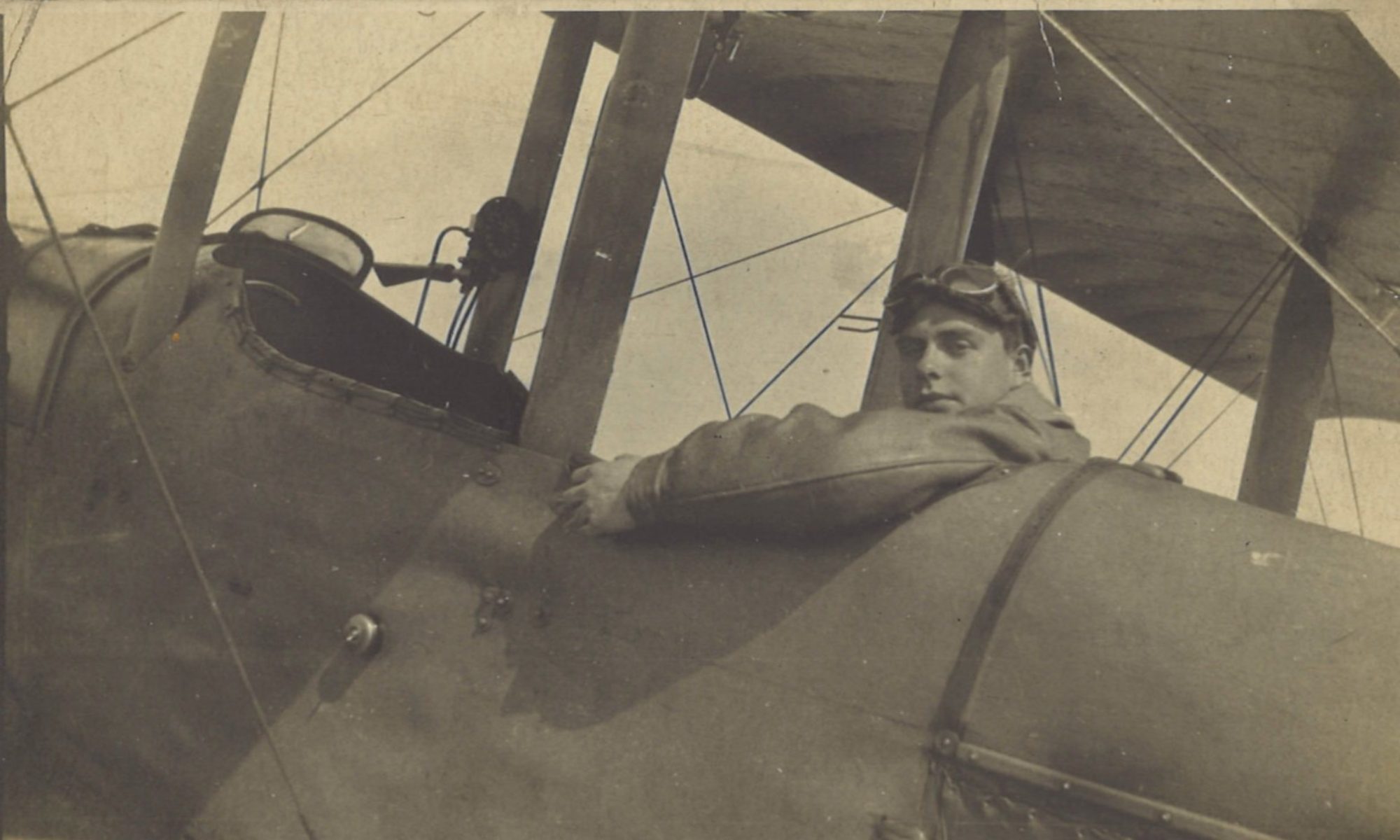
Whichever temperature scale you use, this is cold.  So the leather flying helmet, the goggles, the silk scarf, the fur gloves that make bear paws look small, the sheepskin boots, and the thick leather flying coat over the tunic all now make a lot more sense.

That’s it for a Few Days

The next entry in Greg’s pilot’s log book is for 20 April 1918.  Maybe he had some leave, in which case he probably went back home to Holyhead, or maybe he was still in Yatesbury at ground school.

À bientôt…


[1] Taken from the mountain meteorology site https://www.onthesnow.com/news/a/15157/does-elevation-affect-temperature

[2] http://www.csgnetwork.com/windchillcalc.html
 

© Copyright 2018- Andrew Sheard and licensors. All rights reserved.

Website powered by green energy