After three days of no flying, Greg had three flights in three different RE8s today with Lt Thomas as instructor, and a taste of aerial combat training in a DH.6:
Log book entry
Date: 12.4.18
Hour: 2.0
Instructor: Lt Thomas
Machine type and No.: RE4462
Passenger: Self
Time: 15 min
Height: 1000
Course: Aerodrome
Remarks: Dual. 1 landing.
Date: 12.4.18
Hour: 2.25
Instructor: –
Machine type and No.: RE6632
Passenger: –
Time: 40 min
Height: 2000
Course: [Aerodrome]
Remarks: Practice turns. 2 landings.
Date: 12.4.18
Hour: 3.35
Instructor: –
Machine type and No.: DH7672
Passenger: –
Time: 1 hr 30 min
Height: 2000
Course: [Aerodrome]
Remarks: Fighting (Offence solo)
Date: 12.4.18
Hour: 6.30
Instructor: –
Machine type and No.: RE4968
Passenger: –
Time: 35 min
Height: 1000
Course: [Aerodrome]
Remarks: Landings (five).
The outlook is grim. Operation Georgette progresses apace, as the header image shows, and the front line reached the middle of Merville by nightfall as German forces advance west.
“With our backs to the wall…”
In fact, the outlook is so grim, that on this day General Haig issued his famous ‘backs to the wall’ order:
SPECIAL ORDER OF THE DAY
By FIELD-MARSHAL SIR DOUGLAS HAIG
K.T., G.C.B., G.C.V.O., K.C.I.E.
Commander-in-Chief, British Armies in France
To ALL RANKS OF THE BRITISH ARMY IN FRANCE AND FLANDERS.
Three weeks ago to-day the enemy began his terrific attacks against us on a fifty-mile front. His objects are to separate us from the French, to take the Channel Ports and destroy the British Army.
In spite of throwing already 106 Divisions into the battle and enduring the most reckless sacrifice of human life, he has as yet made little progress towards his goals.
We owe this to the determined fighting and self-sacrifice of our troops. Words fail me to express the admiration which I feel for the splendid resistance offered by all ranks of our Army under the most trying circumstances.
Many amongst us now are tired. To those I would say that Victory will belong to the side which holds out the longest. The French Army is moving rapidly and in great force to our support.
There is no other course open to us but to fight it out. Every position must be held to the last man : there must be no retirement. With our backs to the wall and believing in the justice of our cause each one of us must fight on to the end. The safety of our homes and the Freedom of mankind alike depend upon the conduct of each one of us at this critical moment.
(Signed) D. Haig. F.M.
Commander-in-Chief,
British Armies in France
An RE8 of 42 Squadron RAF, Greg’s future squadron, saw aerial combat around Béthune:
42 Sqn Combat Report; Click or tap for larger image
Time: 2.42 p.m. Locality: BETHUNE
Pilot: 2/Lieut B. Martin; Observer: 2/Lieut J. R. Bono
Five hostile scouts. All were of same type, single seaters, believed to be Albatross Scouts, biplanes and no extensions, with Spad tails, marked black and white
Upon getting above clouds, Observer drew Pilot’s attention to 5 planes coming from North East. Upon reaching 3000 feet the E.A. formation was seen to swerve round and try to drive us over the line. Pilot turned slightly to West and by this time two of the leading E.A. dived on us, one diving directly on our nose which was engaged by the Pilot’s gun, nose to nose, and the other on the right wing was engaged by the Observer’s gun. The machine engaged by Pilot gave way and went under the machine and was not seen again and is believed to have been hit. Meanwhile the E.A. attacking on the right and engaged by Observer was seen to glide down and disappear in cloud, the Observer having fired one magazine into it. One of the other hostile planes was seen to fly towards and parallel to ours and Observer emptied another drum into it. Pilot was then entering clouds and E.A. went away. Ten minutes later 4 machines were seen approaching from enemy line from further North than place where last 5 E.A. were seen. They approached and Pilot disappeared under the clouds.
Header Image: Adapted from Map 7 of Haig’s Despatches ‘The German Offensive on the Lys, April 1918’. Credit: Imperial War Museum and Great War Digital
Despite the somewhat nondescript weather, another significant day dawned for Greg on Monday 8 April 1918:
four flights in three different aircraft types (BE2e, DH.6 and RE8);
first use of bombs;
first solo in RE8; and
Greg was awarded his RAF Graduation Certificate – his ‘wings’.
Log book entry
Date: 8.4.18
Hour: 5.55
Instructor: Lt Thomas
Machine type and No.: RE4462
Passenger: Self
Time: 45 min
Height: 1000
Course: [Aerodrome]
Remarks: Dual. Six landings.
Date: 8.4.18
Hour: 3.35
Instructor: –
Machine type and No.: BE 1358
Passenger: –
Time: 55 min
Height: 3000
Course: Bombs. Successful.
Date: 8.4.18
Hour: 3.00
Instructor: –
Machine type and No.: DH6 7226
Passenger: –
Time: 15 min
Height: 1500
Course: [Aerodrome]
Remarks: Turns
Date: 8.4.18
Hour: 6.45
Instructor: –
Machine type and No.: RE6632
Passenger: –
Time: 35 min
Height: 2000
Course: [Aerodrome]
Remarks: First solo. Two landings
Bombs
Greg dropped his first bombs (probably 20lb Coopers) during the flight at 3:35 pm from BE2e 1358, a photograph of which featured in an earlier post on 14 March and is reproduced again here:
BE2e A1358 at Yatesbury
RE8 Solo
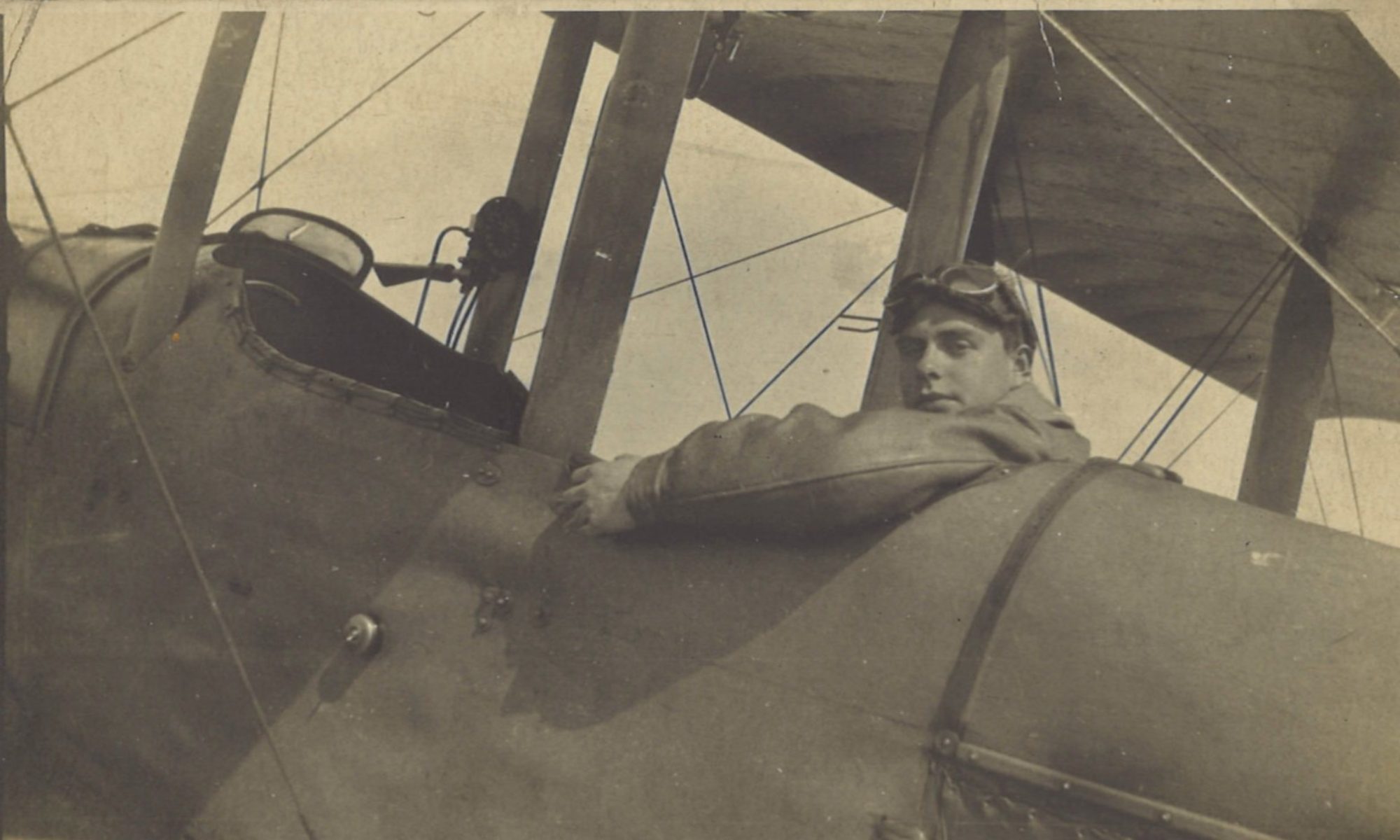
Greg’s first solo in an RE8 was significant enough for him to note in his log book. Possibly it was on this occasion that the following somewhat blurry photograph of him standing in front of an RE8 was taken:
Greg in front of RE8, probably at Yatesbury
Graduation
Greg’s RAF graduation certificate – a fairly crudely adapted RFC graduation certificate – was issued this day by the Central Flying School in Upavon (some 11 miles/18 km to the SSE of Yatesbury):
Greg’s RAF Graduation Certificate. Click or tap for larger image (opens in new tab).
And Finally, the Weather…
In Wiltshire the weather was overcast in the morning and mostly cloudy in the afternoon. Back home in Holyhead, by contrast, Greg’s parents would have enjoyed not only a little over four hours of sunshine, but also, according to the Met Office records, a solar halo:
Met Office weather record
In earlier times, one can imagine that this would have been seen as an omen.
On a day of intense flying in two aeroplanes, BE2e 8646 and RE8 3551, Greg spends almost 5 hours in the air over the course of five flights and 25 take offs and landings, three of which were in his first cross country flight:
Log book entry
Date: 7.4.18
Hour: 7.50
Instructor: Lt Thomas
Machine type and No.: BE2E 8646
Passenger: Self
Time: 35 min
Height: 1000
Course: [Aerodrome]
Remarks: Dual. Six landings.
Date: 7.4.18
Hour: 8.35
Instructor: –
Machine type and No.: BE2E 8646
Passenger: –
Time: 25 min
Height: 1500
Course: [Aerodrome]
Remarks: Solo. Two landings.
Date: 7.4.18
Hour: 11.15
Instructor: Lt Thomas
Machine type and No.: RE3551
Passenger: Self
Time: 1 hr
Height: 1000
Course: [Aerodrome]
Remarks: 12 take off and landings.
Date: 7.4.18
Hour: 2.35
Instructor: –
Machine type and No.: BE2E 8646
Passenger: –
Time: 1 hr 50 min
Height: 3000
Course: Cross Country
Remarks: Landed at Andover & Netheravon
Date: 7.4.18
Hour: 6.45
Instructor: –
Machine type and No.: BE2E 8646
Passenger: – Time: 1 hr 5 min
Height: 2500
Course: Aerodrome
Remarks: Practice turns & landings (2)
The single flight in the RE8 at 11:15 am was real ‘circuits and bumps’ practice: 12 times around in one hour.
The cross country solo flight from 2:35 to 3:35 pm reached 3,000 ft and covered a course of almost 50 miles: 24 miles to Andover, another 10 miles to Netheravon, and then back home to Yatesbury:
Yatesbury-Andover-Netheravon-Yatesbury cross country flight shown on a modern map (courtesy Google). Click for a larger, zoomable map (opens in new tab)
First take-off at 7:50 am and last landing at 7:50 pm: a long day.
Today was spent getting more familiar with the RE8, under dual control with Lt Thomas, and doing some consolidation solo work in the DH.6 – despite being forced down by storm:
Log book entry
Date: 2.4.18
Hour: 8.45
Instructor: Lt Thomas
Machine type and No.: RE3551
Passenger: Self
Time: 35 min
Height: 2500
Course: Aerodrome
Remarks: Dual.  Turns & landings
Date: 2.4.18
Hour: 10.10
Instructor: –
Machine type and No.: DH7670
Passenger: –
Time: 10 min
Height: 1000
Course: [Aerodrome]
Remarks: Left hand flying.  Forced down by storm
Date: 2.4.18
Hour: 11.15
Instructor: –
Machine type and No.: DH7670
Passenger: –
Time: 25 min
Height: 1000
Course: [Aerodrome]
Remarks: Landings (3)
Easter Monday 1918 was a significant day in several respects:
The RAF’s Birthday
First, it was the day on which the Royal Air Force was formed, by an amalgamation of the Army’s Royal Flying Corps and the Royal Naval Air Service.
Greg’s RAF Commission
Secondly, and not unconnected with the first point, it was the date from which Greg’s commission in the RAF was effective.
Greg’s RAF Commission, dated 1 November 1918 but effective from 1 April 1918. Click or tap for larger image.
First Flight in RE8
Thirdly, it was the date of his first flight in an RE8, the aircraft of his future squadron in France. Back to dual control for this. See the ‘Setting the Scene’ article on the Royal Aircraft Factory RE8 here.
Log book
Date: 1.4.18
Hour: 3.15
Machine type and No.: DH7226
Passenger: –
Time: 30 mins
Height: 1500
Course: [Aerodrome]
Remarks: Practice forced landings on aerodrome
Date: 1.4.18
Hour: 4.5
Machine type and No.: RE3551
Passenger: Self
Time: 10 mins
Height: 1000
Course: [Aerodrome]
Remarks: Dual.  Forced down by rain
Date: 1.4.18
Hour: 5.35
Machine type and No.: DH7672
Passenger: –
Time: 40 mins
Height: 1600
Course: [Aerodrome]
Remarks: Practice turns
Date: 1.4.18
Hour: 6.40
Machine type and No.: RE3551
Passenger: Self
Time: 25 mins
Height: 3000
Course: [Aerodrome]
Remarks: Dual.  Flying straight & turns
Date: 1.4.18
Hour: 7.30
Machine type and No.: DH7672
Passenger: –
Time: 35 mins
Height: 2600
Course: [Aerodrome]
Remarks: Practice S turns. Crashed.
Crash!
And fourthly, as the final log book entry of the day shows, it was the first time that Greg crashed an aeroplane: DH.6 7672, on the last flight of the day. Obviously not badly, as he was flying again the next day and the aircraft was soon back in service, but probably his ego was bruised if nothing else.
As the US aviator Chuck Yeager said, long after the First World War:
If you can walk away from a landing, it’s a good landing. If you use the airplane the next day, it’s an outstanding landing.
RAF Type A Roundel (WW1) credit: Wikimedia user NiD.29. Licensed under CC BY-SA 3.0, adapted with white surround.
42 Squadron RFC, Greg’s future squadron, saw multiple enemy aircraft engagements on this day. Aerial combat was by no means the primary role of RE8s, but they defended themselves as well as they could when they had to – successfully on each of the occasions described below.
The squadron had moved to Chocques only the previous Friday, 22 March 1918, but today was back in action in the Somme sector as part of the defence against Operation Michael of the Kaiserschlacht.
Three separate combat reports were filed by the crew of 42 Squadron aircraft that were on reconnaissance or bombing missions. The pilot of the third aircraft was the Squadron Commander, Major R. G. Gould, M.C.
RE8 3866
42 Sqn Combat Report; Click or tap for larger image
Time: 12 Noon; Locality: between VILLERS & BRAY SUR SOMME
Pilot: Lt A. D. McDonald; Observer: Lt J. Chatterton
Five E.A. Albatros scouts.
Crossed front S. of Albert and West of VILLERS. Just E. of Villers saw body of men and horses apparently in Coy formation. Bombs dropped at these and while observer concentrating on these with Lewis gun, pilot sighted one Albatros some distance below, apparently manoeuvring for tail position. Turned and steered westward, and immediately encountered four more E.A.. Two above and on left, and two about level and nearly behind. Enemy secured about 20 hits on our machine. Observer fired on one attacking machine behind us, and after 10 rounds gun jambed. Owing to mist and very thick haze, we were able to get away .
RE8 3598
42 Sqn Combat Report; Click or tap for larger image
Time: 5 p.m.; Locality: between BAPAUME & ALBERT
Pilot: 2/Lt A. R. Holthouse; Observer: Capt. M. F. Bridge
Albatros Scouts (7) seven.
After bombing and shooting on ground targets from 3000 ft to 7800 feet, in vicinity of BAPAUME, 7 Albatros scouts attacked us.
Fought down to 3000 feet, when relief arrived by our own scouts, believed to be S.E.5’s.
About 10 shots only obtained out of Vickers gun, when it jambed. Four shots went through propeller. Old Vickers gear on gun – unsatisfactory.
Lewis gun also jambed, and both guns were out of action.
Controls and machine shot about. Large holes in tail, sight, & tank from A.A.
Observer wounded in leg.
Machine landed at No.2 A.F.C. Aerodrome.
RE8 5886
42 Sqn Combat Report; Click or tap for larger image
Time: 6.30 p.m.; Locality: MORLANCOURT
Pilot: Major R. G. Gould, M.C. ; Observer: 2/Lt. D. G. Smith
Albatross Scout
One drum fired at E.A. after which he turned away, and did not worry us again.
The remainder of the enemy formation was engaged by other British Machines.
On the day Greg begins flight training, the RE8s of 42 Squadron RFC, his future squadron in France, arrive at Fienvillers in the Somme department from Poggia Renatico, near Ferrara in Italy. The squadron had been in Italy since November 1917. Fienvillers is some 16 miles/25 km NNW of Amiens.
42 Squadron RFC returns to Fienvillers in the Somme from Poggia Renatico, Ferrara, Italy, shown on a present day map (courtesy Google) – click for an interactive map (opens in new tab).
42 Squadron had been formed on 1 April 1916 at Filton, near Bristol. It left for France in August 1916 and was successively located at St Omer, La Gorgue (near Merville, on the Lys, west of Lille), Ballieul and Fienvillers/Candas (Somme). A tour of Italy followed (Santa Pelagio, Istrana, Grossa, Santa Luca and Poggia Renatico), before returning to Fienvillers on 14 March 1918. Hat tip to Trevor ‘fetubi’ of The Great War Forum for the list of 42 Squadron locations.