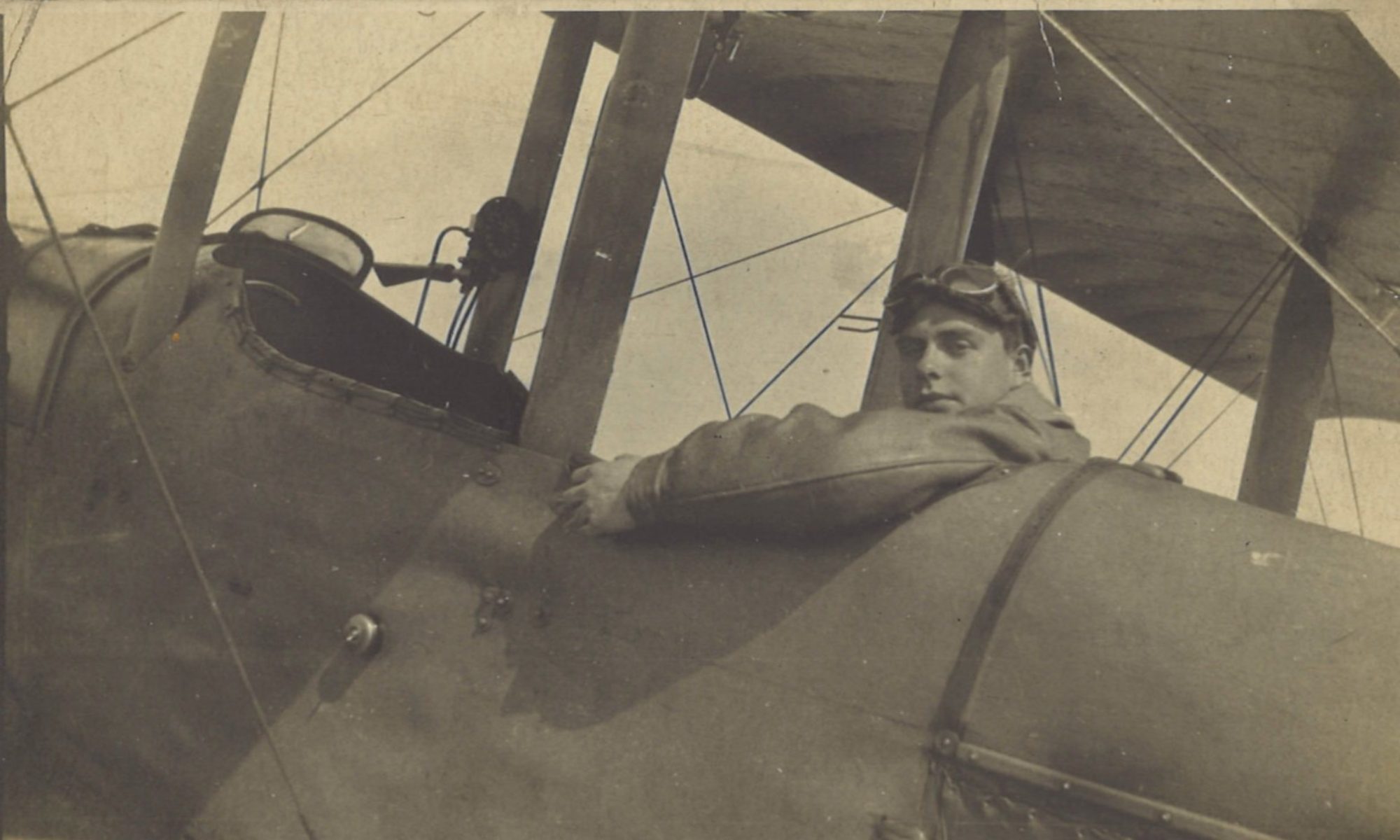
Monday 6 May 1918 – Farewell to Yatesbury

With three last flights today, Greg’s basic training is over. A successful time with the camera, at last: 18 plates exposed and no reported jamming.  Greg’s final flight at Yatesbury was in a BE2e, the type of aircraft in which he had his first flight on 14 March 1918.

Log book entry
Log book entry
Date: 6.5.18 
Hour: 2.0 
Machine type and No.: RE 5146 
Passenger: – 
Time: 1 hr 0 m 
Height: 2500 
Course: – 
Remarks: Photos. 18 plates exposed
Date: 6.5.18 
Hour: 5.50 
Machine type and No.: RE 5148 
Passenger: – 
Time: 40 m 
Height: 1500 
Course: – 
Remarks: Practice turns etc. 1 landing
Date: 6.5.18 
Hour: 7.25 
Machine type and No.: BE 8660 
Passenger: – 
Time: 40 m 
Height: 1500 
Course: – 
Remarks: Camera

It was just over seven weeks since Greg’s first flight:

Thursday 14 March 1918 – Flying Training Starts

Good-bye-ee!

So the instructors would see another batch of students off, and the young airmen would wonder what their fate would be.  Goodbyes all round:

And no doubt there would be some convivial celebration.  At the Officers’ Mess, maybe?  Or perhaps at a nearby hostelry, such as the Waggon & Horses in Beckhampton, which doesn’t look as if it has changed much in the last 100 years…apart from the addition of a TV aerial:

Waggon & Horses, Beckhampton
Waggon & Horses, Beckhampton. Image Credit: Laurie Barber. Tap or click to see source


As the song goes:

Bonsoir old thing, cheerio! chin chin!
Nah-poo! Toodle-oo!
Good-bye-ee!

To Hursley Park…

Greg’s training would continue at Hursley Park in Hampshire, with the next entry in his log book being dated 16 May 1918.  And before the month was out he would be posted to France.

Saturday 4 May 1918 – Shoot, but No Photos

Following on from Greg’s work on zone calls on 29 and 30 April, today saw another exercise in doing a shoot – directing artillery fire onto a target.  That was evidently more successful than the two attempts at photography that followed: one was thwarted by engine trouble, and the other by the camera jamming.

Log book entry
Log book entry
Date: 4.5.18 
Hour: 4.0 
Machine type and No.: RE 6647 
Passenger: – 
Time: 1 hr 20 m 
Height: 1500 
Course: Shoot 
Remarks: Successful
Date: 4.5.18 
Hour: 6.35 
Machine type and No.: RE 6632 
Passenger: – 
Time: 10 m 
Height: 1500 
Course: Photos 
Remarks: Engine dud
Date: 4.5.18 
Hour: 7.5 
Machine type and No.: RE 5146 
Passenger: – 
Time: 50 m 
Height: 2000 
Course: Photos 
Remarks: Camera jambed

A Little More on Shoots

If zone calls are essentially about target acquisition for the artillery, then shoots are about target degradation and ideally destruction.  In a shoot, the aircraft was again the artillery’s ‘eye in the sky’, to direct fire onto a target.  

The corps squadrons of the Royal Air Force, and the Royal Flying Corps before them, worked with siege batteries of the Royal Garrison Artillery.  Each battery might comprise four artillery pieces, for example 6″ or 8″ howitzers.  The battery’s fire was directed from the air using ‘clockface’ radio signals in which the centre of an imaginary clockface was superimposed on the target and a number from 1 to 12 was used to indicate direction of a shell’s impact point from the target, with 12, 3, 6 and 9 representing north, east south and west respectively.  The number was preceded by a letter code to indicate how far away the shell landed. The following diagram illustrates the numbers and letters:

Aeroplane to Artillery - Clock Code
Aeroplane to Artillery – Clock Code. From “Co-operation of Aircraft with Artillery” Revised Edition, Issued by the General Staff, December 1917

A small complication was that the letter O was used instead of the number 12, in order to shorten messages.

The distance codes were:

  • OK – Direct hit
  • Y – 10 yards
  • Z – 25 yards
  • A – 50 yards
  • B – 100 yards
  • C – 200 yards
  • D – 300 yards
  • E – 400 yards
  • F – 500 yards

So a near ideal sequence of signals for successive shells might be (in Morse code):

  • C3 – shell landed 200 yards to the eastof the target
  • A9 – shell landed 50 yards to the west
  • OK – direct hit.

Ground-to-air signals from the battery to the aircraft were by means of ground strips. 

Artillery to Aeroplane - Ground Signals.
Artillery to Aeroplane – Ground Signals. From “Co-operation of Aircraft with Artillery” Revised Edition, Issued by the General Staff, December 1917

For more, see:

Friday 5 April 1918 – Landings and Ground Strips

For more on zone calls see:

Monday 29 April 1918 – Zone Calls


Thursday 2 May 1918 – A Busy Day

Greg’s time at Yatesbury was coming to an end, and on this windy and probably frustrating day he practised landings and tried to practice aerial firing – but he had trouble with the gun.

Date: 2.5.18 
Hour: 8.5 
Machine type and No.: RE 5146 
Passenger: – 
Time: 30 m 
Height: 2000 
Course: [Aerodrome] 
Remarks: Very windy. Practice 1 landing
Date: 2.5.18 
Hour: 10.30 
Machine type and No.: RE 5146 
Passenger: – Time: 25 m 
Height: 2000 
Course: [Aerodrome] 
Remarks: Practice 1 landing
Date: 2.5.18 
Hour: 1.25, 2.10 & 2.25 
Machine type and No.: RE 6647 
Passenger: – 
Time: 35 m, 15 m & 10m 
Height: 1500 
Course: Aerial firing
Remarks: Gun jambed [sic].

Gun Jambed

Interesting spelling of “jambed”, which is regarded as incorrect today.  It clearly wasn’t some idiosyncrasy of Greg’s, as the Aerial Combat reports of the time used the same spelling, as in this blog entry for 27 March 1918:

Wednesday 27 March 1918 – 42 Squadron in Aerial Combat

Whether or not the spelling was common, the problem certainly was evidently more common than it should have been – both for guns and camera jambing, or, as we would say, jamming.  


Monday 29 April 1918 – Zone Calls

In an important training exercise, Greg begins today to practice ‘zone calls’.

Log book entry

Log book entry

Date: 29.4.18 
Hour: 2.35 
Machine type and No.: DH 5155 
Passenger: – 
Time: 55 m 
Height: 3000 
Course: Aerodrome 
Remarks: Practice.
Date: 29.4.18 
Hour: 5.55 
Machine type and No.: DH 5155 
Passenger: – 
Time: 1 h 20 m 
Height: 3000 
Course: – 
Remarks: Zone calls
Date: 29.4.18 
Hour: 8.0 
Machine type and No.: RE 5146 
Passenger: – 
Time: 30 m 
Height: 2500 
Course: Aerodrome 
Remarks: Practice 1 landing.

Zone Calls

Zone calls are one way wireless messages by Morse code from aircraft to artillery batteries giving information about targets, such as enemy batteries firing, enemy transport and troop movements. 

A zone call might be something like:

NF L 26 c 2 0

Zonecall map
Example of a zone call, with map reference – somewhere in France. All will be revealed on 8 August (although there is enough information in this post to identify where…).  Adapted from 1:10,000 scale trench map (credit: Great War Digital).

This would mean:  Guns Now Firing from a position at map reference L 26 c 2 0. Maps of the Western Front (and presumably maps used by Greg’s Training Squadron at Yatesbury) used a reference system that was a combination of squares and a grid. 

  • Each 1:40,000 map sheet was divided into twenty-four 6,000 yd squares, arranged in a 6 x 4 array and lettered A to X – in our case, L
  • Each 6,000 yd square was in turn subdivided into thirty-six 1,000 yd squares, numbered 1 to 36 – in our case, 26.
  • Each 1,000 yd square was then subdivided into four quadrants (a, b, c, d) – in our case, c.  
  • Finally, a decimal grid reference (eastings and then northings) was used to specify the intended position with the required degree of precision.  This could be to one significant figure as in our example (2 0), which identified a 50 yd square.  Or it could be to two significant figures if greater precision was desired and achievable (22 01, for example), which would identify a 5 yd square within the 50 yd square denoted by 2 0.

Fine levels of detail are not visualisable on a 1:40,000 map.  The artillery and infantry tended to use 1:20,000 and 1:10,000 scale maps, depending on the purpose in hand, which were revised periodically as trenches and other ground features changed.  These revisions, incidentally, would rely heavily on the aerial photography of work of the corps squadrons.  The complete map reference would include the number of the 1:40,000 sheet (eg Sheet 36A, to give 36A  L 26 c 2 0), but the sheet number was typically understood in context and therefore omitted in zone calls.

If this combination of squares and grid references sounds complicated, it is not actually different in principle from an Ordnance Survey grid reference, which in one of its incarnations uses a combination of an identified square and a decimal grid reference within the square.  For example, the OS reference SU 053711 is based on a 100 km square designated SU and then, within that square, a three significant figure decimal grid reference 053 711. This in turn identifies a 100 m square – which, as it happens, is on the former Yatesbury airfield (1:50,000 Landranger sheet 173 in today’s OS maps).

A zone call was a one way wireless message from the aircraft to an artillery battery on the ground.  Ground to air communication was done by ‘ground strips’, as explained in this earlier post:

Friday 5 April 1918 – Landings and Ground Strips

Saturday 27 April 1918 – Yet More Landings

Only one flight today after yesterday’s four, but still practising landings:

Log book entry

Log book entry

Date: 27.4.18 
Hour: 5.30 
Machine type and No.: RE 6647 
Passenger: – 
Time: 55 m 
Height: 3000 
Course: [Aerodrome] 
Remarks: Landings 4.

You can’t really over-practice landings.  After all, in aviation it was as true in 1918 as it is today that although takeoffs are optional, landings are mandatory.

Friday 26 April 1918 – Landings and More Landings

Log book entry

The order of the day was clearly to practice landings, and that’s what Greg did, again and again…

Log book entry
Log book entry
Date: 26.4.18 
Hour: 3.15 
Machine type and No.: RE 6647 
Passenger: – 
Time: 30 m 
Height: 2000 
Course: Aerodrome 
Remarks: Landing in circle 2.
Date: 26.4.18 
Hour: 4.15 
Machine type and No.: RE 6647 
Passenger: – 
Time: 10 m 
Height: 2000 
Course: [Aerodrome] 
Remarks: Landing in circle 1.
Date: 26.4.18 
Hour: 4.35 
Machine type and No.: RE 6647 
Passenger: – 
Time: 35 m 
Height: 2000 
Course: [Aerodrome] 
Remarks: Landing in circle 2.
Date: 26.4.18 
Hour: 7.30 
Machine type and No.: RE 6632 
Passenger: – 
Time: 25 m 
Height: 2000 
Course: [Aerodrome] 
Remarks: Landings 2.

Thursday 25 April 1918 – Formation Flying, Compass Course and Vacuum Control

Yatesbury-Marlborough-Swindon circuit

Three flights today: the first in an RE8 around the aerodrome – with an intriguing entry (‘Vacuum Control’) in the Remarks column – and two further afield flying in formation and on a compass course.

Log book entry

Log book entry

Date: 25.4.18 
Hour: 2.50 
Instructor: – 
Machine type and No.: RE 6647 
Passenger: – 
Time: 45 m 
Height: 4500 
Course: Aerodrome 
Remarks: Vacuum control
Date: 25.4.18 
Hour: 5.55 
Instructor: – 
Machine type and No.: DH6 7670 
Passenger: – 
Time: 55 m 
Height: 2000 
Course: Marlboro. Swindon. Aerod. 
Remarks: Formation
Date: 25.4.18 
Hour: 1.10 
Instructor: Lt Gowler 
Machine type and No.: RE 3551 
Passenger: – 
Time: 50 m 
Height: 2000 
Course: Compass course (Wootton Basset, Chippenham & 
        Devizes. 5 forced landings) 
Remarks: DUAL

Vacuum Control

So what was the ‘vacuum control’ of the first entry (but not the first flight) of the day?  I’m grateful to Duncan Curtis, who has provided this authoritative explanation:

‘Vacuum Control’ relates to a feature on some aircraft/engines, whereby the carburettor/s were equipped with vacuum controls. The vacuum control feature allows the pilot to adjust engine mixture for altitude: on early engines no adjustment; then on some engines manual adjustment; and finally all engines gained automatic adjustment via vacuum bellows (post-WW1).  For service types equipped with these engines (of which the RE8 was one), the pilot had to demonstrate correct operation prior to graduating ‘B’ on his operational type.

Requirements to graduate 'B' (from Higher Instruction), referring to Vacuum Controls in point 8.
Requirements to graduate ‘B’ (from Higher Instruction), referring to Vacuum Control in point 8. Click for larger image. Credit: Duncan Curtis
A page from the RE8 parts catalogue showing carburettors were fitted with vacuum control.
A page from the RE8 parts catalogue showing that Claudel and BB carburettors were fitted with vacuum control. Click for larger image. Credit: Duncan Curtis

[Topic updated 25 September 2018]

Formation Flying

The second aerial event of the day was some formation flying on a circuit from Yatesbury to Marlborough to Swindon and back, a distance of some 30 miles (48 km):

Yatesbury-Marlborough-Swindon Circuit
Yatesbury-Marlborough-Swindon flight shown on a modern map (courtesy Google). Click for a larger, zoomable map (opens in new tab)

Cross Country

The third entry in the log book, but actually the first flight of the day, was a cross-country compass course under dual control with Lt Gowler as instructor.  The course was a 34 miles (54 km) circuit from Yatesbury to Wootton Basset to Chippenham to Devizes and back.

Yatesbury-Wootton-Chipp-Devizes cross country route
Yatesbury-Wootton Bassett-Chippenham-Devizes cross country route shown on a modern map (courtesy Google). Click for a larger, zoomable map (opens in new tab)

Wednesday 24 April 1918 – Shooting with Gun and Camera

A day of varied activity, and varying degrees of success.  First some aerial combat practice in a DH.6.  Secondly an outing in an RE8 to take photos and do a shoot – presumably an artillery shoot, as on 22 April – which this time was recorded as unsuccessful.

Log book entry

Log book entry

Date: 24.4.18 
Hour: 2.25 
Instructor: – 
Machine type and No.: DH6 9762 
Passenger: – 
Time: 45 m 
Height: 1500 
Course: Aerodrome 
Remarks: Fighting
Date: 24.4.18 
Hour: 4.40 
Instructor: – 
Machine type and No.: RE 5146 
Passenger: – 
Time: 1 hr 0 
Height: 2000 
Course: Photos & shoot 
Remarks: Unsucc.


Tuesday 23 April 1918 – Unsuccessful Photos (Again)

St George’s Day 1918 🏴󠁧󠁢󠁥󠁮󠁧󠁿 dawned with clear skies, turning overcast through the course of the morning – but no rain or mist.  So the weather was not to blame for the second unsuccessful attempt at photographs, which followed a routine practice flight.  Both flights were in RE8s:

Log book entry
Log book entry
Date: 23.4.18 
Hour: 7.40 
Instructor: – 
Machine type and No.: RE 4968 
Passenger: – 
Time: 40 mins 
Height: 2000 
Course: Aerodrome 
Remarks: Practice. 1 landing.
Date: 23.4.18 
Hour: 10.50 
Instructor: – 
Machine type and No.: RE 5148 
Passenger: – 
Time: 1 hr 5 m 
Height: 2000 
Course: Photos 
Remarks: Unsuccessful


Saturday 13 April 1918 – Height Test

Weather for 13 April morning

The misty and gloomy weather today put paid to an attempt at photography in an RE8.  But it was an opportunity to rise above the murk in a height test, in which Greg took a BE2e to over 8,000 ft.

Log book entry

Log book entry

Date: 13.4.18 
Hour: 9.10 
Instructor: – 
Machine type and No.: RE6632 
Passenger: – 
Time: 20 min 
Height: 1500 
Course: Photos, unsuccessful owing to heavy mist.
Date: 13.4.18 
Hour: 10.15 
Instructor: – 
Machine type and No.: BE8646 
Passenger: – 
Time: 45 min 
Height: 8,200 
Course: [Aerodrome] 
Remarks: Height test.

Heavy Mist

The Met Office’s weather report for Salisbury Plain for the morning of 13 April was the laconic c . omg. Since we are in 1918 and not 2018, the meaning was not “cloudy . omigod” but “cloudy, turning to overcast, mist and gloom”.  This was certainly consistent with heavy mist rendering the attempt at aerial photography unsuccessful.

Up where it’s cooler…

But 45 minutes after landing, Greg was up in the air again to do a height test, and he reached 8,200 ft. 

So how cold was it up there?  Well, the recorded minimum and maximum temperatures for Salisbury Plain that day were 37°F and 52°F, respectively.  So let’s assume that at mid-morning in Yatesbury it was 45°F (7°C) at ground level.  

Using the temperature gradient for low altitudes[1] of

  • -3.3°F/1,000 ft in cloud and 
  • -5.4°F/1,000 ft in clear air,

and assuming for the sake of argument that there was

  • 2,000 ft of cloud and 
  • 6,200 ft of clear air

that gives a temperature at 8,200 ft of around 5°F or -15°C.

But what about wind chill?  Greg was in an open cockpit, with an indicated air speed in the BE2e probably between 50 and 70 mph, so it would have felt colder.

How much?  Assuming a speed of 55 mph and using the wind chill calculator at CSGnetwork.com[2], we obtain:

  • -48°F or -44°C using the old formula and
  • -25°F or -32°C using the new formula.

Not having a good basis to choose between them and therefore splitting the difference, we end up with a temperature that feels something like -37°F or -38°C

Whichever temperature scale you use, this is cold.  So the leather flying helmet, the goggles, the silk scarf, the fur gloves that make bear paws look small, the sheepskin boots, and the thick leather flying coat over the tunic all now make a lot more sense.

That’s it for a Few Days

The next entry in Greg’s pilot’s log book is for 20 April 1918.  Maybe he had some leave, in which case he probably went back home to Holyhead, or maybe he was still in Yatesbury at ground school.

À bientôt…


[1] Taken from the mountain meteorology site https://www.onthesnow.com/news/a/15157/does-elevation-affect-temperature

[2] http://www.csgnetwork.com/windchillcalc.html


© Copyright 2018- Andrew Sheard and licensors. All rights reserved.

Website powered by green energy