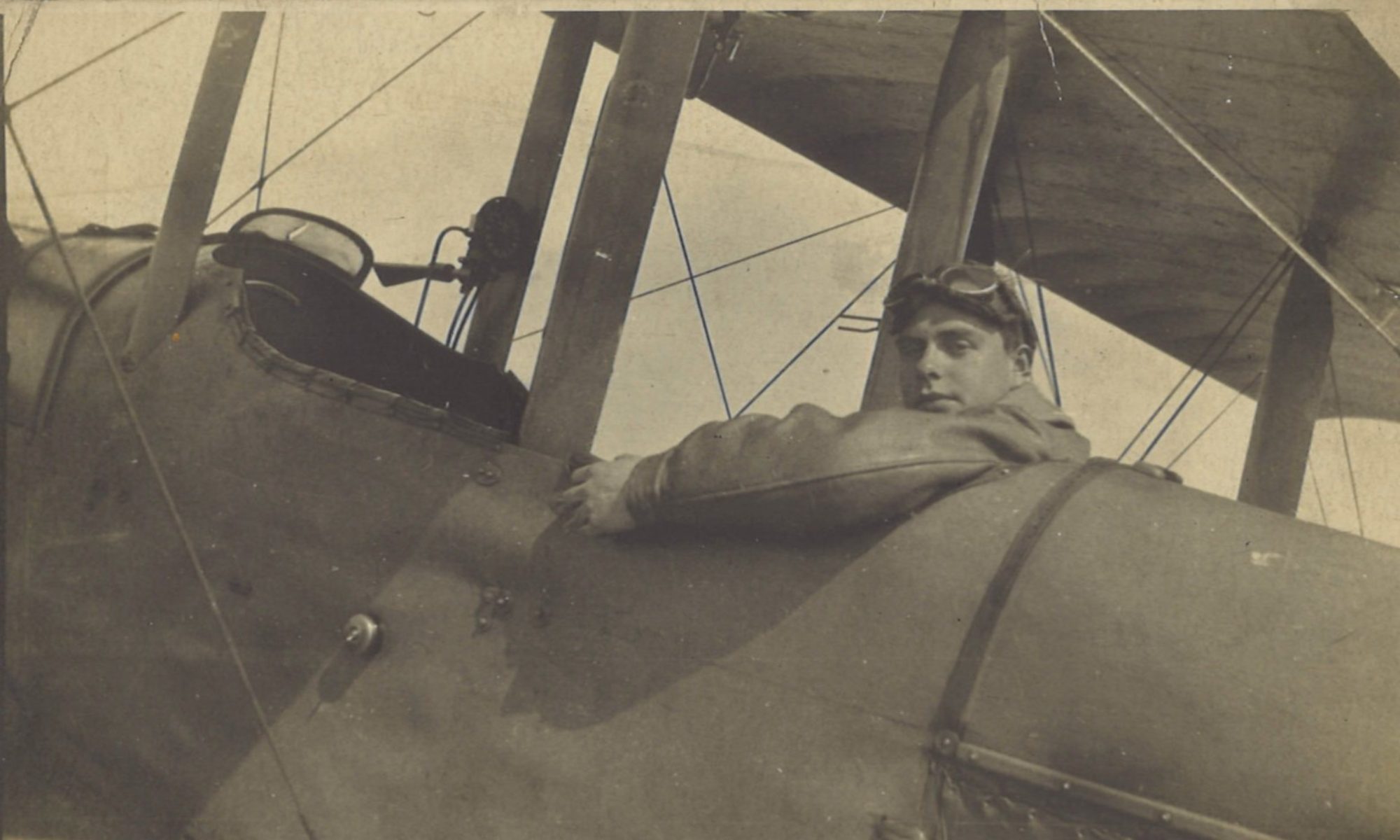
Monday 3 June 1918 – Arrived at 42 Sqn at Rely

After his long journey and spending the night in a railway truck in Aire-sur-la-Lys, Greg finally made it in the morning to his squadron – No. 42 Squadron RAF, Major H. J. F. Hunter, M.C., commanding – at Rely Aerodrome.  He had a first, short flight with the squadron that afternoon.

Diary

Diary
Diary
Monday June 3rd 1918.  Phoned up to 42 Squadron for tender.

Managed to find an Hotel with someone in, where we had breakfast.

Arrived Squadron (at Rely, nr Estrée Blanche, west of Merville) about 9.30am.  Posted to B flight. (Merville – midway between Ypres & Arras.)

[Side note] Squadron about midway between Ypres & Arras.  Front includes Eastern edge of Forest of Nieppe & down to where the line cuts the La Bassée canal north of Béthune.

Log Book

Log book
Log book
Date: 3.6.18 
Hour: 1.30 
Machine type: RE8 
No.: - 
Passenger: Sandbag flight 
Time: 10 min 
Height: 1500 
Course: Aerodrome 
Remarks: Good landing

Rely Aerodrome

So began Greg’s time at Rely, where he was to spend several months.  Rely is a small village set amongst farmland on the gently rising ground to the west and south of the Lys.  It is about 31 miles (50 km) WSW of Lille.  If the name seems familiar to British travellers to France today, it is probably because the Aire de Rely is the first eastbound service area on the A26 autoroute (L’Autoroute des Anglais) from Calais.  

Rely, Merville and Lille map
Rely, Merville and Lille on a modern map (courtesy Google). Click for a larger, zoomable map (opens in new tab).

The First World War aerodrome at Rely was at 50°34’44” N 2°21’4″E (hat-tip to Anciens Aerodromes) , which places it on the Rue de Liettres, NW of the village centre just on the 100 m contour line.  The site looks like this in Google Street View today:

 RE8 E102

As it happens, today was the day that the Squadron’s daily orders recorded that the RE8 aircraft with the serial number E102, which was to be allocated to Greg the following day, was officially transferred to the strength of the squadron:

Daily orders for 3 June 1918

E102 had come from No 1 Aero Supply Depot.  Following the Spring Offensives on 15th April No 1 ASD and its repair section moved from St Omer to Marquise, 8 miles (13 km) NE of Boulogne – http://1914-1918.invisionzone.com/forums/topic/121124-northern-area-repair-depot/.

The Front Line

The sector of the front line on which 42 Sqn was working ran, as Greg notes, from the east of the Nieppe Forest (just west of Merville) to the La Bassée canal near Béthune:

Front Line near Merville map
The Front Line near Merville, from Gen. Haig’s despatches. Image credit: IWM/GreatWarDigital

Most of the action that Greg saw would be in the north of this sector, near Merville.

Sandbag Flight

As Greg had no observer or passenger with him on his first short flight, he had to carry sandbags to ensure that the aeroplane was properly balanced, as explained here, under the heading “Crew”:

The Royal Aircraft Factory RE8

So now he was ready for whatever the next day would bring.


Header image: site of First World War Rely Airfield, from Google Street View.

Sunday 2 June 1918 – Air combat

Meanwhile at 42 Squadron…

There was another air combat today at Neuf Berquin near Merville:

Air combat report
Air combat report. Click for larger image
Time: 6.30 a.m.  
Locality: MERVILLE
Pilot: Capt. R. A. Archer, M.C.  
Observer: 2/Lieut. H.C. Grimes 

5 Albatros Scouts of whom only 3 persisted.  

While over NEUF BERQUIN saw 5 aeroplanes patrolling about same height over ESTAIRES.  Went on South.  the 5 aeroplanes who proved to be hostile got into the sun over us.  We turned towards our own lines.  When about over L'EPINETTE, L.7.c, 3 dived on us firing.  Seeing none of our own machines about we side-slipped home, recrossing the line at about 1500' at LE SART.  During the whole of the fight, the Observer fired his gun at the E.A. but Pilot made no effort to get the Vickers on.  3 of the E.A. persisted in the attack until our lines were reached.
Map extract of Neuf Berquin, Estaires and Le Sart,
Map extract of Neuf Berquin, Estaires and Le Sart, from 1:40,000 series. Estaires is 15 miles (24 km) west of Lille  and 4 miles (6 km) east of Merville.  Each numbered square is 1,000 yds. Click for larger image. Credit: IWM/GreatWarDigital

Looks a bit like a late realisation that the aircraft were hostile.  And then the pilot was fully preoccupied in getting them back to safety.

Tuesday 28 May 1918 – Three Air Combats for 42 Sqn

Meanwhile in France (again)…

…almost 70 miles (110 km) to the north of the battle at Cantigny, 42 Squadron was having a busy day dealing with enemy aircraft, with three ‘Combats in the Air’ reports being filed about activity over Calonne and Le Sart, either side of the River Lys to the west of Merville, itself 17 miles (30 km) west of Lille:

Calonne and Le Sart
Calonne and Le Sart, near Merville, from 1:40,000 scale map. Click for larger image. Map credit IWM/GreatWarDigital

1. Capt. Davis and Lt Chatterton

This crew had a tough time against 12 aircraft only three days ago on 25 May 1918

Air combat report
Air combat report – click for larger image
Time: 5.15 a.m.  
Locality: CALONNE
Pilot: Capt. A. E. Davis  
Observer: Lieut. J. Chatterton, M.C. 

Three small two-seater Fighters, and one with slight extensions on top plane.  

While doing a shoot 4 E.A. appeared over CALONNE.  I turned West but one machine dived on our tail and fired continuously.

Observer fired about 100 rounds into this E.A. which then turned away.  The second then dived and also fired continuously.  Observer fired another drum at about 200 yards into this E.A. which also turned East.

A third machine then dived on us but after firing about 100 rounds on us the whole formation withdrew East.

Vickers gun fired about 50 rounds at E.A. after they had turned East.

2. Lt. Welsh & 2/Lt. Watkins

Air combat report
Air combat report – click for larger image
Time: 10.30 a.m.  
Locality: LE SART
Pilot: Lieut A. W. Welsh 
Observer: 2/Lieut H. Watkins 

Two seater, possibly Aviatik  

R.E.A. [Reconnaissance Enemy Aircraft] obviously trying to bomb our trenches dropped 3 at LE SART, during which time he was fired at back by back and then front gun.  He immediately flew back over MERVILLE to ESTAIRES.

3. Lts. Puckle and Nicolson

This was another crew that had seen air combat recently: on 19 May 1918 and  22 May 1918.

Air combat report
Air combat report – click for larger image
Time: 4.35 p.m.  
Locality: CALONNE 
Pilot: Lieut H. Puckle 
Observer: Lieut J. F. W. Nicolson 

Four two seaters, one with extensions, type unknown.  Machine which fired on our tail had two guns.  Machines had a blue bottom plane (underneath) and large blue patch under the fuselage.  Very small black crosses.   

While flying over CALONNE 4 E.A. two seaters were sighted.  Pilot fired 25 rounds into 1 E.A., then gun jambed.  E.A. then turned on R.E.8. and got one on the tail.  Observer fired 250 rounds into this E.A. which turned East and flew with the others towards MERVILLE. 

One machine had a kidney-shaped tail (not the one with extensions) thus: [see image]  The extensions on the only E.A. which had them were short and square.


Monday 27 May 1918 – Last Day of Training

So this was it. The last day of training in a (relatively) safe environment, with no-one wishing you harm, and no one shooting at you from the ground or the air.

The last day at Hursley Park/Worthy Down was evidently something of a recap, with a shoot (complete with ground strips) and zone calls being rehearsed.  Not a bad thing, either.

Log book entry
Last log book entry during training
Date: 27.5.18 
Hour: – 
Machine type and No.: RE 6650 
Passenger: – 
Time: 1 hr 15 m 
Height: 3000 
Course: Shoot. Gr. Str. & Zonecalls 
Remarks: Successful

More on shoots:

Saturday 4 May 1918 – Shoot, but No Photos

More on ground strips:

Friday 5 April 1918 – Landings and Ground Strips

More on zone calls:

Monday 29 April 1918 – Zone Calls

Farewell to Hursley Park and Worthy Down.  From now on, it was for real.

Sunday 26 May 1918 – Two Shoots

On his penultimate flying day at Hursley Park/Worthy Down, Greg is in intensive training for his work with the artillery on the Western Front.  Two shoots today, one marred by a dodgy engine (a problem that would be recurrent on active service) and the other recorded as successful.

Log book entry
Log book entry
Date: 26.5.18 
Hour: 9.45 
Machine type and No.: RE 4479 
Passenger: – 
Time: 35 m 
Height: 2000 
Course: Shoot 
Remarks: Engine missing badly
Date: 26.5.18 
Hour: 10.45 
Machine type and No.: RE 4529 
Passenger: – 
Time: 1 hr 15 m 
Height: 3000 
Course: Shoot 
Remarks: Successful

More on shoots here:

Saturday 4 May 1918 – Shoot, but No Photos

Saturday 25 May 1918 – 42 Sqn in Air Combat

Meanwhile in France…

…it was another day of aerial combat for an RE8 of 42 Squadron, which was – alarmingly – outnumbered 12 to 1 but survived:

Air combat report
Air combat report – click for larger image
Time: 12.10 p.m.  
Locality: K.28 
Pilot: Capt. A. E. Davis 
Observer: Lieut. J. Chatterton, M.C. 

12 single seater machines, type unknown.
Machines had extension on top planes and slight
dihedral.

 
At 12.10pm two formations of six machines each 
appeared over MERVILLE.  One machine dived on us and
fired about 50 rounds.  Observer fired a burst of 25
rounds with Lewis into this machine which then 
turned away.  A second E.A. then dived and followed 
us down to 4000 feet, firing all the time.  Observer
fired another 70 rounds into this machine which did
a sharp "Immelmann" and turned East. Vickers [the 
pilot's gun] fired about 50 rounds at machines 
retreating.

K.28

“K.28” refers to a 1,000 yd x 1,000 yd square just west of Merville, itself 17 miles (30 km) west of Lille:

K.28, near Merville map.
K.28, near Merville, from 1:10,000 scale map. Click for larger image. Map credit IWM/GreatWarDigital

The centre of K.28 was a mile or so behind, i.e. to the east of, the German front line at the time.

“Immelmann”

The “Immelmann Turn” is associated with and was possibly devised by the German Pilot Max Immelmann.

According to Wikipedia:

In World War I aerial combat, an Immelmann turn was a maneuver used after an attack on another aircraft to reposition the attacking aircraft for another attack.

After making a high-speed diving attack on an enemy, the attacker would then climb back up past the enemy aircraft, and just short of the stall, apply full rudder to yaw his aircraft around. This put his aircraft facing down at the enemy aircraft, making another high-speed diving pass possible. This is a difficult maneuver to perform properly, as it involves precise control of the aircraft at low speed. With practice and proper use of all of the fighter’s controls, the maneuver could be used to reposition the attacking aircraft to dive back down in any direction desired.

The manoeuvre is illustrated in a 1918 RNAS handbook as follows:

Immelmann Turn
The Immelmann Turn, illustrated by E. L. Ford, from ‘Practical Flying’, RNAS, 1918

Immelmann famously flew Fokker Eindeckers, including the E.III as pictured (probably at Upavon in Wiltshire) in this post:

Wednesday 1 May 1918 – The Enemy Close at Hand


Saturday 25 May 1918 – Another Shoot

In his last three days of flying from Worthy Down while training at Hursley Park, Greg has another shoot:

Log book entry
Log book entry
Date: 25.5.18 
Hour: 4.15 
Machine type and No.: RE 6650 
Passenger: – 
Time: 1 hr 0 m 
Height: 3000 
Course: Shoot 
Remarks: Successful

The timing, although late in the day at 4:15 pm, was early enough to avoid the murky weather moving in from the west by evening:

Weather map for 25 May 191
Met Office weather charts for morning and evening of 25 May 1918. Click for larger image. Contains public sector information licensed under the Open Government Licence v1.0

More on shoots here:

Saturday 4 May 1918 – Shoot, but No Photos

Wednesday 22 May 1918 – 42 Sqn in Air Combat Again

Meanwhile in France…

Lts Puckle (Pilot) and Nicolson (Observer) of 42 Sqn RAF again saw aerial combat, only three days after their last encounter.  This time they were on photographic duty, and were incidentally attacking enemy kite balloons near Estaires when they became entangled with a couple of Albatros scouts.  Presumably the job of the scouts was to defend the kite balloons.

Time: 11.35am  
Locality: ESTAIRES 
Pilot: Lt H. Puckle Observer: Lt J. F. W. Nicolson

Two Albatros Scouts. 

While attacking 4 E.K.B. at R.4, R.11, R.17, G.20, two Albatross Scouts were seen by Observer to be climbing up to machine about 1500 feet below. Observer fired a drum of Lewis into nearest E.A. which spun down, flattened out and flew away East. The other Scout also flew away.

Estaires

The map squares R.4, R.11, R.17 and G.20 (1:40,000 sheets 36A and 36) are either side of Estaires, which is in the Département du Nord on the River Lys, about 15 miles (24 km) west of Lille:

Estaires and its environs map
Estaires and its environs. Scale: 1:40,000 on original print; each numbered square is 1,000 yds (914 m). Map credit: IWM/TNA/RGS/GreatWarDigital

Sunday 19 May 1918 – 42 Sqn in Air Combat

Meanwhile in France…

While Greg was at Hursley Park, an RE8 of 42 Sqn RAF saw aerial combat this day while Lts Puckle (Pilot) and Nicolson (Observer) were on artillery registration duty at 6:30am.  “Artillery registration” was more informally known as a “shoot” – the process of directing fire from a battery onto a target, typically a hostile battery, as practised by Greg at Yatesbury on 4 May 1918:

Saturday 4 May 1918 – Shoot, but No Photos

Lts Puckle and Nicolson’s report was as follows:

Time: 6.30am Locality: Between NIEPPE FOREST and 
                       MERVILLE

Pilot: Lt H. Puckle Observer: Lt J. F. W. Nicolson
Two seater, either an Albatros or resembling one

The E.A. was first fired on when flying north from 
MERVILLE and 500 feet above us.  Two drums were fired
at him when he turned and flew towards MERVILLE, 
and in flying somewhat across his track 1½ drums were
fired, and the E.A. disappeared into the haze over 
ESTAIRES apparently undamaged.

Merville and the Nieppe Forest Map
Merville and the Nieppe Forest. Scale: 1:40,000 in original print; each numbered square is 1,000 yds (914 m). Map credit: IWM/TNA/RGS/GreatWarDigital

The area between the Nieppe Forest and Merville, on the River Lys.  Merville is 17 miles (30 km) west of Lille. Map credit: Imperial War Museum/Great War DigitalSo no harm done (or inflicted).  But a nervous moment for the crew of an RE8, which was not built for elective aerial combat.  The risks were never far away.

The combat report was signed by Major H. J. F. Hunter MC, who on 17 April 1918 had taken over as the new CO of 42 Sqn from Major R. G. Gould MC.  Major Hunter would be in charge when Greg was posted to the squadron in June.

Thursday 16 May 1918 – First Day of Flying in Hampshire

With ground transport being arranged from Hursley Park to the aerodrome at Worthy Down, Greg took to the air again in an RE8 to practice aerial firing and photography with the Artillery & Infantry Co-operation School.

Date: 16.5.18 
Hour: 11.0 
Machine type and No.: RE 6616 
Passenger: – 
Time: 30 m 
Height: 1500 
Course: Aerodrome 
Remarks: Aerial firing (150 rounds)
Date: 16.5.18 
Hour: 1.45 
Machine type and No.: RE 2472 
Passenger: – 
Time: 1 hr 5 m 
Height: 2500 
Course: Photography 
Remarks: Camera jambed after 8th plate
Date: 16.5.18 
Hour: 3.40 
Machine type and No.: RE 2472 
Passenger: – 
Time: 1 hr 0 m 
Height: 3500 
Course: Photography 
Remarks: Eighteen plates exposed. Successful.

Second time lucky with the camera.

And at the end of the day it was back in the transport to Hursley Park:

From Hursley Park to Worthy Down
From Hursley Park to Worthy Down and back at the end of the day. Click or tap for a larger, zoomable image. Reproduced with the permission of the National Library of Scotland.

Greg’s next recorded flight would be on Tuesday 21 May 1918.

© Copyright 2018- Andrew Sheard and licensors. All rights reserved.

Website powered by green energy