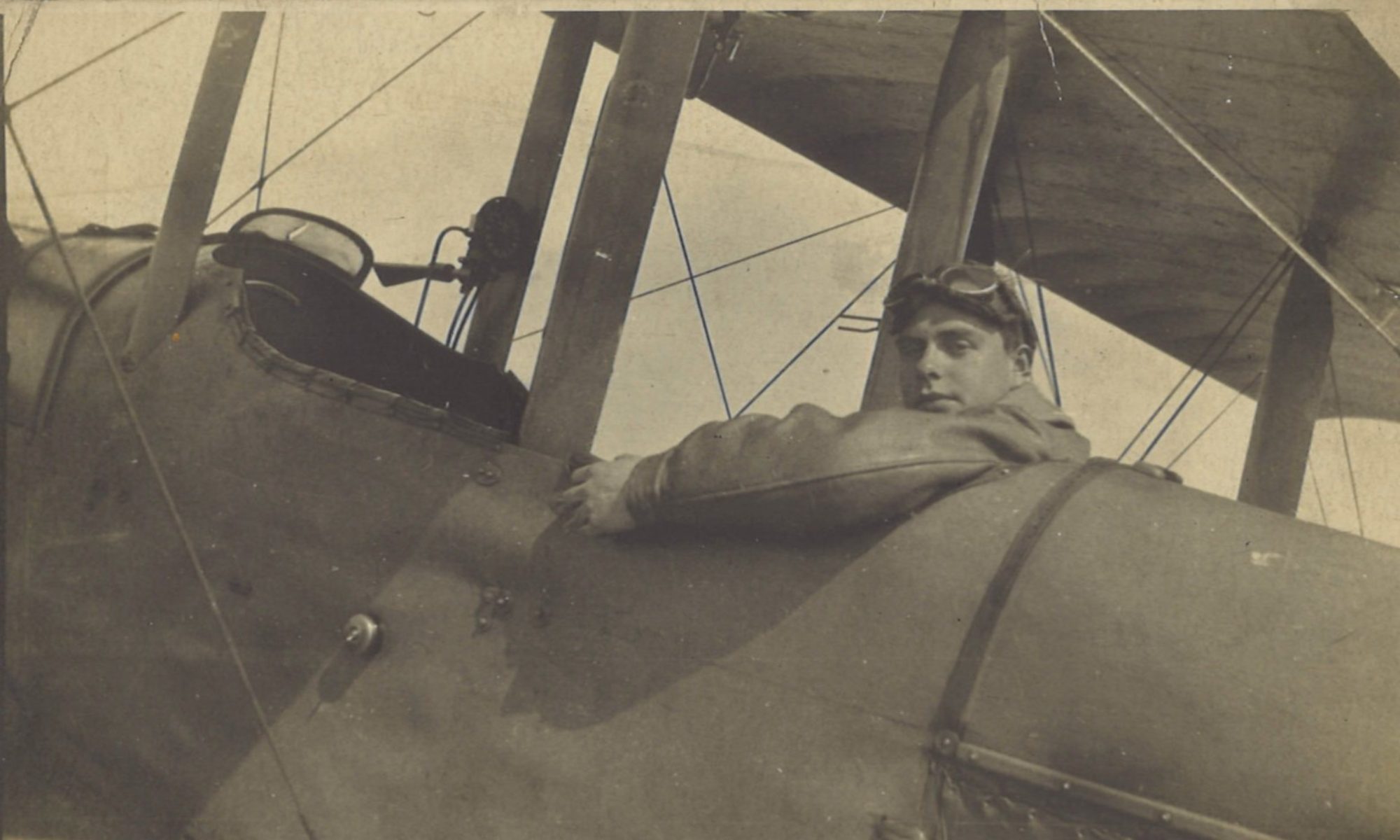
Friday 12 July 1918 – General Birdwood Visits

After his 2 am return from Paris-Plage, Greg was probably glad not to have an early start.  In fact, he didn’t have much of a start at all as his aircraft’s engine had an oil leak, and he didn’t fly.  The big event of the day was a visit by General Birdwood, commander of the Fifth Army.

Diary

DiaryDiary

Friday July 12th 1918.  Found that the oil filter on my engine was leaking, so engine was taken out of E27.

Weather pretty dud, heavy rain in morning, afternoon fine but very windy.

General Birdwood came round in the morning (commanding 5th Army) and spoke to us all. Seemed a nice chap.

Watch the Birdy

General Sir William Birdwood visited 42 Squadron at Rely, not many miles from his headquarters at Upen d’Aval, just west of Thérouanne.  Michael Seymour looks at the the man and the reasons for his visit, and finds a resonance with Greg’s characterisation of him as “a nice chap”:

General Birdwood

Daily Orders Show Greg Confirmed in Rank

In other news, the day’s Daily Orders from Major Hunter report that Greg is no longer on probation but has been confirmed in rank as a (temporary) 2nd Lieutenant:

Daily Orders extract
Daily Orders extract – 12 July 1918

The Daily Orders are written in their customarily elegant way.  Rob (Parsons) thinks that it would almost certainly have been the Orderly Room Clerk who was the scribe.  There would have been a Sergeant in charge, responsible for all the written records, disciplinary procedures etc. And then there would have been a Squadron Adjutant, possibly as a secondary duty.

To give a flavour of administrative operation of the squadron that day, here is a complete copy of the the day’s Daily Orders.  Note the incorrect date on the top right of the first page.  It was definitely 12 July that the orders relate to.  But the clerk’s mind seems to have wandered back to May!

Wednesday 10 July 1918 – Shadows over Target

An aviator’s life on the Western Front in 1918 was bedevilled by two factors – in addition to the small matter of the enemy, that is.  They were mechanical unreliability (of armaments, engines and other equipment) and the weather.  Today, Greg’s engine was better than it was yesterday, but it was another day for the weather to assert itself, as a Counter Battery Patrol evolved into a Shoot.  Even fair weather can cause problems, in the form of shadows over the target, and that was before the rainstorm approached.

Log Book

Log BookLog Book

Date: 10.7.18 
Hour: 3.40 
Machine type: RE8 
No.: E27 
Passenger: Lt Pring 
Time: 1 hr 45 
Height: 5000 
Course/Remarks: CBP & shoot with 14 SB. Successful.  Rainstorm.  Eng better.

Diary

Diary

Wednesday July 10th. CBP at 5.30pm (1hr 45 m). 5000 ft.

Took up a shoot with 14 Siege Battery (6” Hows).

Shoot successful.  Large number of W’s owing to clouds throwing shadows over target.

Archie pretty hot, unable to go over target.

Engine running better.

Two bombs dropped.

Target at L.20.a

So weather-related problems are not confined to bad weather as such:  shadows from clouds over the target meant that a large number of the battery’s rounds were unobserved – hence the ‘W’, for washout.  And then came a rainstorm…

Squadron Record Book

Type and Number: R.E.8.27

Pilot and Observer: P. Lt Gregory. O. Lt Pring

Duty: Art Obs 14 S.B. (6” How) on L.C.21. [northeast of Merville; see below]

Hour of Start: 5.40pm

Hour of Return: 7.25pm

Remarks:

SUCCESSFUL. Called up 5.48pm.  K. 5.50.  L. 5.55.  G. 5.58.  V. 6.45.  Time G. to V. 45 mins.

OBSERVED:- M.C.3.  M.C.5.  1 O.K.  1 Y.  8 A.  11 B.  4 C.  1 D.  11 W.  37 ranging rounds.  M.O.K. sent during B.F.  One direct hit on ranging pit which was badly damaged.  No 1 Pit believed damaged but owing to A.A. could not properly inspect target.  Shoot by P.  Height 5000’.

MISC INF. 5.56pm 2-25lb bombs dropped at K.28.c.5.3.  Both bursts observed.  7.5pm sent C.I. [going home] owing to approaching storm. A.A. active.  Vis. good but shadowy.
Obs. By P. & O.

Successful Shoot, Despite Shadows over Target

This was Greg’s second shoot with 14 Siege Battery. This link is to the post that recounts the first, which was just over a week ago on 2 July:

Tuesday 2 July 1918 – Shoot with 14SB

The ‘G to V’ time – the time taken to range the howitzers – was 45 minutes, down from 1 hr 20 mins last time, which will have pleased Greg, the Squadron Commander and the Battery Commander.  Eleven ‘washouts’ – unobserved shells – wasn’t so good, but explained by the shadows from the clouds.

Target LC 21 was in the 500 yard square L.20.a, northeast of Merville, but Greg dropped his two bombs on the other side of town.  He dropped them on the Rue d’Aire going west out towards Haverskerque.  The time was 5.56pm, just as he was about to begin ranging the guns (‘G’ – the ‘fire’ signal – was at 5:58pm).  The battery itself was probably located a mile or two further west, near Haverskerque.

1:20,000 map of Merville dated 22 May 1918
1:20,000 map of Merville dated 22 May 1918. Numbered squares are 1,000 yards across. Red markings are German trenches, tramways and other works.

One hundred years after Greg bombed the Rue d’Aire, I drove along it.  I can report that the road has been repaired.

For more details on how a shoot operated, see this page:

Observation of Artillery Fire – A Shoot

To see how zone numbers such as LC 21 were allocated to targets, see “Assigning a Zone Number to the Target” on this page:

Counter Battery Patrols and Zone Calls


Monday 8 July 1918 – Jolly Good Shoot

Although Greg’s ‘bus’ – RE8 E27 – had had its propeller fixed, all was still not well, as the engine was backfiring. But what seems to have been the decisive factor in making the morning’s scheduled Counter Battery Patrol a washout was the weather.  The day improved with a ‘jolly good shoot’ with 174 Siege Battery (6″ Howitzers) in the evening.

Log Book

Log BookLog Book

Date: 8.7.18 
Hour: 8. 
Machine type: RE8 
No.: E27 
Passenger: Lt Pring 
Time: 30 mins 
Height: 2000 
Course/Remarks: CBP. Heavy fog.  Came down. Eng. Pretty dud.
Date: 8.7.18 
Hour: 6.30 
Machine type: RE8 
No.: E27 
Passenger: Lt Pring 
Time: 2 hr 10 mins 
Height: 5000 
Course/Remarks: Shoot with 174.  Successful. Eng. missing

Diary

Diary

Monday July 8th 1918. CBP 8-11.

Very cloudy & misty, took off without bombs & went to look at the line & came back after 30 minutes.

Engine missing, seemed inclined to backfire.

6.30pm.  Went up and did a shoot on a Hun battery at K.35.d.1.2

Jolly good shoot.  Both pits badly knocked about, one direct hit on one, which went up in the air.

One shell dropped in the river, great big column of water about 500 ft.

The Hun battery that was the target of the ‘jolly good shoot’ with 174 Siege Battery RGA  was on the southern edge of Merville, just above what is now Merville-Calonne Airport.  Its position is shown on the following map, along with the positions of the house and factory referred to in the Squadron Record Book report below.

Map of position of battery at K.35.d.1.2
Position of battery at K.35.d.1.2 etc on a 1:20,000 map dated 27 June 1918. Each square with a number in its centre (like 35) is 1,000 yards. Map credit: IWM/TNA/GreatWarDigital
 Modern 1:25,000 map of shoot
The equivalent extract from a modern 1:25,000 map. Credit: GreatWarDigital.

Squadron Record Book

Squadron Record Book

Type and Number: R.E.8.27

Pilot and Observer: P. Lt Gregory. O. Lt Pring

Duty: Art Obs 174 S.B. (6” How) on H.B. at K.35.d.10.20

Hour of Start: 6.40pm

Hour of Return: 8.30pm

Remarks: SUCCESSFUL. Called up 6.50pm.  K. 6.52pm.  L 6.54.  G. 6.58.  V 8.0. Time G. to V. 1 hr 2 mins. [time taken to range guns]

OBSERVED:- M.A.9.  M.A.2. 1 O.K. 12.A. 13 B. 12 C. 1 D. 39 ranging rounds.  2 M.O.K. during B.F.  [Two mean points of impact of salvos were direct hits during battery fire] Both pits badly damaged.  Fire caused in house at K.35.b.5.2. Shoot by P.  Height 5000’.

MISC INF.  6.50pm large fire in Factory at K.35.b.4.4. burning continuously.  200 rounds fired into MERVILLE STATION.  Vis. fair.  Obs. By P. & O.

More details about shoots and how to interpret Squadron Record Book reports of them:

Observation of Artillery Fire – A Shoot


Sunday 7 July 1918 – Elevator Rocking Bar Shot

On a murky and misty day – “frightfully dud” was the verdict – Greg was down for a Counter Battery Patrol/Artillery Patrol in the morning but signalled that the weather was unfit.  He dropped one bomb, had an elevator rocking bar shot, made a bad landing and bust the prop.  Then he took another machine up, but the weather was still bad.

Log Book

Log BookLog Book

Date: 7.7.18 
Hour: 8.15 
Machine type: RE8 
No.: E27 
Passenger: Lt Pring 
Time: 30 mins 
Height: 1500 
Course/Remarks: CBP. V Dud.  Elevator rocking bar shot.
Date: 7.7.18 
Hour: 9.45 
Machine type: RE8 
No.: 2327 
Passenger: Lt Pring 
Time: 1 hr 10 m 
Height: 1500 
Course/Remarks: CBP. Very misty & cloudy.

Diary

Diary

Sunday July 7th 1918. Wrote AD [?]. Sent field card home.

8.15-8.45 Took off with four bombs.  Could only get one of them off.  Frightfully dud morning, low clouds and heavy mist.  Got the right hand elevator rocking bar shot.  Overshot on landing & ran into some boxes & broke propeller.  1 bomb.

9.15-11.0 Took up Hutchinson’s bus with a shoot.  Too dud. Good landing.

Squadron Records

The day’s flying is fleshed out a bit in the official report:

Squadron Record Book

Type and Number: R.E.8.27

Pilot and Observer: P. Lt Gregory. O. Lt Pring

Duty: Artillery Patrol

Hour of Start: 8.15am

Hour of Return: 8.45am

Remarks: 
8.30am 1-25lb bomb dropped at K.34.b.5.5. [Rue de Bournoville, Merville] Burst unobserved. 

8.35am sent U.L. U.R. U.D. C.8.  [Unfit for counter-battery work; unfit for artillery registration; unfit for photography; clouds at 800 ft] Very heavy ground mists and fog.  Machine hit on elevator rocking bar.  No E.A. A.A. or E.K.B.  [No enemy aircraft, anti-aircraft fire or enemy kite balloons]

Vis. very poor.  Obs. By P. & O.

Because there were no enemy aircraft and no anti-aircraft fire, it looks as if the rocking bar must have been hit with small arms fire from the ground.  Something of a lucky hit for the shooter at 1500 ft through cloud.

Type and Number: R.E.8.2327

Pilot and Observer: P. Lt Gregory. O. Lt Pring

Duty: Artillery Patrol

Hour of Start: 9.55am

Hour of Return: 10.55am

Remarks: 
10.0am small explosion at E.30.d.4.4. [La Couronne, between Vieux Berquin and Neuf Berquin] 

10.5am sent U.L. U.R. U.D. C.15.  [Unfit for counter-battery work; unfit for artillery registration; unfit for photography; clouds at 1500 ft] Clouds in places below 1200'. Very thick mist prevented observation. No E.A. A.A. or E.K.B.  [No enemy aircraft, anti-aircraft fire or enemy kite balloons]

Vis. very poor.  Obs. By P. & O.

Wrote AD [?]. Sent field card home.

So there was time left for correspondence.  Not sure who “AD” is – or even if it is AD.  If it were AG (which is just possible), it could be either Alice Gregory (Greg’s sister) or Albert Gertrey (Greg’s fellow student from flying training in Yatesbury).

Saturday 6 July 1918 – Dud Day with a Joy Ride

Greg was down to do a shoot but it didn’t happen, presumably because of the weather.  The only flying was a brief joy ride with an infantry officer in the evening.  A good opportunity to catch up on correspondence.

Log Book

Log BookLog Book

Date: 6.7.18 
Hour: - 
Machine type: RE8 
No.: E27 
Passenger: Inf. Chap 
Time: 15 mins 
Height: 2000 
Course/Remarks: Joy ride.

Diary

Diary

Saturday July 6th 1918.  Wrote Home.  Down for a shoot.  Too dud all day, but took up an infantry officer for a joy ride in the evening.

More on “dud” here:

Monday 10 June 1918 – Pretty Dud Day

Sunday 30 June 1918 – CBP – Weather OK, Engine Bad

An improvement in the weather meant that today’s Counter Battery Patrol could go ahead more or less as planned, but it was marred by engine trouble.  (If it’s not one thing, it’s the other.)  So Air Mechanic Corkhill came up for a test ride in the afternoon.  And there was time for some correspondence.

Log book

Log bookLog book

Date: 30.6.18 
Hour: 10.30 
Machine type: RE8 
No.: E27 
Observer: Lt Watkins 
Time: 1 hr 5 m 
Height: 4500 
Course/Remarks: CBP. Engine very bad.

Date: 30.6.18 
Hour: 5 
Machine type: RE8 
No.: E27 
Observer: AM Corkhill 
Time: 30 m 
Height: 2500 
Course/Remarks: Engine test.

Diary

Diary

Sunday June 30th. C.B.P with Lt Watkins.  Engine nothing great, sent FL FR UD (10.30am).

Received parcel of mags & stockings.  Wrote home.

5.30 pm. Took up mechanic with E.27 for engine test.  Engine apparently OK.

“Sent FL FR UD”

This was the weather report that Greg sent at 10:30am:

  • FL – fit for counter battery work
  • FR – fit for registration (of artillery fire)
  • UD – unfit for photography


Saturday 29 June 1918 – CBP Cancelled by Weather

The weather continued to interfere with the work of 42 Squadron.  Following yesterday’s cancellation of a shoot, today the weather forced Greg down 10 minutes after take off for a Counter Battery Patrol.  Also, Lt Ives is posted to the Home Establishment. 

Log Book

Log bookLog book

Date: 29.6.18 
Hour: - 
Machine type: RE8 
No.: E27 
Observer: Lt Pring 
Time: 10 m 
Height: 600 
Course/Remarks: Weather test. (CBP.)

Diary

Diary

Saturday June 29th. CBP at 8.am with Lt Pring.  Weather very dud, came down after 10 mins.

In Other News…

Today’s Routine Orders contain the news that Lt. Edward Leslie Ives, seconded from the West Yorkshire Regiment to the Royal Flying Corps and Royal Air Force, was posted on 28 June 1918 to the Home Establishment:

Daily orders
42 Squadron daily orders for 29 June 1918. Click for larger image

Lt Ives is seen here with Lt Whittles in their flying kit next to an RE8 at Rely:

Lts Ives and Whittles
Lts Ives and Whittles next to an RE8 at Rely. Click for larger image


Wednesday 19 June 1918 – Fruitless Reconnoitre

On another damp day around the River Lys, Greg takes Lt Watkins as observer, since Roche has flu. Central Wireless Station tells them to reconnoitre an area by l’Épinette, southeast of Merville.  But they didn’t see any guns firing and the damp air leads to water in the carburettor again.

Log Book

Log BookLog Book

Date: 19.6.18 
Hour: 3.30 
Machine type: RE8 
No.: E27 
Observer: Lt Watkins 
Time: 1 hr 10 m 
Height: 3000 
Course/Remarks: CBP. Came down due to water in 
                carburettor.

Diary

Diary

Wednesday June 19th. E27. Roche got an attack of the ‘flu’.  Took up Watkins as observer, saw one Hun.

Asked C.W.S. for a target & got R VII.  Went over to reconnoitre square R7 but owing to smoke from a fire just to windward was unable to see any guns firing in that square.  Weather pretty dud & damp.

“Asked C.W.S. [Central Wireless Station] for a target”

CWS was the squadron’s Central Wireless Station.  This station operated one of the squadron’s two radio receivers.  The other was at Station Headquarters for practice and tests.  As the General Staff’s “Co-operation of Aircraft with Artillery” booklet (SS 131) explains:

…the Central Wireless Station should be at some central position in the corps area sufficiently far back to prevent jambing. This station acts as a link between the squadron commander and his machines working on the line, and is of great value in preventing incipient failures in their initial stages.  … Its utility is largely dependent on quick telephone communication to the squadron and to batteries.  Whenever possible, therefore, it should be located near Corps Heavy Artillery Headquarters, whose direct lines run to the above units.  At this station are also taken weather reports, hostile aircraft reports and, in case of sudden enemy bombardments or attacks, calls for reinforcing machines.

Square R7

This would be square R7 in Sheet 36A (zone RA), 2 miles (3.2 km) SSE of Merville, near Lestrem.  At the time, there was some kind of well defended German post or position there, at l’Épinette:

Map of R7
Extract of 1:20,000 ‘Harassing Fire’ map showing Square R7 of 1:40,000 Sheet 36A and l’Épinette. This was the square given by the Central Wireless Station. Red markings show German trenches and wire entanglements. Black marking show centres of activity, occupied areas and numbered targets. Triangles indicate dumps, and the flag shows a headquarters position. The map is dated 27 June 1918, with trenches correct to 16 June 1918.

Nowadays, l’Épinette is on the southern edge of Merville-Calonne Airport:


Sunday 16 June 1918 – Double CBP

Two Counter Battery Patrols today, and more bombing and machine gun activity:

Log Book

Log bookLog book

Date: 16.6.18 
Hour: 1.30 
Machine type: RE8 
No.: E27 
Observer: Lt Roche 
Time: 2 hrs 
Height: 3000 
Course/Remarks: CBP. V bumpy.
Date: 16.6.18 
Hour: 4.30 
Machine type: RE8 
No.: E27 
Observer: Lt Roche 
Time: 1 hr 
Height: 2500 
Course/Remarks: CBP. Engine backfiring.

Diary

Diary

Sunday June 16th.  E27.  CBP. Saw several huns.  Dropped four bombs & fired 100 rounds.  Sent UL UR UD. Got a lot of water in carb.

“Saw Several Huns” – Albatros C series?

Greg doesn’t record what sort of German aircraft he saw that day. They might have been scouts (fighters), or they may have been Albatros C series reconnaissance/light bombing aircraft (essentially the German equivalent of RE8s) such as this:

Albatros C
Albatros C series (C.III?) reconnaissance aircraft. Credit: Greg’s War Collection.

“Dropped four bombs and fired 100 rounds”

The bombs would have been the nominal 20 lb Cooper bombs featured yesterday.  The armaments of the RE8 are given here:

The Royal Aircraft Factory RE8

Later in his log book Greg would record the number of bombs dropped and rounds fired, and from which gun, but he hadn’t started doing that at this stage.

“Sent UL UR UD”

Following on from yesterday’s post, in which Greg sent FL FR FD, these were weather signals sent to the squadron’s Central Wireless Station (CWS):

  • UL: Weather unfit for counterbattery work
  • UR: Weather unfit for registration [of artillery fire onto a target]
  • UD: Weather unfit for photography.

And after sending that trio, he no doubt headed for home: retour à Rely.

Hat tip again to The Long, Long, Trail for the letter codes.


© Copyright 2018- Andrew Sheard and licensors. All rights reserved.

Website powered by green energy