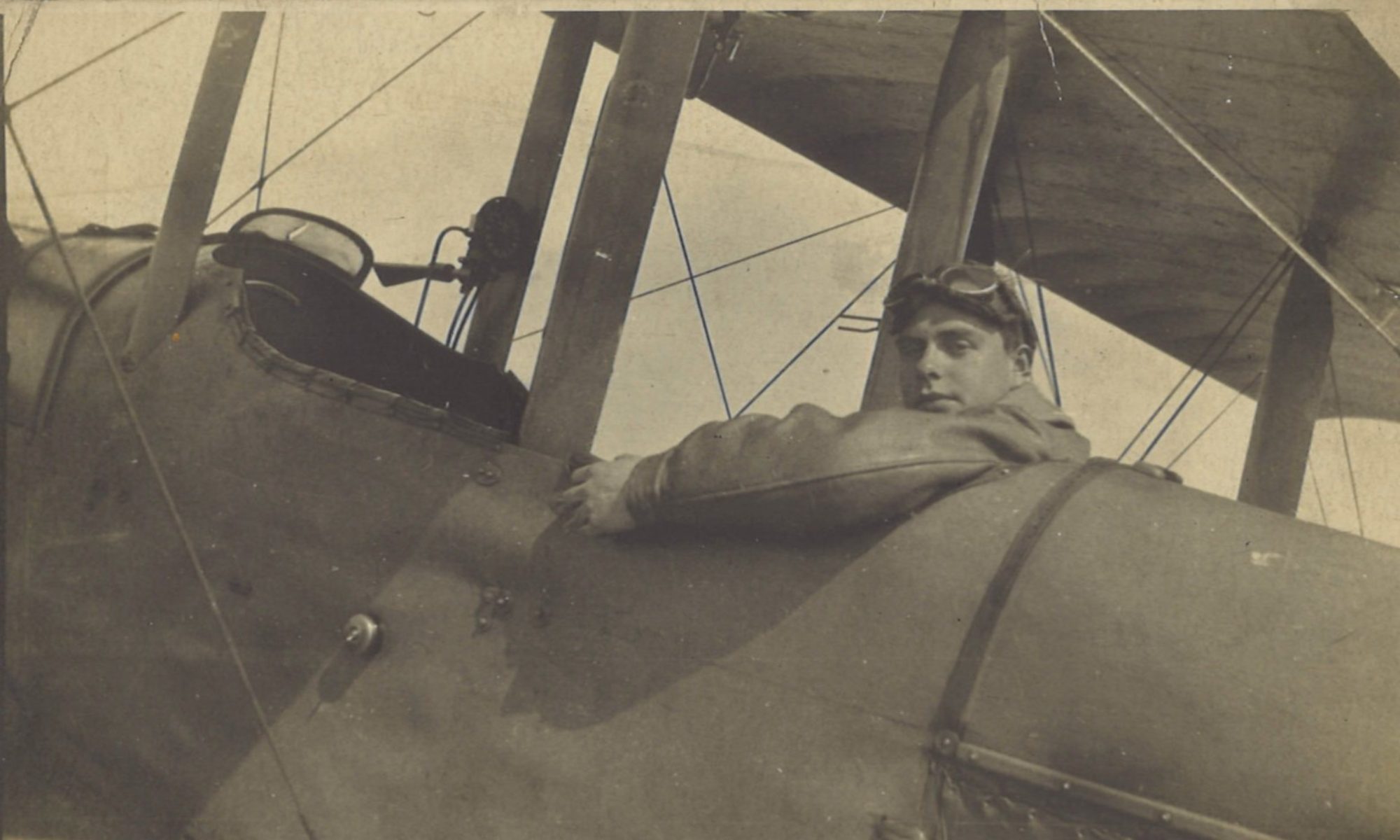
After only a couple of weeks at Aulnoy-lez-Valenciennes, 42 Squadron RAF is on the move once more – to nearby Saultain Aerodrome. Greg and Lt Scarterfield take RE8 2924 to the squadron’s new home.
Log Book
Date: Dec 11thMachine Type: RE8
RE8: 2924
Observer: Scarterfield
Time: 05 min
Height: 500
Course/Remarks: Travelling to Saultain
Squadron Record Book
Squadron Record Book (SRB) entry. Click for larger image.
Type and Number: R.E.8.2517*
Pilot and Observer: P. Lt Gregory. O. Lt Scarterfield
Duty: Travelling Flight
Hour of Start: 1135
Hour of Return: 1145
Remarks: Travelling flight to new aerodrome.
*There is a discrepancy in the aircraft serial number between Greg’s log book and the SRB. Probably the log book is correct. As will be seen, the log book records that Greg came back to Aulnoy in a couple of days to ferry 2517 to Saultain. Whereas the SRB has him flying 2517 on both occasions, which would be as pointless as it is unlikely.
42 Squadron Moves to Saultain Aerodrome
This was the shortest move that the squadron made while it was on the Western Front in 1918: a trip ENE of all of 2.3 miles (3.7 km)! Aulnoy is about 2 miles (3 km) south of Valenciennes, and Saultain is about 2½ miles (4 km) southeast .
Aulnoy to Saultain on a modern map (courtesy Google). Click map for a larger image, or click here to go to Google maps.
Saultain, like Aulnoy, is east of the River Scheldt (Escaut), but still in France. These days they are both satellite settlements for Valenciennes. The residents of Saultain can boast that a couple of fields of farmland separate them from the urban continuum – although those fields are bisected by the A2 autoroute.
Back in the air again for the first recorded flight since travelling to Aulnoy on 25 November 1918. It was a mere 30 minute rigging test.
Log Book
Date: Dec 8thMachine Type: RE8
RE8: 2924
Observer: Scarterfield
Time: 30 min
Height: 3500
Course/Remarks: Rigging test. O.K.
Squadron Record Book
The information in Greg’s log book is sparse. So is that in the Squadron Record Book entry:
Squadron Record Book entry. Click for larger image.
Type and Number: R.E.8.2924
Pilot and Observer: P. Lt Gregory. O. Lt Scarterfield
Duty: Test flight
Hour of Start: 1035
Hour of Return: 1105
Remarks: Rigging test.  Satisfactory.
Rigging Test
Greg’s rigging test was in RE8 2924, with Lt Scarterfield. This was the first time that Greg had flown this aircraft. At a later date, it would be the last RE8 that he flew.
The flight was for 30 minutes. Short, maybe, but the longest flight he had taken since his 1 hr 45 min reconnaissance and message dropping outing on 10 November 1918, before the armistice. And as it turned out, no flight after this one would be longer than 15 minutes.
Two aircraft from B Flight, 42 Squadron, were in the air today. But the main activity was a couple of parades.
B Flight Orders
             B Flight 2/12/18

0900 Parade
For Officers only, outside B & C Flts.
CHATEAU
Dress. Drill Order. Gumboots, shoes & stockings drill not be worn.

Flying Orders
(2517) 0930 Lt McDERMONT & Sandbags.   Practice message dropping.
(2707) 0930 Lt SEWELL    Lt MULHOLLAND Zone calls

MEN’S CHURCH PARADE
10.30 Lt SCARTERFIELD is detailed to take charge of B Flight.

          C.E. Gregory, Lt
          O.C. B Flight
Parade for Officers
The weather was evidently still bad. Gumboots compulsory, and shoes and stockings forbidden. But the reason for the parade wasn’t specified.
Flying Orders
Practice message dropping and zone calls: some of the skills of war still being practised. It is a while since zone calls were mentioned on these pages:
It is a bit of a mystery why the men should have been on a church parade on a Monday. It is not as if it was a major saint’s day. The Catholic church recognises 2 December as the feast day of a little known 4th century Roman martyr, Saint Bibiana (or, variously, Viviana, Vivian, or Vibiana). But that seems an unlikely reason for a Monday church service for the air force of a country whose established church was protestant.
Perhaps it was just a question of helping to fill the men’s day. And maybe that explains what the officers were doing too.
After yesterday’s unsuccessful attempt, Greg and Lt Scarterfield today reach Aulnoy Aerodrome (Aulnoy-lez-Valenciennes). This flight was part of 42 Squadron RAF’s move from Marquain in Belgium back into France.
Log Book
Date: Nov 25thMachine Type: RE8
RE8: 2517
Observer: Scarterfield
Time: 20 min
Height: 2000
Course/Remarks: Travelling to Valenciennes
The fact that they reached 2,000 ft during the flight indicated better weather – or at least higher cloud cover – than yesterday.
Aulnoy-lez-Valenciennes
Greg’s Log Book only indicates that they were travelling to Valenciennes. But there were several airfields near the town. Marly, Saultain, Aulnoy, la Briquette and Saint Leger were all local aerodromes, as shown on the following map.
Aerodromes around Valenciennes. Adapted from a 1:20,000 scale Barrage Map dated 9 October 1918, when British ground forces were preparing to attack. Each numbered square is 1,000 yds. Click for larger image. Map Credit: TNA/IWM/Great War Digital.
I’m grateful to Great War Forum user fetubi for identifying which aerodrome that 42 Squadron moved to at this stage. (He says that the move was on 28 November 1918, so perhaps that was the date of its completion. There was of course less pressure to complete such moves swiftly now.) And the ever useful Anciens Aerodromes site enabled me to distinguish between the adjacent aerodromes known as Aulnoy and la Briquette.
42 Squadron Moves to Aulnoy-lez-Valenciennes
So, from these various sources of information, we can establish that Greg and Lt Scarterfield flew the 21 miles (34 km) SSE from Marquain to Aulnoy.
Marquain to Aulnoy-lez-Valenciennes on a modern map (courtesy Google). Click the map for a larger image or here to go to Google maps.
The squadron’s new aerodrome was just 2 miles (3 km) south of the centre of Valenciennes. The site is now a housing development, next to a Carrefour supermarket and Junction 21 of the A2 autoroute.
Today was exactly two weeks after Armistice Day, which was when the squadron had moved to Marquain. So Greg’s stay in Belgium lasted just 14 days.
Next Up…
The next entry in Greg’s log book is for 8 December 1918. But it seems likely that there was some joyriding to be done before then. And we will have a couple of entries in Greg’s B Flight Orders notebook to look at in early December.
42 Squadron RAF was on the move again, after 13 days at Marquain, near Tournai, in Belgium since Armistice Day. But today’s attempt to reach the squadron’s new aerodrome near Valenciennes was unsuccessful.
Log Book
Date: Nov 24thMachine Type: RE8
RE8: 2517
Observer: Scarterfield
Time: 20 min
Height: 500
Course/Remarks: Attempt to reach Valenciennes
Attempt to reach Valenciennes
Why was the attempt to reach Valenciennes unsuccessful? We can only guess, but judging by the height at which they were flying (500 ft) it looks likely to have been bad weather. Just because the fighting had stopped, it didn’t mean that the dismal weather would improve.
Today was the day the fighting stopped. It was also the day of Greg’s last flight in wartime, a joyride with an intriguing passenger. Was “Norman” Norman Gregory? And the day of his first post-armistice flight: travelling from Ascq to Marquain Aerodrome, over the Belgian border near Tournai. Meanwhile, the King sends his thanks to the Royal Air Force. And we give a quick preview of Michael Seymour’s new ‘Setting the Scene’ article: ‘When the Guns Fell Silent‘.
Log Book
Date: 11.11.18
Time Out: 10.25
Rounds Fired – Lewis: -
Rounds Fired – Vickers: -
Bombs: -
Time on RE8s:  190 hrs 40 mins
RE8: 2517
Observer: Norman
War Flying: 0 hrs 10 mins
Height: 1000
Course/Remarks:  Joyride
Date: 11.11.18
Time Out: 2.00
Rounds Fired – Lewis: -
Rounds Fired – Vickers: -
Bombs: -
Time on RE8s:  190 hrs 45 mins
RE8: 2517
Observer: A.M. Rose
War Flying: 0 hrs 05 mins
Height: 100
Course/Remarks:  Travelling to Marquain
B Flight Orders
B FLIGHT ORDERS FOR 10.11.1918
2872 0800 Lt Bon     Capt Gordon Reconn.
6740 1100 Lt Judd    Lt Elliott  – do -
4889 1400 Lt Sewell  Lt Whittles – do -
2517      Lt Gregory Lt Bett     Next job

All officers’ kits to be packed and outside the mess by 8.15.
No breakfast to be served after 0700.

                     C.E. Gregory, Lt
                     for O.C. B Flight
So Lt Bon and Capt Gordon had a pre-armistice reconnaissance patrol at 8:00am. And at 11:00am, Lt Judd and Lt Elliott went up to reconnoitre the situation as the armistice came into effect.
Who was ‘Norman’?
Greg’s first flight of the day was a 10 minute joyride with “Norman” as an observer/passenger. It is recorded in his log book but was not mandated in the day’s orders for the flight, which Greg signed. So who was this Norman who went on this brief and unofficial flight, just half an hour before the armistice?
According to Cross & Cockade’s list of first world war officers in 42 Squadron RAF, there was none whose surname was Norman. There was a George Norman Goldie, but he does not seem to have been in B Flight, and Greg has never mentioned him. In any event, this George Norman Goldie does not appear on a list of B Flight officers dating from December 1918. And, all other things being equal, he was more likely to have been known to his familiars as George rather than Norman.
A more intriguing – and certainly more poetic – theory is that “Norman” was Lt Norman Gregory, Greg’s brother.
Norman Gregory
Lt. Norman Gregory RE, an elder brother of Greg, who may have been the ‘Norman’ in today’s joyride. Click for larger image. Credit: Greg’s War Collection.
Norman Gregory was born in 1894 and would have been 24 in November 1918. He was a lieutenant – a proper, two-pip lieutenant, not a second lieutenant – in the Royal Engineers. His available war records are sparse, but we know that he entered the French theatre of war on 21 July 1918. So maybe Norman found himself near Lille and called in to see his baby brother at Ascq. And perhaps in those heady minutes before it all ended, they went up for a quick spin.
If they did, and if their mother knew, she would probably have been horrified. To have three sons in the war – one in each of the three services – was bad enough. But for two of them to go up voluntarily together in one of those dangerous contraptions at the last minute was…well, probably something she didn’t need to be told about until they could laugh about it later.
In fact, they were nowhere near danger, at least danger in the sense of German guns and aeroplanes. Even if they had flown flat out east for five minutes, they would have not have been halfway to the front line before they had to turn back.
A Working Hypothesis
Whether this is the true explanation of who “Norman” was, we will probably never know. But it has a strong draw at least for me, as I rather like the idea of my grandfather taking my great uncle up for a little caper in the air as his last flight before the armistice. And one further, but admittedly tiny, piece of evidence that Norman was someone quite familiar, is that his is the only “observer” on that page of Greg’s log book whose name is written in cursive script rather than block capitals.
Greg’s ‘observers’ in November 1918. ‘Norman’ is the only one in cursive script. Click for larger image.
So my conjecture is that it was Norman Gregory that Greg took for a joyride, and that can stand until better evidence refutes the theory.
The Final Front Lines
Front Lines on 11 November. Click for larger image. Map credit: Map Archive
We used to be able to refer to Greg’s sector confidently as the Lys sector, until his squadron no longer operated along the River Lys. This was as forces advanced east to the the next river – the River Scheldt – and beyond. But whatever the sector was called by 11 November, the ground troops of General Birdwood‘s Fifth Army had moved beyond Ath. In fact they had almost reached Grammont and Soignies, which are closer to Brussels than they are to Lille. And here the line was drawn on Armistice Day.
42 Squadron Moves to Marquain Aerodrome
Greg’s second flight of the day was a travelling flight, as part of the squadron’s move that day. (This was why kit had to be packed up and no late breakfasts were served.) After the guns had stopped, Greg and Air Mechanic Rose flew the 7 miles (11 km) to Marquain Aerodrome, just to the west of Tournai. It took them 5 minutes. At 100 ft, they were practically skimming the hedges. And so it was that Greg and the rest of 42 Squadron ended up in Belgium on Armistice Day.
Ascq to Marquain on a modern map (courtesy Google). Click to go to Google maps.
The King’s Message
Meanwhile, the King sent his thanks to his newly formed, and newly tested, Royal Air Force. This printed copy of his message is at the Royal Air Force Museum, Hendon (behind glass, hence the reflections):
The King’s Message to the RAF. Click for larger image. Photograph of printed copy at the RAF Museum, Hendon.
When the Guns Fell Silent
Michael Seymour has written a new article for today in the ‘Setting the Scene’ series. In it, Michael reflects on the circumstances of the signing of the armistice, and surveys some of the consequences of the new-found peace:
Although this post marks the end of Greg’s wartime activity, it doesn’t – quite – mark the end of the Greg’s War blog. As will become apparent, Greg didn’t go home until the new year. Before then, the squadron made three more moves. And there were new photos to be taken, there were joyrides to be had and crashes to be avoided (sometimes). And of course there was Christmas to be celebrated. So there will be more posts to come, but they won’t be daily, and they will no longer involve the activities that were the core of Greg’s war flying since the beginning of June. No more counter-battery patrols, and no more shoots.
The next entry in Greg’s log book is for 20 November 1918.
Things were moving fast on the penultimate day. B Flight was fully engaged in reconnaissance, and then message dropping with the latest information. But they had to see the C.O. or the Battalion Intelligence Officer before going up. Greg and Lt. Bett had the first flight of the day.
Log Book
Date: 10.11.18
Time Out: 6.15
Rounds Fired – Lewis: 200
Rounds Fired – Vickers: -
Bombs: 4
Time on RE8s:  190 hrs 30 mins
RE8: 2517
Observer: Bett
War Flying: 1 hrs 45 mins
Height: 3000
Course/Remarks:  Reconn.  Successful.
Allied forces were keeping up the pressure on the retreating German forces. The Lewis gun was firing, and bombs were dropping from Greg’s aircraft. But, for him, this was the last use of weaponry.
B Flight Orders
B FLIGHT ORDERS FOR 10.11.1918
2517 0600 Lt Gregory    Lt Bett     Reconn: Bombs
4559 0900 Lt Sewell     Lt Whittles    – do –
2872 1200 Lt Bon        Capt Gordon    – do –
2707 1500 Lt Wallington Lt Paton       – do –
2500 0930 Lt Judd       Sandbags      MARQUISE.
2924 To be ready at 10.30.

All Pilots to report to the C.O. [Commanding Officer] or B.I.O. [Battalion Intelligence Officer] before going up.  All machines when coming home are to drop a message at Divisions giving position of the Hun front line troops, M.G.s etc. The same message to be dropped to our advanced troops.
                                          C.E. Gregory, Lt
                                          for O.C. B Flight
The position of the front line was changing rapidly. In 24 hours it advanced 17 miles (27 km) from Tournai to just east of Ath:
Line held 9 November. Click for larger image. Map credit: Map Archive (adapted)
Lt Judd was nor part of the main action, though. He was detailed to take RE8 2500 to Marquise, where No. 1 ASD was now based, as explained in the post for 3 June 1918.
Today was a day for reconnaissance. Greg, with Capt. Gordon as his observer, was among those flying reconnaissance patrols, which were to leave the ground every hour. B Flight’s Orders for the day, which were signed by Greg, said that patrols were to fire all their small arms ammunition before returning.
Log Book
Date: 9.11.18
Time Out: 10.10
Rounds Fired – Lewis: -
Rounds Fired – Vickers: -
Bombs: 4
Time on RE8s:  188 hrs 25 mins
RE8: 2517
Observer: Cpt. Gordon
War Flying: 1 hrs 10 mins
Height: 7000
Course/Remarks:  Reconn. Engine dud.
Later in the day, Greg took up Air Mechanic Corkhill to test the engine.
Date: 9.11.18
Time Out: 15.00
Rounds Fired – Lewis: -
Rounds Fired – Vickers: -
Bombs: -
Time on RE8s:  188 hrs 45 mins
RE8: 2517
Observer: A. M. Corkhill
War Flying: 0 hrs 20 mins
Height: 2000
Course/Remarks:  Engine test – OK.
B Flight Orders
B FLIGHT ORDERS FOR 9.11.1918
6740 0700 Lt. Judd       Lt. Elliott  Reconn. Bombs.
2517 1000 Lt. Gregory    Capt. Gordon     – do –
2707 1300 Lt. Wallington Lt. Paton        – do –
2872      Lt. Sewell     Lt. Whittles Next job
          Lt. Bon        Lt. Bett     Next job
4889  0930  Ready for Major Hunter with bombs
-------------
Patrols will leave the ground at every hour and may return after 1¼ hours on the line, providing that all SAA [small arms ammunition] has been fired and they have a decent report.  Bombs are to be taken if clouds are at 2000 ft or over.

                             C.E. Gregory, Lt
                             for O.C. B Flight
Patrols left every hour. Reconnaissance was clearly the priority of the day. This was because a lot was happening on the ground. The British front line was moving rapidly eastwards from the River Scheldt as the German armies withdrew east from Tournai towards Ath.
Line held 9 November. Click for larger image. Map credit: Map Archive
The small arms ammunition was the .303 rounds that the Vickers and Lewis machine guns fired. For some reason, Greg and Capt. Gordon didn’t fire any. That could have been because the engine gave them trouble, and they went back to the aerodrome prematurely.
This was to be Greg’s last flight with Capt. Gordon before the armistice.