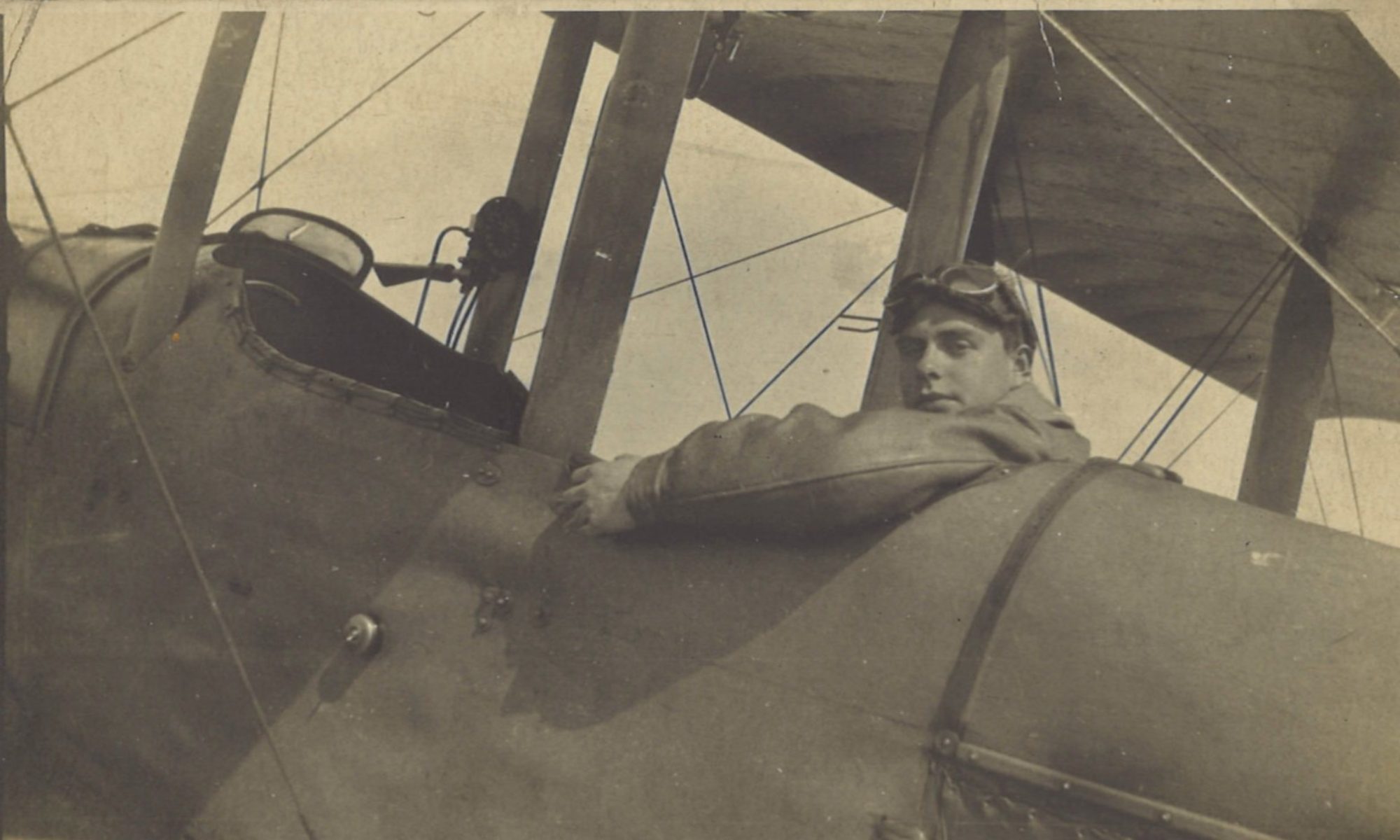
Saturday 5 October 1918 – Reconnaissance in the Rain

Back to work proper today, after yesterday’s brief test flight.  A reconnaissance flight with Lt Scarterfield, and it was raining.  So the weather hadn’t improved while Greg was away on leave.

Log Book

Log BookLog Book

Date: 5.10.18 
Time Out: 14.10 
Rounds Fired – Lewis: 200 
Rounds Fired – Vickers: 200 
Bombs: - 
Time on RE8s:  163 hrs 10 mins 
RE8: 6740 
Observer: Scarterfield 
War Flying: 2 hrs 10 mins 
Height: 2000 
Course/Remarks: Reconnaissance. Raining.

Squadron Record Book

Squadron Record Book

Squadron Record Book
Squadron Record Book. Click for larger image.
Type and Number: R.E.8. 6740
Pilot and Observer: P. Lt Gregory. O. Lt Scarterfield
Duty: Reconnaissance
Hour of Start: 1410
Hour of Return: 1620
Remarks:
FIRES & EXPLOSIONS
1430.  Large fire at LILLE at approx. Q.8.a.5.5 (Yellow smoke)
1430.  Two fires at P.14.c.3.5 (Buildings)
1435. Large fire S.E. of LILLE. Q.11. (Unable to pin-point owing to poor visibility.)
1535. Fire in LAMBERSART.
FLASHES.
1450. K.K. on flash in J.22.a. (Unable to pin-point.) [K.K. is a signal of a flash, possibly denoting an enemy gun firing]
1535. K.K. on flash in J.3.a. (Medium sized white flash)
Shell seen to fall in ARMENTIERES after about 35 seconds.
MOVEMENT
No movement seen in Sq. I.6. to 36.
Bridge at P.21.a.0.8. intact.
Rain prevented much observation. Returned with carburettors full of water.
E.K.B. [Enemy kite balloons] Nil.
E.A. [Enemy aircraft] Nil
A.A. [Anti-aircraft fire] Normal.
200.L.G. 200.V.G. [200 rounds from each of the Lewis gun and the Vickers gun] fired into FORT d’ENGLOS (P.1.a) and PERENCHIES from 1200’.
Vis. Poor.  Height 1500’.  Obs.by P.&.O.

The following map shows the locations mentioned:

Map of reconnaissance sortie
Map showing observations on reconnaissance sortie. Adapted from a 1:40,000 scale map. Each numbered square is 1,000 yards. Click for larger image. Map credit IWM/TNA/GreatWarDigital.

Reconnaissance

Even though the weather hadn’t got any better while Greg was away, the position of the British front line had improved.  The action has moved eastwards, and was now getting towards Lille.  The fact that a German shell was seen to land in Armentières shows that the town was by then in British hands.

Fort d’Englos

One of the target for small arms fire was the Fort d’Englos, in sub-square P.1.a.  This was one of the “forts Séré de Rivières” that formed a belt around Lille and other cities. They were built from 1874 under the aegis of General Raymond Adolphe Séré de Rivières, who gave his name to them.  In the First World War, Fort d’Englos was used by the Germans as a garrison site and ammunition depot – which made it a good target for two reasons.

Back to Rely in the Rain

“Rain prevented much observation. Returned with carburettors full of water” says the entry in the Squadron Record Book.  And so a wet pilot and observer made their way back to the aerodrome at Rely.  It was quite a distance back.  When the aircrews had been operating around Merville, they had to fly about 13½ miles (22 km) to get back home.  From Lille, it was more than double that. Soon the squadron’s base would have to move further east, or a disproportionate amount of their sortie times – not to mention fuel – would be taken up with travelling.

Friday 4 October 1918 – Machine Test

Back to work at Rely and back in the air, but only for a 10 minute evening machine test flight.

Log Book

Log BookLog Book

Date: 4.10.18 
Time Out: 18.00 
Rounds Fired – Lewis: - 
Rounds Fired – Vickers: - 
Bombs: - 
Time on RE8s:  161 hrs 00 mins 
RE8: 2517 
Observer: 2/A.M. Nixon 
War Flying: 0 hrs 10 mins 
Height: 2000 
Course/Remarks: Machine test – O.K.

Machine Test on RE8 2517

Although 2517 was deemed ‘OK’ in the machine test with Air Mechanic (2nd Class) Nixon, Greg didn’t actually fly it again until 22 October, at which point it became his regular ‘bus’.

This first flight after Greg’s leave was much less eventful than his flight exactly four months ago when he had just arrived at Rely and joined 42 Squadron:

Tuesday 4 June 1918 – Near Disaster on the First Day on the Front


Monday 16 September 1918 – Shoot with 1/1 West Riding HB

Another disappointing shoot today.  After yesterday’s perplexing lack of success with 346 SB because the shell bursts could not be observed, today’s shoot with 1/1 West Riding Heavy Battery (two 60 pounders) was thwarted for another reason: enemy aircraft.  

Log Book

Log BookLog Book

Date: 16.9.18 
Time Out: 10.35 
Rounds Lewis: - 
Rounds Vickers: - 
Bombs: 4 
Time on RE8s: 160 hrs 50 mins 
RE8: 2500 
Observer: Lt Bett 
War Flying Time: 2 hrs 55 mins 
Height: 5000 
Course/Remarks: Shoot with 1/1 West Riding. Unsucc. E.A.

Squadron Record Book

Squadron Record Book
Squadron Record Book. Click for larger image.
Type and Number: R.E.8.2500
Pilot and Observer: P. Lt Gregory. O. Lt Bett
Duty: Art Reg on Cross roads.
Hour of Start: 10.35
Hour of Return: 13.30
Remarks: U. with 1/1 W.Riding H.B. (2-60 pdr) on crossroads N.23.c.0.9. [at FROMELLES] (P).
Called 11.15.  K. 11.17. [signals being received]  L.11.19. [battery ready to fire]  G. 11.20. [fire]
37 ranging rounds:- M.C.9.  1 A.  1 B.  8 C.  2 D.  25 W.
Unsuccessful owing to E.A.  11.55. sent M.Q. E.A. [wait: enemy aircraft]  12.15. send A. and G. [stand by; fire]  Battery did not fire and in answer to R.U.F. [are you firing?] put out E.A.  12.35. battery put out L.  1 burst observed and 6 W.  12.42. another E.A. appeared W. of FLEURBAIX and battery again ceased fire.  Several bursts missed owing to A.A. [anti-aircraft fire]
C.I. [returning to aerodrome] sent 12.45.
11.15.  fire burning in wood at J.18.d. & 24.b. (N. of LILLE). [same location as yesterday's reported fire]
12.05.  2 R.E.A. [reconnaissance enemy aircraft] R.12. sent.
12.15. explosion at H.6.d.8.9.
12.40.  1 F.E.A. [fighter enemy aircraft] about 5000’ over G.24.
1 E.K.B. [enemy kite balloon] at approx. J.6.d.  A.A. active.
11.10. 4-25lb bombs dropped at H.34.b.  4 bursts observed.
Vis. good.  Height 4/6000’.  Obs by P. & O. 

For more details on the codes sent, see here.

So three enemy aircraft – two reconnaissance and one fighter – spoilt the party.  This meant that the shoot on the crossroads at Fromelles was unsuccessful.  We don’t know precisely where the battery was located.  But we do know that two reconnaissance enemy aircraft over R.12 sufficiently disturbed them to stop firing.  So we can reasonably conclude that the battery was probably somewhere to the south of Estaires.  The following map shows the locations of more precisely known features and events:

Map of Fromelles, Estaires and Armentières.
Map of Fromelles, Estaires and Armentières. Adapted from a combination of 1:40,000 scale maps. Each numbered square is 1,000 yards. Click for larger image. Map credit IWM/TNA/GreatWarDigital

1/1 West Riding Heavy Battery

The 1/1 West Riding Heavy Battery of the Royal Garrison Artillery was a unit of the part-time Territorial Force (TF).  The TF was a forerunner to the Territorial Army (TA).  Wikipedia reports:

1/1st West Riding Bty was detached to 49th Bde RGA (normally composed of 8-inch howitzers) with Fourth Army from 21 August to 16 September, during the Second Battle of the Somme returning to 28th Bde thereafter. It was with 28th Bde during Fifth Army’s pursuit of the defeated German army towards the Scheldt in October 1918, when the ‘heavies’ were principally employed on harassing fire on the roads and tracks the Germans were using, and on concentrations of fire on headquarters and exits from villages, while trying to avoid civilian casualties. [https://en.wikipedia.org/wiki/West_Riding_Heavy_Battery,_Royal_Garrison_Artillery, References omitted]

We know from Greg’s and 42 Sqn RAF’s records that on 16 September 1918 at least two 60-pdrs were already in the Lys sector with the Fifth Army – prior to the push to the Scheldt, east of Lille (although they couldn’t know yet that that would happen).  And with their target being the crossroads at Fromelles, it looks as though they were indeed “employed on harassing fire on the roads and tracks the Germans were using”.

BL 60-Pounder

The 1/1 West Riding HB’s weapons were breech-loading 60-pounder (often abbreviated to 60-pdr) guns.  Although nominally ‘heavy’ guns, they were not as heavy as those operated by the siege batteries of the RGA.  (Even the ‘small’ 6-inch Howitzers fires 100 lb shells.) But they were true, 5-inch calibre guns, with a relatively long barrel (14 ft for the Mk Is).

The following photo, from the Imperial War Museum’s collection, shows a column towing a 60-pdr.  The barrel is shifted backwards, i.e. towards the direction of travel of the column.  This is to even up the weight distribution between the wheels of the gun carriage and those of the limber.

Troops of the RGA moving 60-pounder guns forward through St. Venant,
THE HUNDRED DAYS OFFENSIVE, AUGUST-NOVEMBER 1918 (Q 6996) Advance in Flanders. Troops of the Royal Garrison Artillery moving 60-pounder guns forward through St. Venant, 22 August 1918. Click for larger image.  Copyright: © IWM. Original Source: http://www.iwm.org.uk/collections/item/object/205216469

The IWM’s caption refers to the location being St Venant.  More precisely, it is the bridge over the weir on the River Lys, next to St Venant lock, just north of the village.  The direction of travel of the artillery train is south. The railings on the bridge have since been replaced.  But railings of the same pattern are still in position by the adjoining wharf, on the left in the following Google Maps street view image  Today they are painted a cheerful bright green.

Google Maps street view, looking north from St Venant towards the lock and weir on the River Lys, with the wharf on the left.

More on the 60-pounder, from Wikipedia, here.

Next up…

The next entry in Greg’s Log Book is for Wednesday 18 September 1918.

Sunday 15 September 1918 – Unsuccessful shoot with 346 SB

An unsuccessful – and probably frustrating – shoot with a new battery (346 Siege Battery, RGA).  It was unsuccessful because Greg couldn’t see the bursts of the shells, and he didn’t know why he couldn’t.  Greg’s observer today was Lt Bett, but in another sortie Lt Mulholland has a lucky escape.

Log Book

Log BookLog Book 

Date: 15.9.18 
Time Out: 14.10 
Rounds Lewis: - 
Rounds Vickers: - 
Bombs: - 
Time on RE8s: 157 hrs 55 mins 
RE8: 2517 
Observer: Lt Bett 
War Flying Time: 1 hrs 25 mins 
Height: 4000 
Course/Remarks: Shoot with 346 SB, 6” How. Unsucc.

RE8 2517

Greg’s usual ‘bus’, RE8 E27, was presumably with the mechanics.  He had described the engine as ‘rotten’ yesterday.  Greg flew 2517 on one earlier occasion (21 July 1918), and would fly it more often as the war progressed.

Squadron Record Book

Squadron Record Book
Squadron Record Book – click for larger image
Type and Number: R.E.8.2517
Pilot and Observer: P. Lt Gregory. O. Lt Bett
Duty: Art Obs on H.B. Destructive.
Hour of Start: 16.20
Hour of Return: 17.45
Remarks: U. [unsuccessful] with 346 S.B. (4-6” Hows) on H.B. [Hostile battery] at N.17.c.15.52. (P).
Called 16.40.  K. 16.42. L. 16.45. G. 16.47.
10 ranging rounds:- 1 C. 9 W.  Salvos unobserved.
Battery firing, but unable to see any bursts.  Vis. good and unable to account for inability to see bursts.
C.I. sent 17.15.
16.50. fire in wood in J.18.d and 24.b. (Nth of LILLE).
17.00. sent N.F. [Now firing] N.12.a.5.0. (A). Result unobserved.
17.05. sent K.K. on flash in I.2.a.
A.A. active.  E.A. and E.K.B. nil.
Vis. good.  Height 4000’.  Obs. by P. & O.

The locations in the above Squadron Record Book are shown on this map extract:

Map of Fromelles, Armentières and Lille showing 213 Siege Battery's target
Map of Fromelles, Armentières and Lille. Adapted from a 1:40,000 scale map. Each numbered square is 1,000 yards. 213 Siege Battery’s target was in square N.17. Click for larger image. Map credit IWM/TNA/GreatWarDigital.

The hostile battery that was 213 SB’s target was near Fromelles (bottom left of map) not far from Aubers.  This is where Greg saw a lighthouse in a pre-dawn patrol on 14 July 1918.

More about shoots here:

Observation of Artillery Fire – A Shoot

Lt Mulholland Shot Down

Greg’s observer three days ago, on 12 September 1918, was 2/Lt Arthur Mulholland.  Today, Lt Mulholland was up with pilot 2/Lt R.M. Marshall on a counter-battery patrol in RE8 2649 (which Greg had earlier flown on 13 July, 7 August and 8 August 1918).  According to a casualty report in file AIR 1/859 at The National Archives:

[C2649 RE8] Shot down by EA at Sh36G7 on artly patrol. 2Lt RM Marshall slightly wounded/2Lt A Mulholland Ok

‘EA’ is enemy aircraft.  ‘Sh36G7’ is 1:40,000 map sheet 36, square G7, which is just north of Estaires:

Map of Estaires
Map of Estaires. Adapted from a composite of 1:40,000 scale maps. Each numbered square is 1,000 yards. Click for larger image. Map credit IWM/TNA/GreatWarDigital.

Fortunately, where they were shot down was more or less over the British front line at the time.  They made it back to safety.  Greg was next to fly with Lt Mulholland at the end of October.

Thanks to airhistory.org.uk for the casualty information.

Saturday 14 September 1918 – Weather & Engine Rotten – Lt Bett

A midday counter-battery patrol for an hour and a half with Lt Stuart Francis Bett.  Not a great time by the sound of it, with the weather and E27’s engine both being ‘rotten’.  Still, makes a change from ‘dud‘!

Log Book

Log BookLog Book

Date: 14.9.18 
Time Out: 12.00 
Rounds Lewis: - 
Rounds Vickers: - 
Bombs: - 
Time on RE8s: 156 hrs 30 mins 
RE8: E27 
Observer: Lt Bett 
War Flying Time: 1 hrs 30 mins 
Height: 3000 
Course/Remarks: C.B.P.  Weather & engine rotten.

2/Lt Stuart Francis Bett

This was Greg’s first patrol with 2/Lt Stuart Francis Bett, with whom he would fly several times in the next couple of months.

Stuart Bett was born on 11 November 1899 to Mary Bett, and so was some nine months younger than Greg.  He survived the war, and was no doubt delighted that  Armistice Day was on his 19th birthday.  He was injured a few weeks later, on 17 December 1918 – playing rugby! – and wasn’t present at the B Flight Officers’ Christmas Dinner.  Injury may have been the cause of his absence. Maybe he went home.

After the war, he graduated with a B.Sc. degree and on 1 October 1923 joined the Indian Service of Engineers an an assistant executive engineer in the United Provinces (of Agra and Oudh) – roughly present day Uttar Pradesh and Uttarakhand. Promotion to executive engineer followed in October 1932. Later, he transferred to the central public works department in August 1933 as a divisional officer.  Stuart Bett died aged only 37, on 6 June 1937, in Dehra Dun. His widow was Ethel Margaret Fisher Bett.

Thanks to Margaret Sheard for sourcing information on Stuart Francis Bett.

Thursday 12 September 1918 – Dud CBP, Very Windy – Lt Mulholland

After an absence from the field of operations of eight days, Greg is back in the air today, with (for the first time) 2/Lt Arthur Mulholland as observer.  But the poor weather hasn’t improved.  Greg rated today’s counter-battery patrol – yet again – as a dud as a result of it being very windy.

Log Book

Log BookLog Book

Date: 12.9.18 
Time Out: 16.05 
Rounds Lewis: - 
Rounds Vickers: - 
Bombs: - 
Time on RE8s: 155 hrs 0 mins 
RE8: E27 
Observer: Lt Mulholland 
War Flying Time: 1 hrs 05 mins 
Height: 2000 
Course/Remarks: C.B.P.  Dud. V windy.

Very Windy

Not a round fired, and not a bomb dropped.  Pilot and Observer were probably glad to get back home after a little over an hour of being bounced around in the very windy conditions.

Lt Arthur Mulholland

This was Greg’s first outing with 2nd Lt Arthur Mulholland as his observer.  In  fact it was one of only two, the other being at the end of October.

Arthur Mulholland was born on 4 November 1894 in Sheffield.  He had been with the army in France since 1914.  But he had only been commissioned within the last few weeks, on 24 August 1918.

Although he was to have a narrow escape a few days after this patrol with Greg, he survived to the end of the war, and after demobilisation became “an Auxiliary” –  a member of The Auxiliary Division of the Royal Irish Constabulary (ADRIC).  He survived that experience, too, despite being on a tram in Dublin held up by the IRA in May 1921.  

After the disbandment of the ADRIC, Mulholland became a policemen in Palestine, as did many of his colleagues. But he then emigrated to Canada in 1926.  He spent the rest of his life there and died in Vancouver in 1976, aged 82.

Grateful acknowledgement to David Grant of theauxiliaries.com website,  which is the source of this information about Arthur Mulholland and much more about the ADRIC.  Arthur Mulholland’s page is here

Next Up…

Greg’s next log book entry is on 14 September 1918. 


Tuesday 3 September 1918 – Contact Patrol

Just after Greg landed at the end of his counter-battery patrol as covered in this morning’s post, the next aircraft of 42 Squadron to take to the air from Rely aerodrome was on contact patrol.  Greg wasn’t the pilot, but there’s a nice reason to take a look at what the crew reported. The information in the Squadron Record Book (SRB) for this patrol gives the precise positions of troops on the ground in the Lys Sector as they approach Laventie.  We get a good sense of their rate of progress, as we know where the British line was yesterday morning.  

So here, 100 years to the hour after their patrol, is the report that Lts Newson (Pilot) and Griffiths (Observer) filed.

Squadron Record Book

Squadron Record Book
Squadron Record Book – click for larger image
Type and Number: RE8 2300
Pilot and Observer: P. Lt Newson. O. Lt Griffiths
Duty: Contact Pat’l
Hour of Start: 12.45
Hour of Return: 2.15
Remarks: 13.03 Called for flares.  White panels observed at M 3b 5.5, M 9a 7.5, G 32a 7.5, M 15d 6.4, M 15b 6.3
Troops observed along main ESTAIRES ROAD from G 26.c 2.0 – M 21a 5.0
Troops observed walking along from M 14b 7.7 to M 9c 20.35
14.45 Fi[r]es in WOODS at M 10c 5.2 and M 16d 6.8
      Fire in HOUSE at M 4c 70.35
2 EKB’s in direction of AUBERS.
Vis good. Height 500’.  Obs by P & O.

Troops advance on Laventie

The troop locations and fires mentioned in the report are shown on this map:

Map of Estaires and Laventie
Map of Estaires and Laventie. Adapted from a composite of 1:40,000 scale maps. Each numbered square is 1,000 yards. Click for larger image. Map credit IWM/TNA/GreatWarDigital.

It looks like Estaires is now in British hands, and that units are positioning to take Laventie. The eastward advance continues.

Contact Patrol

Two earlier posts have dealt (briefly) with contact patrols.  They were essentially low altitude (e.g. 500 ft, as here) patrols gathering troop location information to feed back to HQ:

Sunday 12 May 1918 – Observers School

Thursday 27 June 1918 – CBP, Archie…and Sheet Tin

Tuesday 3 September 1918 – Fires & Explosions

On his last sortie for over a week, a counter-battery patrol takes Greg well to the east of Estaires.  He sees fires and explosions around Laventie and along the River Lys in Sailly-sur-Lys, Erquinghem Lys and Pont de Nieppe, near Armentières. 

Log Book

Log BookLog Book

Date: 3.9.18 
Time Out: 9.45 
Rounds Lewis: 300 
Rounds Vickers: 200 
Bombs: - 
Time on RE8s: 153 hrs 55 mins 
RE8: E27 
Observer: Lt Scarterfield 
War Flying Time: 2 hrs 35 mins 
Height: 5000 
Course/Remarks: C.B.P.  Few fires.  Two explosions.

Squadron Record Book

Squadron Record Book
Squadron Record Book – click for larger image
Type and Number: RE8 27
Pilot and Observer: P. Lt Gregory. O. Lt Scarterfield
Duty: Art Patrol [The "2.9.18" in this column looks like a typo for 3.9.18, which is the date given at the top of the sheet – and which agrees with Greg’s log book]
Hour of Start: 9.45
Hour of Return: 12.20
Remarks: 10.20 Explosion followed by fire and column of smoke at M 3c 5.2.
10.25 Similar observation at G 18d 1.2
Fires in HOUSES at G 27d 5.7, and 2.5, G33d 3.5 and small BUILDING on Railway at M 3b 0.5 and in G 17 a
Fires in SAILLY, PONT DE NIEPPE and ERQUINGHEM [ERQUINGHEM LYS].
10.30 UL FR UD [Weather unfit for counter-battery work and photography, but fit for artillery registration]
AA active east of LAVENTIE, none W. of LAVENTIE
Vis good.  Height 4000'. 4-25lb bombs on LAVENTIE.  Bursts obs.
200 V.G. 300 L.G. into LAVENTIE and M4 from 2000'.

All this observed action is to the east of Estaires, around Laventie and along the River Lys towards Armentières, as this annotated map shows:

Map of Estaires, Laventie and Armentières, also showing Sailly-sur-Lys, Erquinghem Lys and Pont de Nieppe
Map of Estaires, Laventie and Armentières, also showing Sailly-sur-Lys, Erquinghem Lys and Pont de Nieppe. Adapted from a composite of 1:40,000 scale maps. Each numbered square is 1,000 yards. Click for larger image. Map credit IWM/TNA/GreatWarDigital.

It is just to the west of Erquinghem Lys that, today, the high speed rail line from Calais crosses the Lys on its way to Lille, Paris and Brussels.

Next Up…

Greg’s next log book entry is on 12 September 1918.  But watch out for news of a contact patrol and troop movements later today.

Monday 2 September 1918 – Bumpy & Windy CBP

The generally unfavourable weather continues, with a bumpy and windy counter-battery patrol with Lt Scarterfield as Observer.  On the ground, the British front line is at Estaires.

Log Book

Log Book - bumpy & windy CBP

Date: 2.9.18 
Time Out: 12.15 
Rounds Lewis: 400 
Rounds Vickers: 300 
Bombs: - 
Time on RE8s: 151 hrs 20 mins 
RE8: E27 
Observer: Lt Scarterfield 
War Flying Time: 2 hrs 45 mins 
Height: 3000
Course/Remarks: C.B.P.  Very bumpy & windy

Bumpy & Windy

The poor weather conditions did not stop flying so much as they did in the earlier years of the war.  But they did make it both more difficult and less useful.  As an American climatologist noted in a contemporary article:

In aviation, it is increasingly evident that weather conditions which earlier in the war were regarded as prohibitive for flying, are now interfering less and less, at least so far as bombing is concerned. High winds, low clouds and fog, and heavy rain, decidedly lessen aerial activity, and spells of fine weather always greatly increase it, yet month by month, as the reports come in, it is evident that in the intensity of this modern warfare, flying must be done in practically all weather. Nevertheless, aerial reconnaissance and photography, and direction of artillery firing from airplanes, can not be effectively carried out unless there is a reasonably clear view of the ground. The advantage which the prevailing westerly winds give to the enemy aviators on the Western Front is readily recognized.  [Robert DeC. Ward, “Weather Controls over the Fighting during the Summer of 1918” The Scientific Monthly, Vol. 7, No. 4 (Oct., 1918), pp. 289-298]

Professor Robert DeCourcy Ward was at Harvard University and was the first professor of climatology in the United States.

The British Front Line

On the ground, British troops of General Birdwood‘s Fifth Army continued to make progress eastwards. By this morning, they were knocking on the doors of Estaires, as the map shows:

Map of the British Front on the morning of 2 September 1918
The British Front on the morning of 2 September 1918. Adapted from a 1:40,000 scale map dated December 1917 with information from a map accompanying General Haig’s despatches on the final British offensive. Each numbered square is 1,000 yards. Click for larger image. Map credit: IWM/TNA/GreatWarDigital.

Saturday 31 August 1918 – CBP, Dud, Cloudy

After two days of fine weather, the clouds clamped down again today.  Still, Greg and Lt Scarterfield managed a two hour counter-battery patrol, during which they loosed off 700 rounds of small arms fire between them – despite it being a dud and cloudy day.

Log Book

Log BookLog Book

Date: 31.8.18 
Time: 7.55 
Rounds Lewis: 400 
Rounds Vickers: 300 
Bombs: - 
Time on RE8s: 148 hrs 35 mins 
RE8: E27 
Observer: Lt Scarterfield 
War Flying Time: 2 hrs 0 mins 
Height: 2000 
Course/Remarks: C.B.P.  Dud.  Cloudy.

No Post Tomorrow…

…next post Monday 2 September 1918.

© Copyright 2018- Andrew Sheard and licensors. All rights reserved.

Website powered by green energy